
A high-temperature box muffle furnace acts as the critical engine for thermal decomposition. It provides the precise, sustained thermal environment necessary to convert the calcium carbonate (CaCO3) inherent in mussel shells into calcium oxide (CaO). By maintaining a specific temperature range between 800°C and 1100°C, typically for four hours, the furnace drives the calcination process that releases carbon dioxide and isolates the chemically active solid base.
Core Insight: The muffle furnace facilitates this conversion not merely by heating the material, but by sustaining a specific "calcination window" (800°C–1100°C). This sustained heat provides the activation energy required to break the chemical bonds of calcium carbonate, releasing carbon dioxide and transforming inert shell waste into a highly active catalytic material.
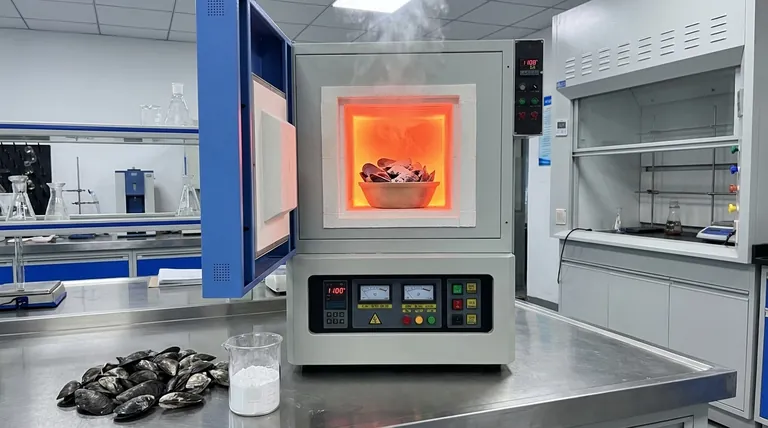
The Mechanism of Thermal Decomposition
Breaking the Chemical Bonds
The primary function of the muffle furnace is to push the mussel shells past their thermal stability point. Calcium carbonate is stable at room temperature, but the furnace provides the high activation energy required to trigger decomposition.
The Calcination Reaction
Once the furnace reaches the target range of 800°C to 1100°C, a chemical phase change occurs. The heat forces the release of carbon dioxide (CO2) gas from the shell structure. This leaves behind Calcium Oxide (CaO), which is characterized by its high catalytic activity.
The Role of Precision Control
Sustained Heat Soak
Achieving conversion requires more than just reaching a peak temperature; it requires a "soak" time. The primary reference indicates a duration of approximately four hours is necessary for mussel shells. This sustained exposure ensures the heat penetrates the entire mass of the shell, preventing a situation where only the outer layers are converted.
Removal of Organic Impurities
Beyond the conversion of calcium carbonate, the furnace ensures purity. Drawing from similar processes with eggshells and bone waste, the high-temperature environment combusts residual organic matter. This leaves a pure inorganic precursor, which is essential if the CaO is to be used as a catalyst.
Uniform Thermal Environment
A box muffle furnace is designed to create a uniform thermal field. This consistency is vital for ensuring that all shells within the batch undergo the same degree of transformation. Inconsistent heating could lead to a mixture of unreacted carbonate and over-sintered oxide, compromising the material's overall performance.
Understanding the Trade-offs
The Risk of Over-Sintering
While high heat is necessary, excessive temperature or duration can be detrimental. If the material is held at the upper limit (1100°C) for too long, the grains of the calcium oxide may begin to sinter (fuse together). This reduces the surface area of the material, which effectively lowers its catalytic activity.
Energy Intensity
The process is energy-intensive due to the requirement of maintaining temperatures up to 1100°C for several hours. Operators must balance the need for complete conversion against energy costs. Operating at the lower end of the effective range (closer to 800°C) may save energy but requires careful verification that conversion is complete.
Making the Right Choice for Your Goal
To optimize the conversion of mussel shells, you must align your furnace settings with your specific purity and activity requirements.
- If your primary focus is Maximum Catalytic Activity: Aim for the lower end of the temperature range (800°C - 900°C) to ensure full conversion without reducing surface area through sintering.
- If your primary focus is Material Purity: Utilize the higher temperature range (1000°C - 1100°C) to guarantee the complete combustion of all organic residues and total decomposition of carbonates.
The value of the box muffle furnace lies in its ability to turn a variable biological waste product into a chemically predictable, high-performance catalyst through precise thermal governance.
Summary Table:
| Process Parameter | Target Specification | Purpose in Conversion |
|---|---|---|
| Temperature Range | 800°C – 1100°C | Provides activation energy for CaCO3 decomposition |
| Soak Time | Approx. 4 Hours | Ensures uniform heat penetration and complete reaction |
| Atmosphere | Uniform Thermal Field | Prevents unreacted carbonate or over-sintered oxide |
| Chemical Output | Calcium Oxide (CaO) | Transforms shell waste into highly active catalyst |
| By-product Removal | CO2 & Organic Matter | Purifies the material through combustion and gas release |
Precision thermal processing is the key to transforming waste into high-performance catalysts. Backed by expert R&D and manufacturing, KINTEK offers specialized Muffle, Tube, Rotary, Vacuum, and CVD systems designed for rigorous calcination and chemical conversion. Whether you need a standard laboratory furnace or a fully customizable solution for unique material needs, our high-temperature systems deliver the uniform heat control your research demands. Contact KINTEK today to optimize your lab’s thermal efficiency!
References
- Halimah A. Alsabi, Alaa A. Alaswad. From Waste to Catalyst: Transforming Mussel Shells into a Green Solution for Biodiesel Production from Jatropha curcas Oil. DOI: 10.3390/catal14010059
This article is also based on technical information from Kintek Furnace Knowledge Base .
Related Products
- 1700℃ High Temperature Muffle Oven Furnace for Laboratory
- 1800℃ High Temperature Muffle Oven Furnace for Laboratory
- 1200℃ Muffle Oven Furnace for Laboratory
- 1400℃ Muffle Oven Furnace for Laboratory
- High Temperature Muffle Oven Furnace for Laboratory Debinding and Pre Sintering
People Also Ask
- What is the primary function of a high-temperature laboratory muffle furnace in chemical synthesis? Achieve Precision.
- How does a high-temperature laboratory muffle furnace affect material properties? Transform Anodic Oxide Films Fast
- What role does a muffle furnace play in BCZY712 electrolyte powder production? Achieve Perfect Phase Purity
- What is the role of a high-temperature muffle furnace in guava leaf carbonization? Master Precise Pyrolysis Control
- How does a muffle furnace impact Ni/MgAl2O4 catalysts? Optimize Stability and Catalytic Performance



















