
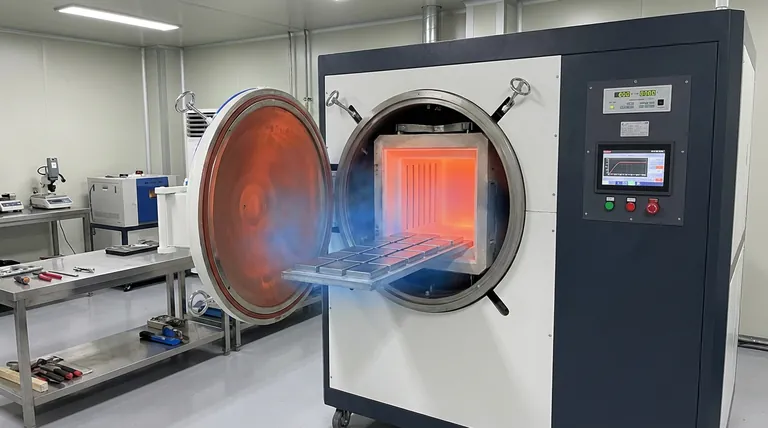
Grain Boundary Diffusion (GBD) heat treatment fundamentally alters the microstructure of high-grade magnets by infiltrating heavy rare earth elements from the surface into the material's interior. Operating at temperatures between 800°C and 900°C, these furnaces facilitate the creation of a specialized shell around the magnet's main grains, significantly enhancing magnetic properties without altering the core composition.
By targeting the distribution of dysprosium specifically to the grain boundaries rather than the entire volume, GBD furnaces increase coercivity while reducing heavy rare earth consumption by 50-60%. This process decouples performance gains from material costs, enabling the scalable production of high-performance magnets.
The Microstructural Advantage
Precise Thermal Diffusion
The core function of the GBD furnace is to manage a high-temperature environment, specifically between 800°C and 900°C.
At this temperature range, heavy rare earth elements, primarily dysprosium, become mobile. They diffuse from the magnet's surface deep into its interior structure.
Formation of the Hardening Shell
The diffusion process does not simply mix the elements; it creates a specific microstructural feature.
The dysprosium reacts to form a (Nd,Dy)₂Fe₁₄B shell that wraps around the main grains of the magnet.
This shell acts as a magnetic hardening layer, drastically improving the magnet's coercivity (its resistance to becoming demagnetized).
Economic and Efficiency Implications
Solving the Bulk Alloying Problem
Traditional methods, known as bulk alloying, require mixing dysprosium throughout the entire volume of the magnet to achieve high performance.
This is inefficient because the heavy rare earth elements are only strictly necessary at the grain boundaries to stop magnetic reversal.
Drastic Reduction in Material Costs
GBD furnaces eliminate this waste by placing the dysprosium exactly where it is needed.
The reference data indicates that this targeted approach reduces dysprosium consumption by 50% to 60% compared to traditional methods.
This makes the GBD furnace essential for the cost-effective production of high-grade magnets, as it minimizes the use of expensive raw materials.
Understanding the Trade-offs
Process Sensitivity
While GBD offers material savings, it introduces a complex thermal processing step that demands rigorous control.
The temperature window (800°C–900°C) must be maintained precisely to ensure uniform diffusion without degrading the magnet's existing properties.
Dependency on Surface Area
Because the process relies on diffusion from the exterior, the geometry of the magnet matters.
The efficiency of the (Nd,Dy)₂Fe₁₄B shell formation depends on the ability of the furnace to ensure the dysprosium penetrates effectively from the surface to the required depth.
Making the Right Choice for Your Goal
To maximize the value of a Grain Boundary Diffusion furnace, align its capabilities with your production targets:
- If your primary focus is Cost Reduction: Leverage GBD to replace bulk alloying, cutting your heavy rare earth consumption by up to 60% while maintaining target specifications.
- If your primary focus is High Performance: Utilize the furnace to maximize coercivity by ensuring the consistent formation of the (Nd,Dy)₂Fe₁₄B shell around every grain.
Implementing GBD technology is the decisive step in moving from standard manufacturing to the high-efficiency production of superior magnetic components.
Summary Table:
| Feature | Traditional Bulk Alloying | Grain Boundary Diffusion (GBD) |
|---|---|---|
| HREE Consumption | High (distributed throughout) | Low (50-60% reduction) |
| Microstructure | Homogeneous alloy | Specialized (Nd,Dy)₂Fe₁₄B shell |
| Operating Temp | Various | Precise 800°C - 900°C |
| Key Benefit | Simple process | High coercivity at lower cost |
| Efficiency | Material-intensive | Targeted element distribution |
Maximize Magnet Performance with KINTEK Precision
Ready to revolutionize your production efficiency? KINTEK’s advanced heat treatment solutions are engineered to help you achieve superior magnetic coercivity while drastically cutting material costs.
Backed by expert R&D and world-class manufacturing, we provide high-performance Vacuum, CVD, and specialized high-temperature furnace systems—all fully customizable to meet your specific GBD processing requirements. Whether you are aiming for peak performance or cost optimization, our systems ensure the precise thermal control necessary for (Nd,Dy)₂Fe₁₄B shell formation.
Take the next step in high-grade magnet manufacturing. Contact KINTEK today to discuss your custom furnace needs!
References
- Finks, Christopher. Technical Analysis: Magnet-to-Magnet Rare Earth Recycling Without Solvent Extraction (M2M-Δ Architecture) - Defense Supply Chain Resilience. DOI: 10.5281/zenodo.17625287
This article is also based on technical information from Kintek Furnace Knowledge Base .
Related Products
- 2200 ℃ Graphite Vacuum Heat Treat Furnace
- Vacuum Heat Treat Furnace with Ceramic Fiber Liner
- Vacuum Heat Treat Sintering and Brazing Furnace
- 9MPa Air Pressure Vacuum Heat Treat and Sintering Furnace
- Vacuum Heat Treat Sintering Furnace Molybdenum Wire Vacuum Sintering Furnace
People Also Ask
- Why are vacuum heat treating furnaces essential for aerospace? Ensure Superior Material Integrity for High-Stakes Applications
- What is the primary application of vacuum heat treating furnaces in aerospace? Enhance Component Performance with Precision
- What is the process of vacuum heat treating? Achieve Superior Metallurgical Properties
- How does vacuum heat treating work in terms of temperature and time control? Master Precise Material Transformations
- How does a vacuum heat treating furnace improve the condition of metal alloys? Achieve Superior Metal Performance



















