
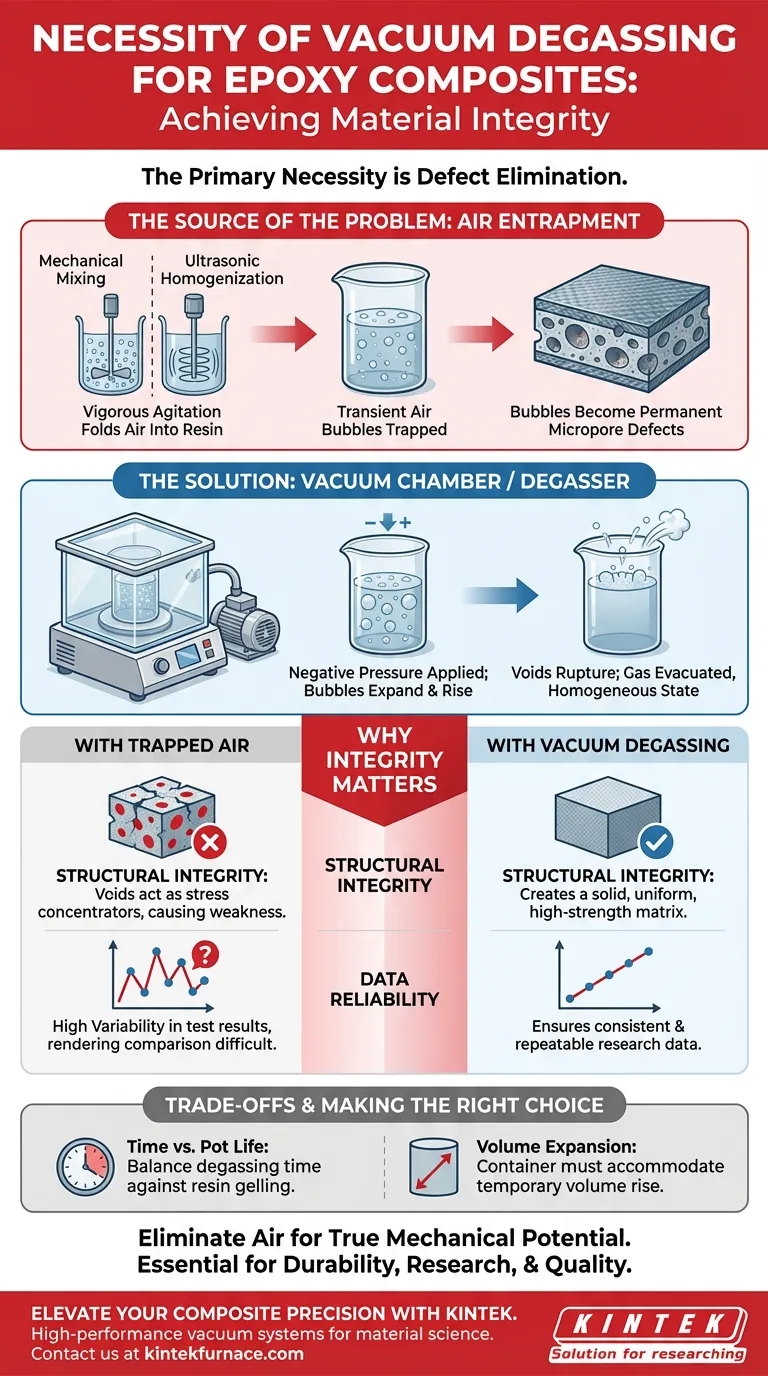
The primary necessity is defect elimination. When epoxy resin is subjected to mechanical mixing or ultrasonic homogenization, air bubbles are inevitably trapped within the viscous liquid. A vacuum chamber or degasser is required to create a negative pressure environment that forces these air pockets out of the mixture before it hardens.
The presence of trapped air creates micropore defects that fundamentally compromise the material. Vacuum degassing is essential to remove these voids, ensuring the composite maintains its intended structural integrity and yields consistent, reliable mechanical test results.
The Source of the Problem
The Inevitability of Air Entrapment
The process of preparing epoxy composites almost always involves vigorous agitation. Whether you are using mechanical mixing blades or ultrasonic homogenization to blend components, the physical action folds air into the liquid.
From Bubbles to Defects
If this mixture is allowed to cure without intervention, those transient air bubbles become permanent features of the solid material. In materials science, these are classified as micropore defects.
The Impact on the Matrix
These defects interrupt the continuity of the polymer matrix. Instead of a solid, uniform composite, you end up with a material riddled with microscopic voids that act as internal flaws.
The Mechanism of Degassing
Applying Negative Pressure
A vacuum chamber operates by significantly reducing the atmospheric pressure surrounding the resin. As the pressure drops, the trapped air bubbles expand in size and rise rapidly to the surface of the liquid.
Rupturing the Voids
Once at the surface, these bubbles rupture and the gas is evacuated from the chamber. This effectively "resets" the density of the mixture, returning it to a homogeneous state free of gas inclusions.
Why Integrity and Reliability Matter
Preserving Structural Integrity
The primary goal of a composite is usually mechanical strength or durability. Micropore defects act as stress concentrators, making the final part significantly weaker than its theoretical limit.
Ensuring Reliable Testing
For research or quality control, the reliability of data is paramount. If you test a sample full of random voids, your results will reflect the defects rather than the true properties of the material.
Consistency Across Samples
Degassing ensures that every sample is uniform. Without it, the random distribution of bubbles leads to high variability in performance data, rendering comparative analysis difficult or impossible.
Understanding the Trade-offs
Time vs. Pot Life
Vacuum degassing takes time. You must balance the duration of the vacuum process against the pot life (working time) of your epoxy; if the resin begins to gel while still under vacuum, the process will fail.
Volume Expansion
As bubbles expand under vacuum, the overall volume of the resin rises temporarily (often doubling or tripling). The container must be large enough to accommodate this rise to prevent the resin from overflowing into the vacuum pump.
Making the Right Choice for Your Goal
To ensure your composite meets your specific requirements, apply the following logic:
- If your primary focus is Structural Durability: You must degas to eliminate stress concentrators that could lead to premature cracking or failure under load.
- If your primary focus is Research and Testing: You must degas to prevent variable void content from skewing your data and reducing the repeatability of your experiments.
Eliminating air entrapment is not merely an aesthetic step; it is a fundamental requirement for achieving the true mechanical potential of epoxy composites.
Summary Table:
| Feature | Impact of Air Entrapment | Benefit of Vacuum Degassing |
|---|---|---|
| Structural Integrity | Voids act as stress concentrators; cause weakness | Creates a solid, uniform, and high-strength matrix |
| Data Reliability | High variability in mechanical test results | Ensures consistent and repeatable research data |
| Material Quality | Internal micropore defects and surface flaws | Homogeneous material free of gas inclusions |
| Performance | Premature cracking and material failure | Maximizes the theoretical mechanical potential |
Elevate Your Composite Precision with KINTEK
Don't let trapped air compromise your research or production quality. KINTEK provides high-performance vacuum chambers and degassing systems designed to meet the rigorous demands of advanced materials science. Backed by expert R&D and manufacturing, we offer customizable Vacuum, CVD, and high-temperature lab systems tailored to your unique epoxy processing needs.
Ready to eliminate defects and achieve superior material performance? Contact our specialists today to find the perfect vacuum solution for your laboratory.
Visual Guide
References
- Mertol Tüfekci, Loïc Salles. Nonlinear behaviour of epoxy and epoxy-based nanocomposites: an integrated experimental and computational analysis. DOI: 10.1080/15397734.2023.2293763
This article is also based on technical information from Kintek Furnace Knowledge Base .
Related Products
- Vacuum Hot Press Furnace Machine for Lamination and Heating
- Vacuum Hot Press Furnace Machine Heated Vacuum Press
- Vacuum Heat Treat Sintering Furnace with Pressure for Vacuum Sintering
- Vacuum Hot Press Furnace Machine Heated Vacuum Press Tube Furnace
- Vacuum Heat Treat Sintering and Brazing Furnace
People Also Ask
- What are the primary components of a vacuum hot press furnace? Master the Core Systems for Precise Material Processing
- What safety features are incorporated in vacuum hot press furnaces? Ensure Operator and Equipment Protection
- What are the benefits of the vacuum environment system in a vacuum hot press furnace? Unlock High-Density Sintering
- What industries benefit from the use of vacuum hot press furnaces? Unlock High-Performance Materials for Your Industry
- What is a vacuum hot press furnace? Unlock Superior Material Performance











