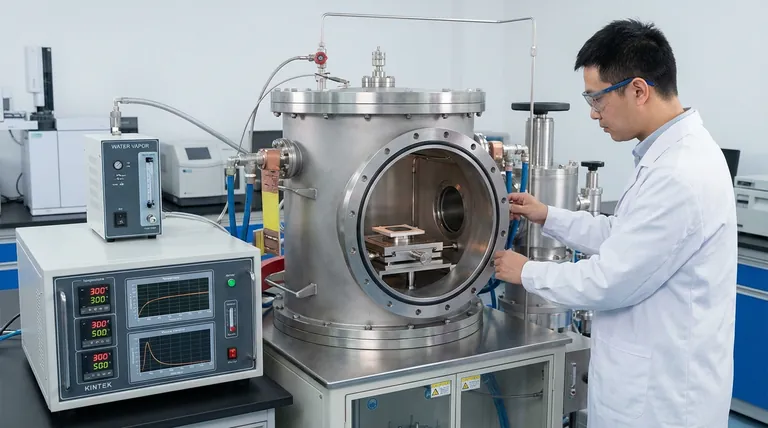
Evaluating graphene degradation requires a synergy between environmental control and thermal stress. A stainless steel vacuum chamber provides a sealed environment where parameters like pressure and humidity are tightly regulated, while the integrated heating unit maintains precise temperatures between 300 K and 500 K. Together, they create a reproducible simulation of long-term storage and usage conditions to observe graphene’s thermal stability and anti-oxidation behavior.
This integrated system transforms a static material sample into a dynamic subject of study by mimicking real-world environmental stresses under laboratory conditions. By isolating variables like heat and moisture, researchers can pinpoint the exact triggers for graphene's chemical and structural breakdown.
The Synergistic Role of the Chamber and Heating Unit
Maintaining Environmental Isolation
The stainless steel vacuum chamber serves as the primary containment vessel, ensuring the sample is isolated from uncontrolled external factors. Its construction allows for the creation of a high-vacuum state or the introduction of specific gases, such as water vapor, to test humidity-induced degradation.
Precision Thermal Stressing
The constant temperature heating unit provides the kinetic energy necessary to drive chemical reactions or structural changes in the graphene. By maintaining a stable range between 300 K and 500 K, the system simulates the heat generated during electronic operation or accelerated aging during storage.
Reproducibility Through Parameter Control
The interaction between the two components allows for stable and reproducible simulation conditions. This precision is critical for comparing different graphene samples or protective coatings under identical stress levels to determine their relative durability.
Mechanistic Evaluation of Graphene Degradation
Investigating Anti-Oxidation Mechanisms
Graphene is sensitive to environmental oxygen and moisture, which can degrade its electrical properties. By introducing water vapor into the heated vacuum environment, researchers can observe the anti-oxidation mechanisms of the material in real-time.
Thermal Stability Assessment
Long-term storage often exposes materials to fluctuating temperatures. The heating unit allows for long-term thermal stability tests, identifying the specific temperature thresholds where graphene begins to lose its structural integrity or bond with substrate materials.
Simulating Real-World Usage
Modern electronics operate in varied climates and altitudes. This setup simulates these environments by adjusting vacuum pressure and temperature simultaneously, providing a comprehensive view of how graphene will perform in a consumer or industrial device.
Understanding the Trade-offs
Thermal Range Constraints
The system is optimized for a range of 300 K to 500 K, which covers most consumer electronics and standard storage scenarios. However, it may not be suitable for investigating graphene's behavior in ultra-high-temperature industrial processes or aerospace applications that exceed 500 K.
Environmental Complexity
While the system is excellent for isolating variables, it may simplify the chemical complexity of the atmosphere. Real-world degradation often involves a cocktail of pollutants (like sulfur or nitrogen oxides) that are not present unless specifically introduced into the chamber.
How to Apply This to Your Project
When utilizing a vacuum-heating setup for graphene analysis, your methodology should align with your specific end-use case.
- If your primary focus is long-term storage stability: Focus on maintaining a steady 300 K to 350 K while varying humidity levels to simulate different global climates.
- If your primary focus is high-performance electronics: Prioritize the 400 K to 500 K range to simulate the "hot spots" generated by active processors and circuit components.
- If your primary focus is material benchmarking: Use the vacuum state to eliminate air as a variable, allowing you to measure the intrinsic thermal breakdown of the graphene itself.
By precisely controlling the intersection of temperature and atmosphere, you can accurately predict the lifecycle and reliability of graphene-based technologies.
Summary Table:
| Component | Primary Function | Evaluation Metric |
|---|---|---|
| Stainless Steel Chamber | Environmental isolation & pressure control | Humidity-induced degradation & anti-oxidation |
| Heating Unit | Precision thermal stressing (300K - 500K) | Thermal stability & accelerated aging thresholds |
| Vacuum System | Atmospheric control | Intrinsic material breakdown & real-world simulation |
Maximize Your Graphene Research Precision with KINTEK
Are you looking to achieve reproducible results in your material degradation studies? KINTEK provides industry-leading solutions designed for the most demanding laboratory environments.
Backed by expert R&D and manufacturing, we offer high-performance Muffle, Tube, Rotary, Vacuum, and CVD systems, along with customizable stainless steel chambers tailored to your specific temperature and pressure requirements. Whether you are testing anti-oxidation mechanisms or long-term thermal stability, our equipment ensures the precision your project deserves.
Ready to upgrade your thermal processing capabilities? Contact us today to discuss your unique needs and see how our customizable lab furnaces can drive your innovation forward.
References
- Shunsuke Kawabata, Tomonori Ohba. Degradation of Graphene in High- and Low-Humidity Air, and Vacuum Conditions at 300–500 K. DOI: 10.3390/nano14020166
This article is also based on technical information from Kintek Furnace Knowledge Base .
Related Products
- Electric Rotary Kiln Continuous Working Small Rotary Furnace Kiln for Pyrolysis Plant Heating
- Multi Heating Zones CVD Tube Furnace Machine for Chemical Vapor Deposition Equipment
- 1200℃ Muffle Oven Furnace for Laboratory
- 2200 ℃ Graphite Vacuum Heat Treat Furnace
- Molybdenum Disilicide MoSi2 Thermal Heating Elements for Electric Furnace
People Also Ask
- What are the advantages of electric rotary kilns compared to fuel-fired ones? Boost Precision and Efficiency in Your Process
- What materials can be processed in an electric rotary kiln? Versatile Solutions for Advanced Materials
- What advantages do electric rotary kilns offer over fuel-based kilns? Boost Efficiency and Purity in Your Process
- What are the primary applications of electric rotary kilns? Precision Thermal Processing for High-Value Materials
- How do electric rotary kilns achieve high thermal efficiency? Unlock Over 95% Thermal Efficiency