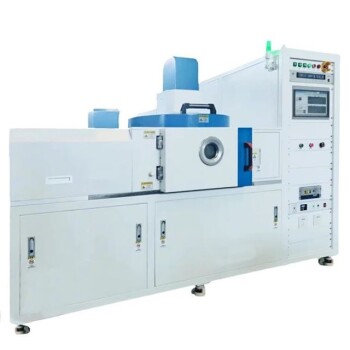
Magnesium's extreme chemical reactivity makes it uniquely difficult to process at high temperatures without specialized environmental controls. An industrial-grade vacuum system is critical during Pulsed Plasma Sintering (PPS) because it lowers the chamber pressure to approximately 5 x 10⁻³ Pa, effectively evacuating oxygen to prevent the magnesium matrix and reinforcements (such as Ti6Al4V) from oxidizing or burning.
The vacuum system acts as a fundamental barrier to chemical degradation, ensuring that the final composite material retains pure interfaces and superior mechanical properties rather than succumbing to oxidation.
The Chemistry of Isolation
Counteracting High Reactivity
Magnesium and its alloys are highly chemically active. When exposed to the elevated temperatures required for sintering, they oxidize rapidly if oxygen is present.
Eliminating Atmospheric Oxygen
The primary function of the vacuum system is to reduce the partial pressure of oxygen within the furnace. By achieving a vacuum level of 5 x 10⁻³ Pa, the system removes the reactants necessary for oxidation.
Protecting Composite Interfaces
In composites where magnesium is reinforced with materials like Ti6Al4V, the interface between the metal and the reinforcement is the structural weak point. The vacuum ensures these interfaces remain clean and free of brittle oxide layers.
Beyond Oxidation: Density and Purity
Evacuating Trapped Gases
Metal powders naturally contain atmospheric gases trapped within the gaps between particles. The vacuum system extracts these gases before sintering begins.
Desorbing Surface Contaminants
Powder particles often have gases adsorbed onto their surfaces. A high-vacuum environment promotes the removal of these surface contaminants.
Facilitating Sintering Necks
By removing physical gas barriers and surface impurities, the vacuum promotes the formation of strong sintering necks between particles. This results in a final product with higher density and structural integrity.
Understanding the Trade-offs
The Vapor Pressure Challenge
Magnesium has a significantly higher vapor pressure than many other metals. While a vacuum is essential for preventing oxidation, it also lowers the boiling point of the metal.
Process Precision
Operators must balance the vacuum level and temperature precisely. If the pressure is too low relative to the temperature, there is a risk of magnesium vaporizing (subliming) rather than sintering, which would alter the alloy's composition.
Equipment Sensitivity
Industrial-grade vacuum systems add complexity and cost. Because magnesium is so sensitive to oxygen, even a minor leak or pump failure can result in the rapid burning or total ruin of the batch.
Making the Right Choice for Your Goal
To maximize the effectiveness of your PPS process, align your vacuum parameters with your specific material objectives:
- If your primary focus is Mechanical Strength: Ensure the vacuum reaches at least 5 x 10⁻³ Pa to guarantee oxide-free interfaces between the matrix and reinforcements.
- If your primary focus is Component Density: Utilize the vacuum cycle to thoroughly degas the powder bed prior to reaching peak sintering temperatures, ensuring no porosity remains.
Control the atmosphere, and you control the material's potential.
Summary Table:
| Feature | Impact on Magnesium PPS Process |
|---|---|
| Vacuum Level (5 x 10⁻³ Pa) | Eliminates oxygen to prevent rapid oxidation and burning of magnesium matrix. |
| Interface Protection | Ensures clean, oxide-free bonds between magnesium and reinforcements like Ti6Al4V. |
| Degassing Capability | Removes trapped and adsorbed gases to increase final product density. |
| Sublimation Control | Precision balancing of vapor pressure to prevent magnesium loss during heating. |
| Mechanical Integrity | Promotes strong sintering neck formation for superior structural strength. |
Elevate Your Material Research with KINTEK Precision
Don't let oxidation compromise your magnesium alloy composites. KINTEK provides industry-leading, industrial-grade vacuum solutions tailored for the most demanding Pulsed Plasma Sintering (PPS) applications.
Backed by expert R&D and manufacturing, KINTEK offers Muffle, Tube, Rotary, Vacuum, and CVD systems, all fully customizable to your unique sintering requirements. Whether you are aiming for maximum component density or pure interface integrity, our high-temp furnaces provide the atmosphere control you need to succeed.
Ready to optimize your sintering process? Contact our technical experts today to find the perfect high-temperature solution for your lab.
References
- Anna Dobkowska, Łukasz Żrodowski. Microstructure and Corrosion of Mg-Based Composites Produced from Custom-Made Powders of AZ31 and Ti6Al4V via Pulse Plasma Sintering. DOI: 10.3390/ma17071602
This article is also based on technical information from Kintek Furnace Knowledge Base .
Related Products
- Spark Plasma Sintering SPS Furnace
- MPCVD Machine System Reactor Bell-jar Resonator for Lab and Diamond Growth
- 915MHz MPCVD Diamond Machine Microwave Plasma Chemical Vapor Deposition System Reactor
- RF PECVD System Radio Frequency Plasma Enhanced Chemical Vapor Deposition
- High Temperature Muffle Oven Furnace for Laboratory Debinding and Pre Sintering
People Also Ask
- Why is it necessary to maintain a high vacuum environment during the SPS of SiC? Key to High-Density Ceramics
- How does the heating mechanism of Spark Plasma Sintering (SPS) function? Enhance TiC/SiC Composite Fabrication
- What are the technical advantages of using an SPS sintering furnace? Elevate Al2O3-TiC Material Performance
- What are the steps in the discharge plasma sintering process? Master Fast, High-Density Material Consolidation
- What are the advantages of spark plasma sintering (SPS) over traditional forging? Precision Microstructural Control