
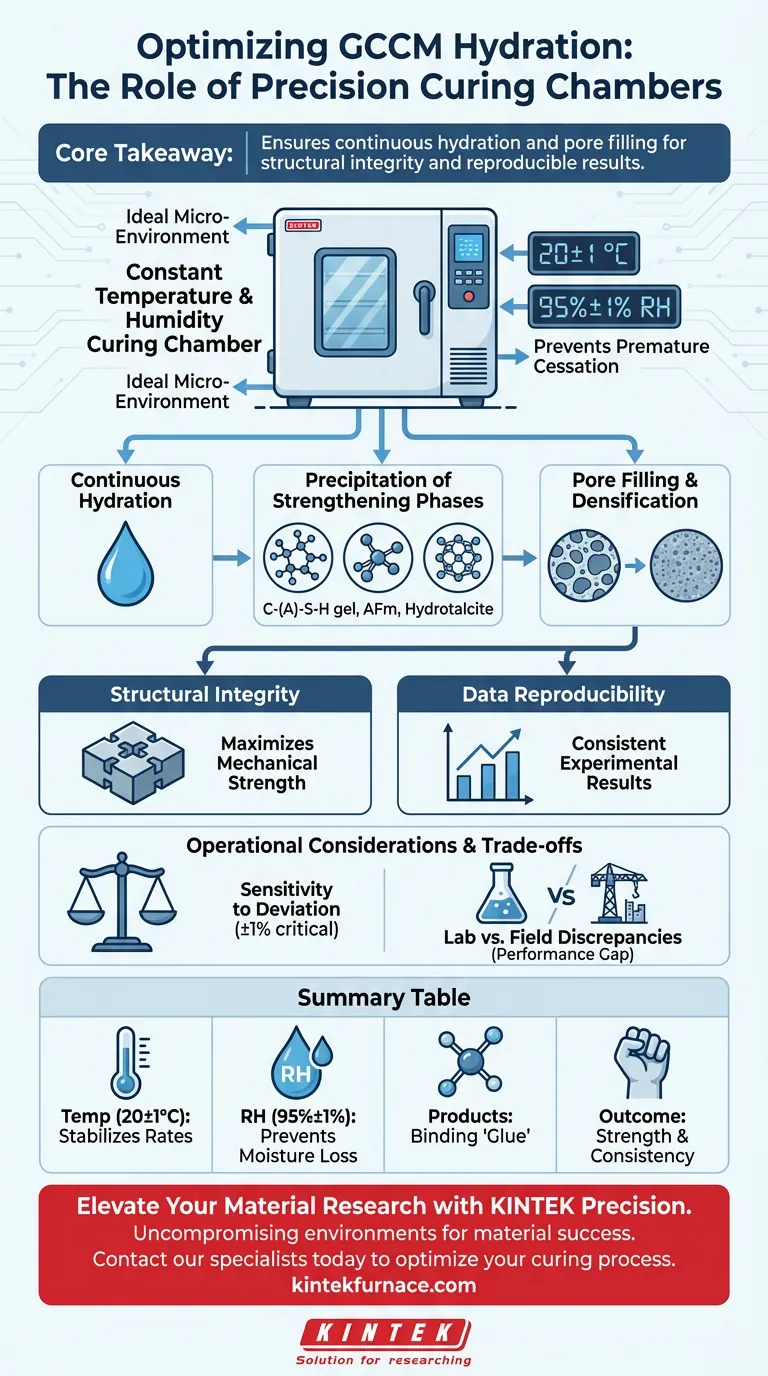
A constant temperature and humidity curing chamber serves as a critical stabilization tool for the chemical evolution of Geopolymer Cementitious Materials (GCCM). By maintaining a rigorous micro-environment—specifically 20±1 °C and 95%±1% relative humidity—it prevents the premature cessation of hydration. This controlled atmosphere allows for the continuous, uninterrupted precipitation of binding phases necessary for physical strength.
Core Takeaway The curing chamber ensures the gradual and complete formation of strengthening phases like C-(A)-S-H gel and hydrotalcite by preventing moisture loss. This process is essential for filling micropores to achieve structural integrity and guarantees that experimental data remains reproducible across different batches.

The Role of Environmental Stability
Maintaining the Ideal Micro-Environment
For GCCM to develop properly, it requires a setting that mimics ideal curing conditions without fluctuation. The chamber provides this by locking in a temperature of 20±1 °C and a relative humidity of 95%±1%.
This precision eliminates external variables that could disrupt the chemical reactions. Without this stability, the material risks drying out or reacting unevenly, compromising its final properties.
Ensuring Continuous Hydration
The primary function of this high-humidity environment is to drive the continuous progression of the hydration reaction.
If the moisture content drops, the reaction stalls, leaving unreacted particles. The chamber ensures that water remains available as a reactant and transport medium throughout the curing process.
Formation of Specific Hydration Products
Precipitation of Strengthening Phases
Under these stable conditions, specific chemical products are able to precipitate gradually. The primary reference highlights the formation of C-(A)-S-H gel, AFm, and hydrotalcite.
These phases are the "glues" of the geopolymer system. Their proper formation is directly linked to the mechanical strength of the final material.
The Mechanism of Pore Filling
As these hydration products form, they occupy space within the material's microstructure. The controlled environment allows these phases to effectively fill micropores.
This densification reduces porosity. A denser microstructure leads to higher durability and better resistance to environmental stressors.
Importance for Research and Engineering
Reproducibility of Data
For scientific analysis, consistency is paramount. The curing chamber ensures that every sample is subjected to the exact same history of temperature and moisture.
This guarantees the reproducibility of experimental data. Researchers can be confident that variations in strength are due to material formulation, not erratic curing conditions.
Structural Integrity
Ultimately, the goal of GCCM is to bear loads. The chamber facilitates the full development of the material's internal structure.
By maximizing hydration and pore filling, the chamber ensures the structural integrity of the cementitious material is achieved as designed.
Operational Considerations and Trade-offs
Sensitivity to Deviation
While these chambers are precise, the material is highly sensitive to even minor deviations. A failure to maintain the ±1% tolerance in humidity or temperature can alter the rate of crystal growth, leading to inconsistent microstructures.
Lab vs. Field Discrepancies
It is important to acknowledge that this "ideal" curing environment represents a best-case scenario.
Materials cured in this perfect micro-environment may exhibit superior properties compared to those cured in uncontrolled field conditions. Engineers must account for this performance gap when translating lab results to real-world applications.
Making the Right Choice for Your Goal
To maximize the utility of your curing chamber for GCCM, consider your specific objectives:
- If your primary focus is Research Accuracy: Ensure strict adherence to the ±1% tolerances to guarantee that any observed changes in strength are solely due to your mix design, not environmental variance.
- If your primary focus is Material Strength: prioritize maintaining 95% relative humidity to prevent self-desiccation and ensure maximum pore filling by the C-(A)-S-H gels.
By strictly controlling the curing environment, you transition GCCM from a theoretical mixture into a reliable, high-performance structural material.
Summary Table:
| Parameter | Standard Requirement | Impact on GCCM Hydration |
|---|---|---|
| Temperature | 20±1 °C | Stabilizes chemical reaction rates and crystal growth. |
| Relative Humidity | 95%±1% | Prevents moisture loss; ensures continuous C-(A)-S-H gel precipitation. |
| Key Products | C-(A)-S-H, AFm, Hydrotalcite | Acts as binding 'glue' to fill micropores and increase density. |
| Outcome | Structural Integrity | Maximizes mechanical strength and ensures data reproducibility. |
Elevate Your Material Research with KINTEK Precision
Achieving the perfect chemical evolution in Geopolymer Cementitious Materials (GCCM) requires more than just a formula—it requires an uncompromising environment. KINTEK provides industry-leading constant temperature and humidity chambers designed to maintain the rigorous ±1% tolerances essential for continuous hydration and pore-filling.
Backed by expert R&D and manufacturing, KINTEK offers a comprehensive range of lab solutions including Muffle, Tube, Rotary, Vacuum, and CVD systems, all customizable for your unique material science needs. Ensure your experimental data is reproducible and your structural materials reach their peak performance.
Ready to optimize your curing process? Contact our laboratory specialists today to find the perfect high-temp or environmental system for your application.
Visual Guide
References
- Jianmin Li, Kai Wang. Study on the synergistic hydration mechanism of granulated blast furnace slag-carbide slag-based cementitious materials and the properties of full-solid waste backfill materials. DOI: 10.1038/s41598-025-86509-7
This article is also based on technical information from Kintek Furnace Knowledge Base .
Related Products
People Also Ask
- What role does a Tube Furnace play in the CVD growth of carbon nanotubes? Achieve High-Purity CNT Synthesis
- How does a CVD tube furnace achieve high purity in gate media preparation? Master Precision Control for Flawless Films
- What are the advantages of using a CVD tube furnace for preparing gate dielectrics? Achieve High-Quality Thin Films for Transistors
- What are the operational and maintenance requirements for a CVD tube furnace? Ensure Precision for Thin Film Deposition
- What are the key features of CVD tube furnaces for 2D material processing? Unlock Precision Synthesis for Superior Materials
