
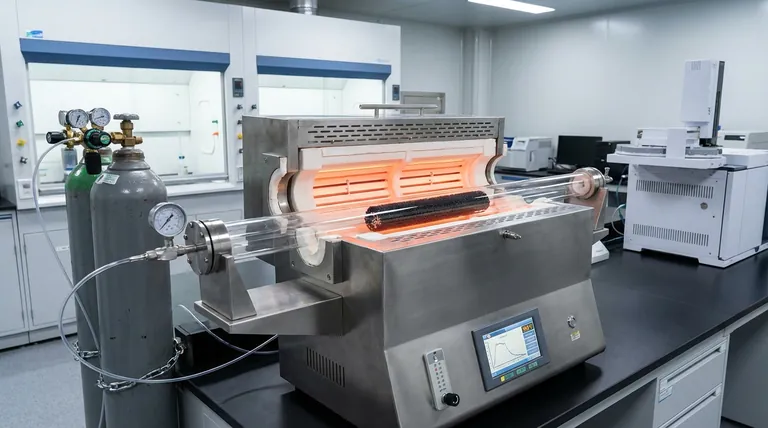
Precise thermal regulation is the mechanism by which a carbonization furnace sculpts a macroporous carbon framework (MPCF). By maintaining an argon-protected environment at 900 °C, the furnace thermally decomposes organic precursors like chitosan, transforming them into a rigid, directed carbon architecture.
The heating rate and isothermal holding time are the critical levers in this process. Manipulating these variables dictates the framework's mechanical strength and porosity, directly influencing its capacity for electronic and ionic transport.
The Mechanics of Carbonization
Thermal Decomposition in Inert Atmospheres
The furnace operates by creating a controlled environment that prevents simple combustion. By filling the chamber with argon gas, the system ensures the organic components do not burn away but instead undergo pyrolysis.
Transformation of Precursors
At 900 °C, organic materials such as chitosan are thermally decomposed. This heat strips away non-carbon elements, leaving behind a pure, structured carbon skeleton.
Developing the Directed Architecture
This process is not random; it results in a directed macroporous architecture. The thermal treatment ensures that vertical graphene sheets are securely attached to the pore walls.
Creating Transport Channels
The structural arrangement facilitates function. The attachment of graphene creates interconnected channels, which are essential for allowing electrons and ions to move freely through the material.
Key Control Variables
The Role of Heating Rate
The speed at which the furnace reaches its target temperature is a primary determinant of the material's final properties. The heating rate influences how the carbon structure settles and stabilizes during decomposition.
The Importance of Isothermal Holding Time
Once the target temperature is reached, the duration the material remains at that heat—the isothermal holding time—is equally critical. This period allows the carbonization process to complete fully, solidifying the framework's integrity.
Understanding the Trade-offs
Balancing Strength and Porosity
The primary reference indicates that heating rate and holding time determine both mechanical strength and porosity.
The Structural Compromise
There is an inherent relationship between these two outcomes. Adjusting the furnace parameters to maximize porosity (for better transport) must be balanced against the need for sufficient mechanical strength to prevent the framework from collapsing.
Optimizing for Material Performance
To achieve the desired microstructural properties, you must tune the furnace parameters to match your specific application requirements.
- If your primary focus is Structural Durability: Prioritize furnace settings that enhance mechanical strength, likely by ensuring the holding time is sufficient to fully stabilize the carbon bonds.
- If your primary focus is Conductivity: Optimize the process to maximize the formation of interconnected channels and the secure attachment of vertical graphene for superior electronic and ionic transport.
Mastering the thermal profile of the carbonization furnace is the only way to transform organic precursors into high-performance carbon frameworks.
Summary Table:
| Parameter | Influence on MPCF Structure | Impact on Performance |
|---|---|---|
| Inert Atmosphere (Argon) | Prevents combustion; ensures pure pyrolysis | Preserves carbon skeleton integrity |
| Temperature (900 °C) | Strips non-carbon elements from precursors | Defines directed architecture and purity |
| Heating Rate | Governs structural settlement and stabilization | Dictates mechanical strength and porosity |
| Holding Time | Completes carbonization; solidifies bonds | Ensures long-term structural durability |
| Microstructure | Vertical graphene sheets on pore walls | Facilitates electronic/ionic transport |
Precision Control for Advanced Carbon Synthesis
Unlock the full potential of your macroporous carbon frameworks with KINTEK’s industry-leading thermal solutions. Backed by expert R&D and manufacturing, KINTEK offers a comprehensive range of Muffle, Tube, Rotary, Vacuum, and CVD systems, all designed to provide the precise thermal regulation required for complex pyrolysis and carbonization. Whether you need to optimize mechanical strength or enhance conductivity through interconnected channels, our lab high-temp furnaces are fully customizable to meet your unique research and production needs.
Ready to refine your material performance? Contact our technical experts today to find your custom furnace solution!
References
- Zhenwei Li, Jie Yu. Macroporous Directed and Interconnected Carbon Architectures Endow Amorphous Silicon Nanodots as Low-Strain and Fast-Charging Anode for Lithium-Ion Batteries. DOI: 10.1007/s40820-023-01308-x
This article is also based on technical information from Kintek Furnace Knowledge Base .
Related Products
- Electric Rotary Kiln Small Rotary Furnace for Activated Carbon Regeneration
- 1200℃ Controlled Inert Nitrogen Atmosphere Furnace
- 1700℃ Controlled Inert Nitrogen Atmosphere Furnace
- Vacuum Heat Treat Sintering Furnace with Pressure for Vacuum Sintering
- Small Vacuum Heat Treat and Tungsten Wire Sintering Furnace
People Also Ask
- What are the main applications of a rotary kiln electric furnace? Achieve Uniform Heat Treatment for Powders
- What are the key components of a rotary kiln electric furnace? Unlock Efficient Thermal Processing
- What is the significance of the refractory lining in a rotary kiln electric furnace? Unlock Efficiency and Longevity
- What advantages do electric rotary kilns offer over fuel-based kilns? Boost Efficiency and Purity in Your Process
- What materials can be processed in an electric rotary kiln? Versatile Solutions for Advanced Materials



















