The physical dimensions of the quartz tube fundamentally dictate the gas flow dynamics within a CVD system. Specifically, the tube’s diameter and length regulate the stability of laminar flow and the uniformity of precursor distribution. These specifications turn the tube from a passive vessel into an active component that directly influences the quality and consistency of molybdenum disulfide (MoS2) growth.
The geometry of the reaction chamber is the primary driver of flow stability. A sufficiently wide and long tube establishes a predictable velocity field, minimizing turbulence and ensuring uniform deposition across substrates.
The Role of Tube Diameter in Gas Flow
Establishing Laminar Flow
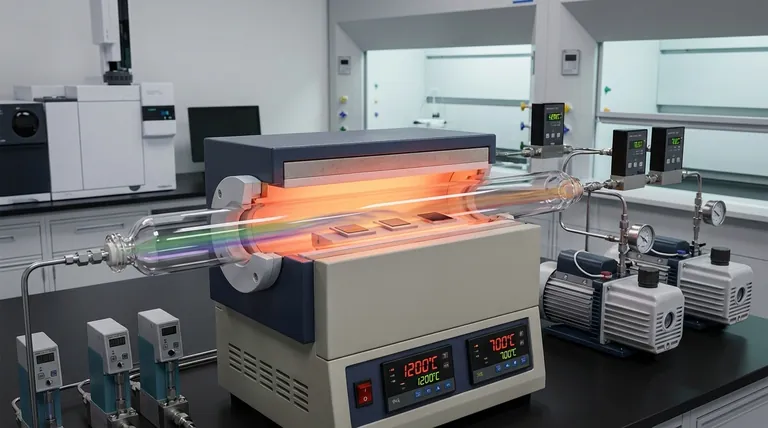
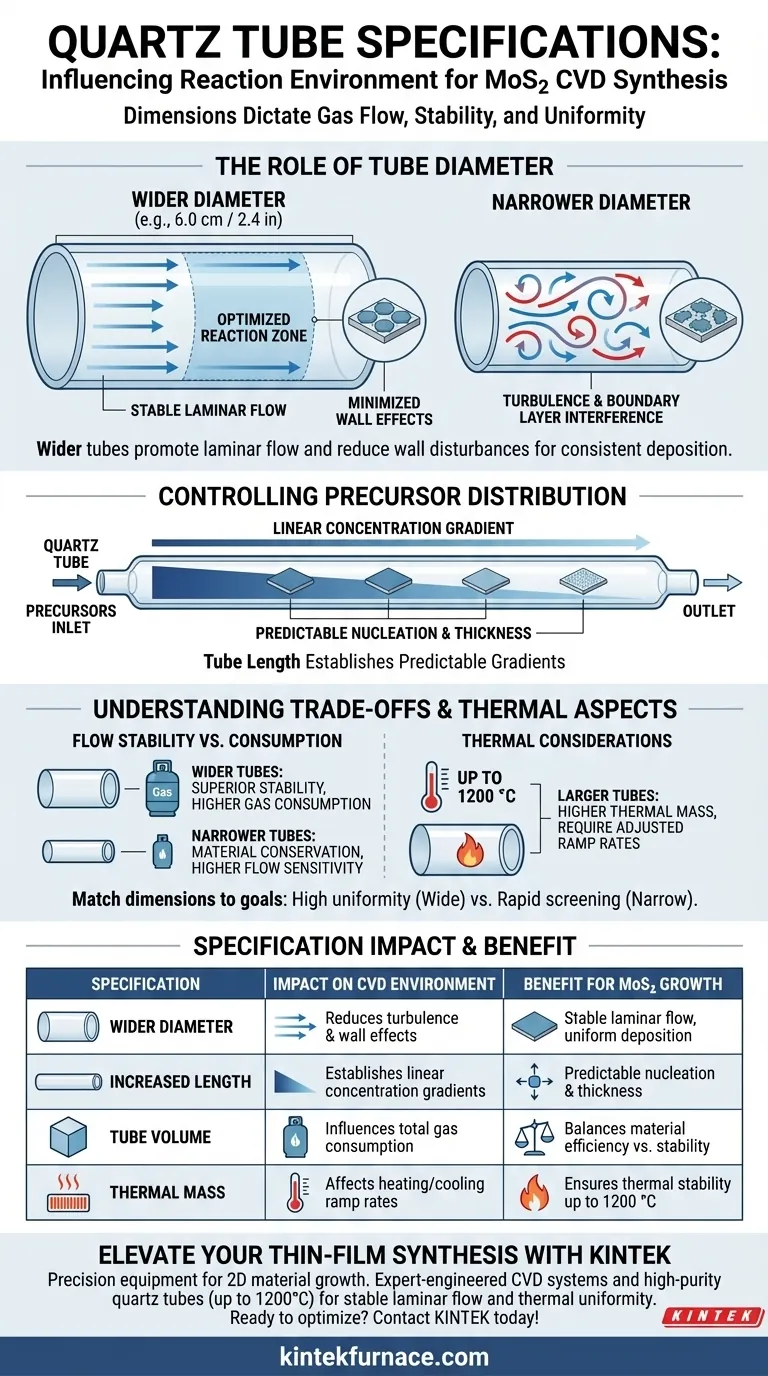
To achieve high-quality MoS2 synthesis, the reaction environment must maintain a stable laminar flow. A tube with a sufficiently wide diameter—such as the 6.0 cm (approx. 2.4 inches) specification noted in successful setups—is critical for establishing this flow regime. Narrower tubes increase the likelihood of turbulence, which can lead to unpredictable deposition rates.
Minimizing Wall Effects
Gas flowing through a tube experiences friction and drag against the inner walls. In a wider tube, the central reaction zone is physically distanced from these boundary layer disturbances. This separation ensures that the substrates interact with a consistent gas stream rather than the chaotic flow found near the tube walls.
Controlling Precursor Distribution
Predictable Concentration Gradients
The physical volume defined by the tube allows for the development of predictable precursor concentration gradients. As the gas travels down the length of a tube (e.g., 60.0 cm), the concentration of reactants changes in a linear, calculable fashion. This predictability allows researchers to position substrates precisely to achieve specific nucleation densities or layer thicknesses.
Uniformity Across Orientations
A stable velocity field, enabled by correct tube dimensions, ensures that the precursor supply is uniform regardless of how the substrate is angled. This is essential for achieving uniform MoS2 growth across substrates positioned in various orientations, preventing "shadowing" effects where gas flow is blocked or uneven.
Understanding the Trade-offs
Impact on Gas Consumption
While larger tubes (e.g., 2-inch or 6.0 cm diameters) offer superior flow stability, they increase the total volume of the reaction chamber. This generally requires higher flow rates or larger quantities of precursors to maintain the necessary partial pressures compared to smaller, 1-inch setups.
Thermal Considerations
Standard CVD systems for this application are designed to operate with quartz tubes at temperatures up to 1200 °C. However, the physical size of the tube influences the thermal mass. Larger tubes may require adjusted ramp rates to ensure the internal temperature stabilizes uniformly without shocking the quartz material.
Making the Right Choice for Your Goal
When selecting a quartz tube for your CVD system, align the dimensions with your specific research objectives.
- If your primary focus is high uniformity and large-area growth: Prioritize a wider tube diameter (approx. 6.0 cm or 2 inches) to maximize the laminar flow region and reduce wall interference.
- If your primary focus is rapid screening or material conservation: Consider a narrower tube (1 inch), accepting slightly higher flow sensitivity in exchange for reduced precursor consumption.
By matching the tube's physical specifications to your fluid dynamic requirements, you convert a variable into a constant, ensuring reproducible synthesis results.
Summary Table:
| Specification | Impact on CVD Environment | Resulting Benefit for MoS2 Growth |
|---|---|---|
| Wider Diameter | Reduces turbulence & wall effects | Stable laminar flow and uniform deposition |
| Increased Length | Establishes linear concentration gradients | Predictable nucleation density and thickness |
| Tube Volume | Influences total gas consumption | Balances material efficiency vs. flow stability |
| Thermal Mass | Affects heating/cooling ramp rates | Ensures thermal stability up to 1200 °C |
Elevate Your Thin-Film Synthesis with KINTEK
Precision in 2D material growth starts with the right equipment. KINTEK provides expert-engineered CVD systems, Muffle, Tube, Rotary, and Vacuum furnaces designed to meet the rigorous demands of MoS2 synthesis. Our high-purity quartz tubes and customizable high-temperature systems (up to 1200°C and beyond) ensure you achieve the stable laminar flow and thermal uniformity essential for large-area, high-quality deposition.
Ready to optimize your lab's CVD performance? Contact our technical specialists today to discuss our customizable furnace solutions and how we can support your unique research needs.
Visual Guide
References
- Feng Liao, Zewen Zuo. Optimizing the Morphology and Optical Properties of MoS2 Using Different Substrate Placement: Numerical Simulation and Experimental Verification. DOI: 10.3390/cryst15010059
This article is also based on technical information from Kintek Furnace Knowledge Base .
Related Products
- Vertical Laboratory Quartz Tube Furnace Tubular Furnace
- Custom Made Versatile CVD Tube Furnace Chemical Vapor Deposition CVD Equipment Machine
- Laboratory Quartz Tube Furnace RTP Heating Tubular Furnace
- Multi Zone Laboratory Quartz Tube Furnace Tubular Furnace
- Slide PECVD Tube Furnace with Liquid Gasifier PECVD Machine
People Also Ask
- What are the key differences between single-zone and multi-zone vertical tube furnaces? Choose the Right Furnace for Your Lab
- How are metal support wires selected for sample suspension? Expert Guide to High-Temp Furnace Materials
- How do heat treatment processes influence the configuration of a vertical tube furnace? Optimize for Quenching, Annealing, and More
- What is a vertical tube furnace and how does it function? Optimize Material Processing with Precision
- What physical conditions does a vertical tube furnace provide for desulfurization experiments? Precision Heat Control