Knowledge How do laboratory tablet presses ensure performance in iodine battery prototypes? Optimize Interfacial Contact Today
Author avatar

Tech Team · Kintek Furnace

Updated 2 hours ago

How do laboratory tablet presses ensure performance in iodine battery prototypes? Optimize Interfacial Contact Today


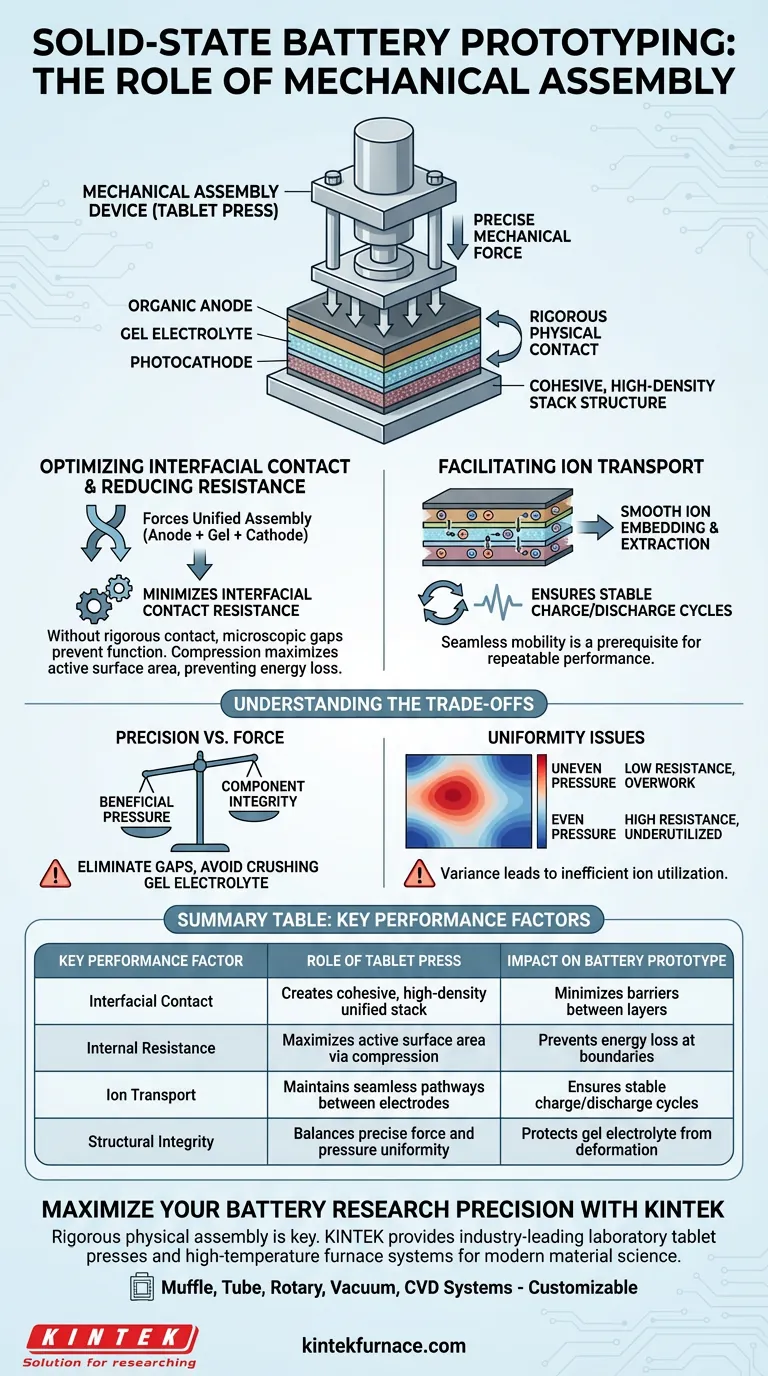
Laboratory tablet presses ensure performance by creating a cohesive, high-density stack structure. By applying precise mechanical force, these devices establish rigorous physical contact between the organic anode, the gel electrolyte, and the photocathode. This physical compression is the fundamental mechanism used to overcome interfacial barriers in solid-state prototypes.

The critical function of mechanical assembly is to minimize interfacial contact resistance. By enforcing a tight stack structure, the device ensures that ions can move freely between electrodes, which is essential for efficient charging and discharging.
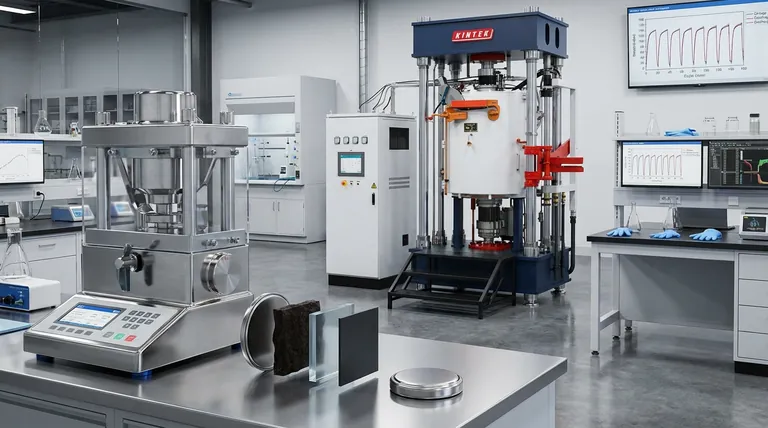
How do laboratory tablet presses ensure performance in iodine battery prototypes? Optimize Interfacial Contact Today

The Mechanics of Prototype Assembly

Optimizing Interfacial Contact

In dual-ion solid-state iodine batteries, the physical boundaries between layers are the most vulnerable points for performance loss.

The tablet press forces the organic anode, gel electrolyte, and photocathode into a unified assembly.

Without this rigorous contact, microscopic gaps prevent the components from functioning as a single electrochemical system.

Reducing Internal Resistance

A loose or uneven assembly inherently results in high interfacial contact resistance.

Mechanical compression directly combats this by maximizing the active surface area where the layers touch.

By minimizing this resistance, the assembly ensures that energy is directed toward storage and release rather than being lost to poor connectivity.

Facilitating Ion Transport

The ultimate goal of the assembly process is to support the chemical cycle of the battery.

The tight stacked structure created by the press allows ions to smoothly embed and extract between the two electrodes.

This seamless mobility is a prerequisite for achieving stable and repeatable charging and discharging cycles.

Understanding the Trade-offs

Precision vs. Force

While rigorous contact is necessary, there is a limit to how much pressure is beneficial.

The mechanical device must apply enough force to eliminate gaps without crushing the delicate gel electrolyte or deforming the organic anode.

Successful assembly requires finding the exact balance where contact is maximized but component integrity is preserved.

Uniformity Issues

Mechanical assembly devices must ensure pressure is distributed evenly across the entire surface of the tablet.

If pressure is applied unevenly, it creates localized areas of low resistance and other areas of high resistance.

This variance can lead to inefficient ion utilization, causing parts of the battery to overwork while others remain underutilized.

Making the Right Choice for Your Assembly Process

To ensure reliable data from your dual-ion solid-state iodine prototypes, consider these priorities:

  • If your primary focus is Cycle Stability: Prioritize a press setting that guarantees a "tight stacked structure" to maintain ion pathways over repeated charging cycles.
  • If your primary focus is Efficiency: Ensure your assembly minimizes "interfacial contact resistance" to prevent energy loss at the layer boundaries.

Ultimately, the performance of your solid-state prototype relies as much on the physical quality of the assembly as it does on the chemistry of the components.

Summary Table:

Key Performance Factor Role of Tablet Press in Assembly Impact on Battery Prototype
Interfacial Contact Creates a cohesive, high-density unified stack Minimizes barriers between layers
Internal Resistance Maximizes active surface area via compression Prevents energy loss at boundaries
Ion Transport Maintains seamless pathways between electrodes Ensures stable charge/discharge cycles
Structural Integrity Balances precise force and pressure uniformity Protects gel electrolyte from deformation

Maximize Your Battery Research Precision with KINTEK

High-performance solid-state battery prototypes require more than just chemistry; they demand rigorous physical assembly. KINTEK provides industry-leading laboratory tablet presses and high-temperature furnace systems designed to meet the exacting standards of modern material science.

Backed by expert R&D and manufacturing, KINTEK offers Muffle, Tube, Rotary, Vacuum, and CVD systems, all customizable to your unique research needs. Whether you are focusing on minimizing interfacial resistance or ensuring long-term cycle stability, our equipment ensures your components function as a single, efficient electrochemical system.

Ready to elevate your lab's performance? Contact us today to discuss your custom furnace and assembly needs!

Visual Guide
How do laboratory tablet presses ensure performance in iodine battery prototypes? Optimize Interfacial Contact Today Visual Guide

References

  1. Solar Trap‐Adsorption Photocathode for Highly Stable 2.4 V Dual‐Ion Solid‐State Iodine Batteries. DOI: 10.1002/adma.202504492

This article is also based on technical information from Kintek Furnace Knowledge Base .

Related Products

People Also Ask

Related Products

Vacuum Heat Treat Sintering Furnace with Pressure for Vacuum Sintering

Vacuum Heat Treat Sintering Furnace with Pressure for Vacuum Sintering

KINTEK's Vacuum Pressure Sintering Furnace offers 2100℃ precision for ceramics, metals, and composites. Customizable, high-performance, and contamination-free. Get a quote now!

2200 ℃ Tungsten Vacuum Heat Treat and Sintering Furnace

2200 ℃ Tungsten Vacuum Heat Treat and Sintering Furnace

2200°C Tungsten Vacuum Furnace for high-temperature materials processing. Precise control, superior vacuum, customizable solutions. Ideal for research & industrial applications.

600T Vacuum Induction Hot Press Vacuum Heat Treat and Sintering Furnace

600T Vacuum Induction Hot Press Vacuum Heat Treat and Sintering Furnace

600T Vacuum Induction Hot Press Furnace for precise sintering. Advanced 600T pressure, 2200°C heating, vacuum/atmosphere control. Ideal for research & production.

High Pressure Laboratory Vacuum Tube Furnace Quartz Tubular Furnace

High Pressure Laboratory Vacuum Tube Furnace Quartz Tubular Furnace

KINTEK High Pressure Tube Furnace: Precision heating up to 1100°C with 15Mpa pressure control. Ideal for sintering, crystal growth, and lab research. Customizable solutions available.

9MPa Air Pressure Vacuum Heat Treat and Sintering Furnace

9MPa Air Pressure Vacuum Heat Treat and Sintering Furnace

Achieve superior ceramic densification with KINTEK's advanced air pressure sintering furnace. High-pressure up to 9MPa, precise 2200℃ control.

Vacuum Heat Treat Furnace with Ceramic Fiber Liner

Vacuum Heat Treat Furnace with Ceramic Fiber Liner

KINTEK's Vacuum Furnace with Ceramic Fiber Lining offers precise high-temperature processing up to 1700°C, ensuring uniform heat distribution and energy efficiency. Ideal for labs and production.

2200 ℃ Graphite Vacuum Heat Treat Furnace

2200 ℃ Graphite Vacuum Heat Treat Furnace

2200℃ Graphite Vacuum Furnace for high-temperature sintering. Precise PID control, 6*10⁻³Pa vacuum, durable graphite heating. Ideal for research & production.

Vacuum Heat Treat Sintering and Brazing Furnace

Vacuum Heat Treat Sintering and Brazing Furnace

KINTEK Vacuum Brazing Furnaces deliver precision, clean joints with superior temperature control. Customizable for diverse metals, ideal for aerospace, medical, and thermal applications. Get a quote!

Vacuum Heat Treat Sintering Furnace Molybdenum Wire Vacuum Sintering Furnace

Vacuum Heat Treat Sintering Furnace Molybdenum Wire Vacuum Sintering Furnace

KINTEK's Vacuum Molybdenum Wire Sintering Furnace excels in high-temperature, high-vacuum processes for sintering, annealing, and material research. Achieve precise 1700°C heating with uniform results. Custom solutions available.

Small Vacuum Heat Treat and Tungsten Wire Sintering Furnace

Small Vacuum Heat Treat and Tungsten Wire Sintering Furnace

Compact vacuum tungsten wire sintering furnace for labs. Precise, mobile design with superior vacuum integrity. Ideal for advanced material research. Contact us!

Vacuum Dental Porcelain Sintering Furnace for Dental Laboratories

Vacuum Dental Porcelain Sintering Furnace for Dental Laboratories

KinTek Vacuum Porcelain Furnace: Precision dental lab equipment for high-quality ceramic restorations. Advanced firing control & user-friendly operation.

Magnesium Extraction and Purification Condensing Tube Furnace

Magnesium Extraction and Purification Condensing Tube Furnace

Magnesium purification tube furnace for high-purity metal production. Achieve ≤10Pa vacuum, dual-zone heating. Ideal for aerospace, electronics, and lab research.

Laboratory Vacuum Tilt Rotary Tube Furnace Rotating Tube Furnace

Laboratory Vacuum Tilt Rotary Tube Furnace Rotating Tube Furnace

KINTEK Laboratory Rotary Furnace: Precision heating for calcination, drying, sintering. Customizable solutions with vacuum & controlled atmosphere. Enhance research now!

High Temperature Muffle Oven Furnace for Laboratory Debinding and Pre Sintering

High Temperature Muffle Oven Furnace for Laboratory Debinding and Pre Sintering

KT-MD Debinding & Pre-Sintering Furnace for ceramics - precise temperature control, energy-efficient design, customizable sizes. Boost your lab efficiency today!

Vacuum Sealed Continuous Working Rotary Tube Furnace Rotating Tube Furnace

Vacuum Sealed Continuous Working Rotary Tube Furnace Rotating Tube Furnace

Precision rotary tube furnace for continuous vacuum processing. Ideal for calcination, sintering, and heat treatment. Customizable up to 1600℃.

1400℃ High Temperature Laboratory Tube Furnace with Quartz and Alumina Tube

1400℃ High Temperature Laboratory Tube Furnace with Quartz and Alumina Tube

KINTEK's Tube Furnace with Alumina Tube: Precision high-temperature processing up to 2000°C for labs. Ideal for material synthesis, CVD, and sintering. Customizable options available.

Laboratory Muffle Oven Furnace with Bottom Lifting

Laboratory Muffle Oven Furnace with Bottom Lifting

Boost lab efficiency with KT-BL Bottom Lifting Furnace: precise 1600℃ control, superior uniformity, and enhanced productivity for material science and R&D.

Laboratory Quartz Tube Furnace RTP Heating Tubular Furnace

Laboratory Quartz Tube Furnace RTP Heating Tubular Furnace

KINTEK's RTP Rapid Heating Tube Furnace delivers precise temperature control, rapid heating up to 100°C/sec, and versatile atmosphere options for advanced lab applications.

Split Chamber CVD Tube Furnace with Vacuum Station CVD Machine

Split Chamber CVD Tube Furnace with Vacuum Station CVD Machine

Split Chamber CVD Tube Furnace with Vacuum Station - High precision 1200°C lab furnace for advanced materials research. Customizable solutions available.

Multi Heating Zones CVD Tube Furnace Machine for Chemical Vapor Deposition Equipment

Multi Heating Zones CVD Tube Furnace Machine for Chemical Vapor Deposition Equipment

KINTEK's Multi-Zone CVD Tube Furnaces offer precision temperature control for advanced thin film deposition. Ideal for research and production, customizable for your lab needs.


Leave Your Message



















