
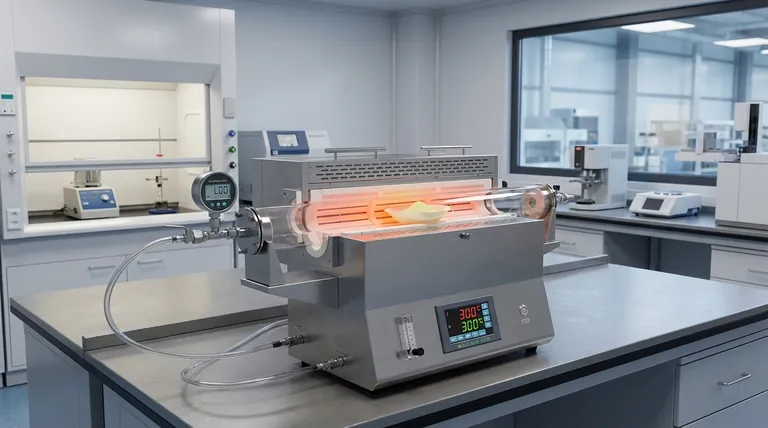
High-vacuum muffle and tube furnaces facilitate the activation of materials like UiO-66-NH2 by creating an environment that combines elevated temperatures with extremely low pressure. Specifically, by applying heat (approximately 300 °C) alongside a vacuum (e.g., $1 \times 10^{-3}$ mbar), these furnaces drive out residual solvents like DMF and unreacted ligands that act as impurities within the material's pores.
The activation process goes beyond simple drying; it is a critical structural preparation that unblocks pores to maximize surface area and chemically alters core centers to create clean active sites for future modification.
The Mechanisms of Activation
Deep Degassing and Pore Clearance
The synthesis of Metal-Organic Frameworks (MOFs) like UiO-66-NH2 often leaves behind solvent molecules and unreacted ligands. These remnants become trapped within the porous architecture.
High-vacuum furnaces utilize low pressure to lower the boiling point of these trapped volatiles.
This "deep degassing" effectively evacuates the pores, preventing blockage and fully releasing the material's specific surface area for its intended application.
Creating Chemical Active Sites
Beyond physical clearance, the activation process induces chemical changes necessary for downstream utility.
The thermal and vacuum conditions trigger the deprotonation or dehydration of the cluster core centers within the framework.
This creates "clean" active sites, which are essential prerequisites for subsequent chemical modifications, such as lithium alkoxide grafting.
Preventing Re-Contamination
The architecture of these furnaces plays a vital role in maintaining the purity achieved during activation.
Muffle furnaces often feature separate heating and combustion chambers to ensure that heating byproducts do not contact the material.
Furthermore, the use of ceramic muffles or high-temperature alloys helps the equipment resist aggressive vapors released during the degassing of the MOF.
Understanding the Trade-offs
Thermal Stability Limits
While high temperatures are required to drive out stubborn solvents like DMF, excessive heat can compromise the structural integrity of the material.
Operators must balance the temperature needed for activation against the thermal stability limit of the UiO-66-NH2 framework.
Overheating can lead to the collapse of the porous structure, rendering the activation process counterproductive.
Vacuum Quality vs. Processing Time
Achieving the deep vacuum levels ($1 \times 10^{-3}$ mbar) required for complete activation demands high-quality sealing and pumping systems.
Insufficient vacuum levels may require significantly longer heating times to achieve the same result, increasing the risk of thermal degradation.
Conversely, aggressive vacuum pull-down rates can sometimes disturb loose powder samples, necessitating careful control of the atmosphere.
Optimizing the Activation Process
To ensure the material performs as intended, you must align the furnace settings with your specific end goal.
- If your primary focus is maximizing surface area: Prioritize the vacuum level to ensure the deepest possible degassing of trapped ligands and solvent molecules.
- If your primary focus is chemical grafting (e.g., Lithium Alkoxide): Ensure the temperature reaches the threshold required for deprotonation/dehydration to generate the necessary active sites.
Effective activation transforms UiO-66-NH2 from a synthesized raw material into a functional, high-performance substrate.
Summary Table:
| Feature | Impact on UiO-66-NH2 Activation |
|---|---|
| High Vacuum ($1 \times 10^{-3}$ mbar) | Lowers solvent boiling points for deep degassing and unblocked pores. |
| Thermal Control (~300 °C) | Triggers deprotonation/dehydration to create clean chemical active sites. |
| Chamber Isolation | Prevents re-contamination from heating byproducts or aggressive vapors. |
| Structural Integrity | Balances heat vs. vacuum to prevent framework collapse and maximize surface area. |
Unlock the Full Potential of Your MOF Research
Proper activation is the difference between a raw material and a high-performance substrate. KINTEK provides the precision heating and vacuum technology necessary to maximize the surface area and active sites of materials like UiO-66-NH2.
Backed by expert R&D and manufacturing, KINTEK offers a comprehensive range of Muffle, Tube, Rotary, Vacuum, and CVD systems. Our lab high-temp furnaces are fully customizable to meet your unique research requirements, ensuring stable thermal environments and deep vacuum levels for even the most sensitive frameworks.
Ready to elevate your material performance? Contact KINTEK today for a customized solution.
References
- Antonija Ferbezar, Ilie Hanzu. Tuning the ion conductivity of Zr-based metal–organic framework ionogels by linker functionalization. DOI: 10.1039/d3ta06986a
This article is also based on technical information from Kintek Furnace Knowledge Base .
Related Products
- 1700℃ High Temperature Muffle Oven Furnace for Laboratory
- 1800℃ High Temperature Muffle Oven Furnace for Laboratory
- 1400℃ Muffle Oven Furnace for Laboratory
- 1200℃ Muffle Oven Furnace for Laboratory
- High Temperature Muffle Oven Furnace for Laboratory Debinding and Pre Sintering
People Also Ask
- What is the primary function of a high-temperature laboratory muffle furnace in chemical synthesis? Achieve Precision.
- How does a high-temperature laboratory muffle furnace affect material properties? Transform Anodic Oxide Films Fast
- What role does a muffle furnace play in BCZY712 electrolyte powder production? Achieve Perfect Phase Purity
- What is the role of a high-temperature muffle furnace in guava leaf carbonization? Master Precise Pyrolysis Control
- How does the two-stage sintering process contribute to the synthesis of MeCuFeO3 perovskite? Optimize crystal purity.



















