
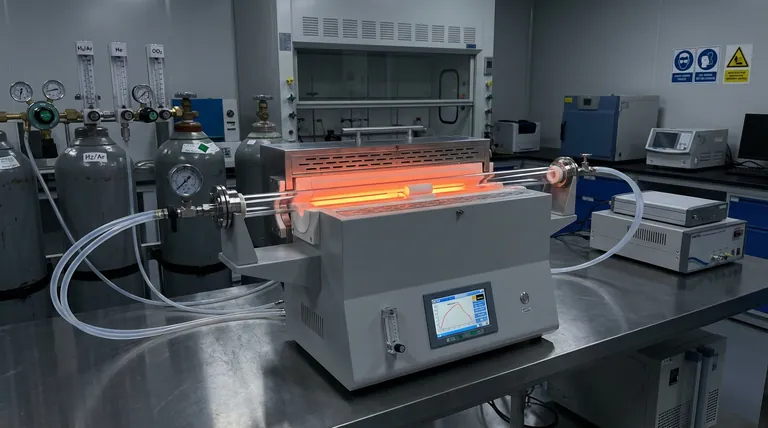
Controlled tube furnace systems achieve atmosphere regulation by isolating the reaction zone within specialized sealed quartz tubes and introducing precise gas compositions. By injecting specific gases—such as 5 vol% H2/Ar, Helium, CO2, or air—researchers can create exact redox environments to determine how different atmospheres influence the phase transformation of Zirconia.
Core Takeaway The true power of these systems lies in the ability to isolate the chemical environment from external variables. By maintaining a tightly sealed chamber with controlled gas flow, you can pinpoint exactly how reduction or oxidation drives the transition of Zirconia from the tetragonal phase to the monoclinic phase (t→m).
The Mechanics of Isolation and Control
Sealed Reaction Chambers
The foundation of atmosphere regulation is the sealed quartz tube. This component isolates the sample from the ambient laboratory air.
Effective regulation requires a tightly sealed furnace chamber or muffle. This prevents external air infiltration, ensuring that the environment inside the tube remains pure and consistent throughout the experiment.
Precise Gas Composition
To study Zirconia, researchers introduce specific gas components into the reaction zone. The primary reference highlights the use of 5 vol% H2/Ar, He, CO2, or air.
This flexibility allows for the creation of distinct chemical baselines. Whether the goal is an inert environment (Helium) or a reducing environment (Hydrogen/Argon mix), the system allows for the tailored management of these gases.
Uniform Atmosphere Flow
Achieving a stable environment is not just about filling the tube; it is about consistent distribution.
Advanced systems feature mechanisms to ensure uniform atmosphere flow. This guarantees that the gas distribution is even across the material, preventing localized variations that could skew the phase transformation data.
The Impact on Zirconia Phase Transformation
Regulating Redox Environments
The primary scientific objective here is investigating the redox (reduction-oxidation) influence.
By switching between oxidizing agents (like air or CO2) and reducing agents (like H2/Ar), researchers can manipulate the chemical potential surrounding the Zirconia sample.
Driving the t→m Transformation
These specific atmospheric conditions are the variables that dictate Zirconia's stability.
The system is specifically used to observe the transformation from the tetragonal phase to the monoclinic phase (t→m). Precise control allows you to correlate specific atmospheric conditions directly to the onset or inhibition of this structural change.
Operational Trade-offs and Safety
Heating Element Durability
Not all heating elements are compatible with all atmospheres.
You must ensure that the heating elements are designed to withstand both high temperatures and the specific chemical nature of the gases used. Incompatible elements may degrade rapidly when exposed to reactive atmospheres like hydrogen or CO2.
Critical Safety Protocols
Handling special atmospheres, particularly reducing gases like Hydrogen, introduces significant risk.
Adherence to strict safety protocols is non-negotiable. Systems must include advanced safety mechanisms, such as explosion protection devices, to manage the potential hazards associated with combustible or toxic gas mixtures.
Making the Right Choice for Your Research
To effectively study Zirconia phase laws, you must align your atmosphere choice with your specific experimental goals.
- If your primary focus is determining stability under reduction: Utilize a mixture like 5 vol% H2/Ar to simulate reducing conditions and observe the acceleration of the t→m transformation.
- If your primary focus is establishing a neutral baseline: Use inert gases such as Helium or Argon to study thermal effects without chemical interference.
- If your primary focus is oxidizing behaviors: Introduce CO2 or standard air to observe how oxygen presence stabilizes or destabilizes the tetragonal phase.
Precision in atmosphere regulation is the key to unlocking the true mechanisms behind Zirconia's structural evolution.
Summary Table:
| Feature | Function in Zirconia Research |
|---|---|
| Sealed Quartz Tube | Isolates sample from ambient air to prevent contamination |
| Gas Composition | Controls redox environments (H2/Ar, He, CO2, Air) |
| Uniform Flow | Ensures consistent chemical distribution across samples |
| Safety Devices | Explosion protection for handling combustible gases |
| Heating Elements | High-durability materials compatible with reactive gases |
Elevate Your Material Research with KINTEK Precision
Unlock the full potential of your atmospheric studies with KINTEK’s advanced thermal solutions. Backed by expert R&D and world-class manufacturing, we provide high-performance Tube, Muffle, Rotary, Vacuum, and CVD systems tailored specifically for the rigorous demands of Zirconia phase transformation research.
Whether you require precise redox control or customizable high-temperature environments, our engineers are ready to design a system that meets your unique lab requirements. Ensure accuracy, safety, and durability in every experiment.
Ready to optimize your lab's capabilities? Contact KINTEK today to discuss your custom furnace needs!
References
- Maged F. Bekheet, Aleksander Gurlo. A quantitative microscopic view on the gas‐phase‐dependent phase transformation from tetragonal to monoclinic ZrO <sub>2</sub>. DOI: 10.1111/jace.19749
This article is also based on technical information from Kintek Furnace Knowledge Base .
Related Products
- 1200℃ Controlled Inert Nitrogen Atmosphere Furnace
- Controlled Inert Nitrogen Hydrogen Atmosphere Furnace
- Mesh Belt Controlled Atmosphere Furnace Inert Nitrogen Atmosphere Furnace
- 1700℃ Controlled Inert Nitrogen Atmosphere Furnace
- Vacuum Sealed Continuous Working Rotary Tube Furnace Rotating Tube Furnace
People Also Ask
- What controlled-atmosphere furnace conditions are required for sintering powder metallurgy copper alloy compacts? Ideal Setup
- What are the key benefits of precise temperature control in a controlled atmosphere furnace? Unlock Superior Quality and Efficiency
- Why is a controlled atmosphere furnace required for 316L debinding? Ensure Structural Integrity & Zero Cracks
- How does a controlled atmosphere furnace prevent oxidation and decarburization? Master Precision Heat Treatment
- What types of gases are used in controlled atmosphere furnaces? Optimize Material Protection and Transformation



















