
The integration of controlled atmospheres and automated temperature cycles is the deciding factor in sintering success. These systems work in tandem to prevent surface oxidation and ensure uniform thermal distribution, protecting the mechanical integrity of complex alloy components. Without these precise controls, high-temperature processing would compromise both the chemical purity and the dimensional accuracy of the final part.
The combination of an inert environment and precise thermal management eliminates the primary causes of structural failure—oxidation and thermal stress—ensuring consistent dimensional accuracy for even the most intricate geometries.
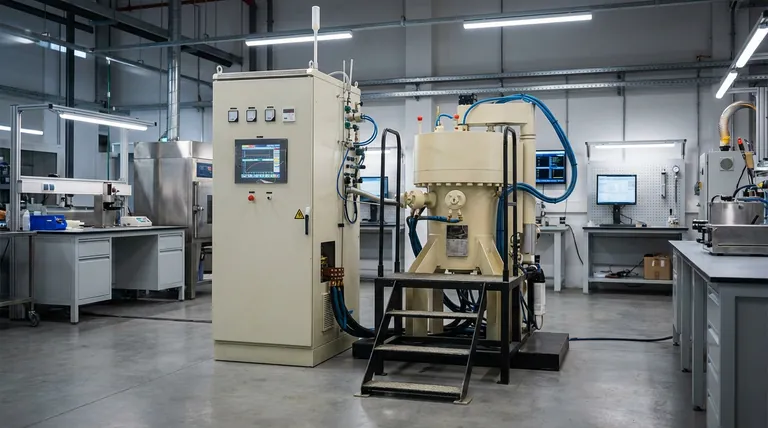
Preserving Material Purity via Atmosphere Control
Preventing Oxidation
High-temperature environments are notoriously aggressive toward metal alloys. Controlled inert atmospheres are introduced into the furnace specifically to shield these materials.
By displacing oxygen, the inert gas prevents the oxidation of sensitive alloys during critical heating stages.
Maintaining Surface Integrity
When oxidation is blocked, the surface chemistry of the component remains pure. This ensures that the material properties of the alloy are preserved throughout the transition from powder to solid part.
Managing Thermal Stress in Complex Geometries
The Role of Automated Cycles
Sintering is not merely about heating; it is about the rate and duration of thermal change. Automated temperature cycles precisely manage the heating, soaking, and cooling phases of the process.
Heating Internal Lattice Structures
Modern components often feature complex geometries and internal lattice structures that are difficult to heat evenly. Automated cycling ensures these intricate areas are heated uniformly along with the bulk material.
Eliminating Distortion
By ensuring uniform heat distribution, the furnace minimizes thermal gradients across the part. This reduction in thermal stress directly prevents distortion, ensuring the component retains its intended shape.
Understanding the Constraints
Dependency on Cycle Precision
While automated cycles are powerful, they require rigorous calibration. If the heating, soaking, or cooling phases are not perfectly tuned to the specific alloy and geometry, the benefits of uniformity are lost.
The Limits of Atmosphere Control
An inert atmosphere is only effective as long as it is fully maintained. Any breach in the controlled environment can lead to immediate oxidation, compromising the entire batch of sensitive alloys.
Making the Right Choice for Your Goal
To maximize the quality of your sintered components, align your process controls with your specific design challenges:
- If your primary focus is complex geometries: Prioritize automated temperature cycles to ensure uniform heating and prevent distortion in internal lattices.
- If your primary focus is material purity: Prioritize controlled inert atmospheres to strictly prevent oxidation in chemically sensitive alloys.
Mastering these two variables allows you to produce complex, high-performance metal parts with reliable dimensional accuracy.
Summary Table:
| Feature | Impact on Sintering Quality | Primary Benefit |
|---|---|---|
| Controlled Atmosphere | Displaces oxygen and prevents surface oxidation | Maintains material purity and chemical integrity |
| Automated Cycles | Regulates heating, soaking, and cooling rates | Ensures uniform thermal distribution across complex geometries |
| Thermal Management | Reduces internal thermal gradients | Prevents distortion and structural failure in lattice structures |
| Inert Shielding | Protects sensitive metal alloys at high temperatures | Preserves surface finish and dimensional accuracy |
Elevate Your Sintering Precision with KINTEK
Don’t let oxidation or thermal distortion compromise your high-performance alloys. KINTEK provides industry-leading thermal solutions tailored for complex material science. Backed by expert R&D and world-class manufacturing, we offer a full range of Muffle, Tube, Rotary, Vacuum, and CVD systems, all fully customizable to meet your specific temperature and atmosphere requirements.
Whether you are processing intricate internal lattices or chemically sensitive alloys, our high-temperature furnaces deliver the reliability and control you need. Contact KINTEK today to find your custom furnace solution and ensure the dimensional accuracy of every part.
Visual Guide

References
- Tobias Rosnitschek, Stephan Tremmel. Dimensional Accuracy and Mechanical Characterization of Inconel 625 Components in Atomic Diffusion Additive Manufacturing. DOI: 10.3390/applmech5020022
This article is also based on technical information from Kintek Furnace Knowledge Base .
Related Products
- Vacuum Heat Treat Sintering Furnace with Pressure for Vacuum Sintering
- Spark Plasma Sintering SPS Furnace
- Vacuum Heat Treat Sintering Furnace Molybdenum Wire Vacuum Sintering Furnace
- Small Vacuum Heat Treat and Tungsten Wire Sintering Furnace
- Vacuum Dental Porcelain Sintering Furnace for Dental Laboratories
People Also Ask
- How does vacuum heat treating affect the grain structure of metal alloys? Achieve Precise Microstructure Control
- What is one of the most important uses of vacuum heat treating furnaces in aerospace? Achieve Superior Strength in Aircraft Alloys
- What are the benefits of using vacuum heat treating furnaces for metal alloys? Achieve Superior Metal Properties and Performance
- What are the key components of a vacuum sintering furnace? Essential Parts for Precision Material Processing
- What is the purpose of setting a mid-temperature dwell stage? Eliminate Defects in Vacuum Sintering



















