
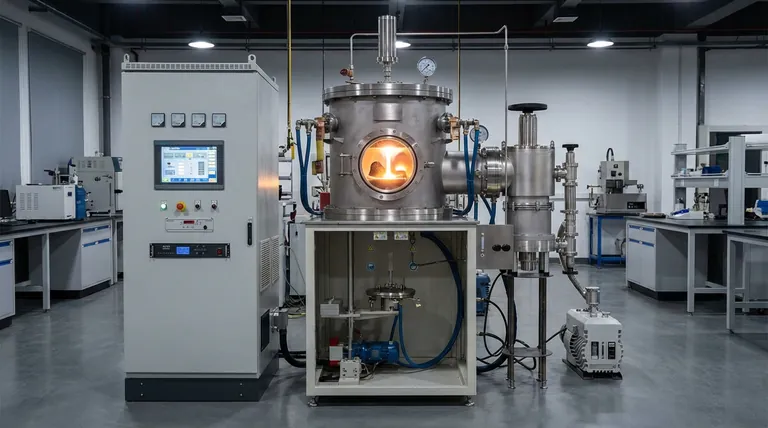
The primary function of a vacuum arc melting furnace is to generate the extreme heat necessary to melt high-melting-point metals while maintaining a strictly controlled, oxygen-free environment. By utilizing high-energy electric arcs within an argon protective atmosphere, the furnace prevents reactive rare earth elements like Yttrium from oxidizing, thereby guaranteeing the chemical accuracy and structural purity of the final high-entropy alloy.
The vacuum arc melting furnace serves as a specialized isolation chamber that allows for the fusion of volatile and refractory metals, ensuring that reactive elements like Yttrium are integrated into the alloy rather than lost to oxidation.
Preserving Chemical Integrity
To understand the necessity of this furnace, one must first understand the vulnerability of the materials involved.
The Role of the Protective Atmosphere
High-entropy alloys frequently incorporate reactive rare earth elements, such as Yttrium, which are highly prone to oxidation at elevated temperatures.
The vacuum arc melting furnace mitigates this risk by replacing the standard atmosphere with a controlled vacuum or inert argon environment.
Ensuring Compositional Accuracy
If oxygen were present during the melting process, reactive elements would chemically degrade, altering the intended formula of the alloy.
By eliminating oxygen, the furnace ensures that the final ingot maintains the precise chemical composition and purity required for advanced material applications.
Achieving Fusion Temperatures
Beyond protection, the furnace provides the raw power needed to process difficult materials.
Overcoming High Melting Points
High-entropy alloys often consist of metals with exceptionally high melting points, such as vanadium and chromium.
The furnace utilizes high-energy electric arcs to generate temperatures extreme enough to liquefy these refractory metals quickly and efficiently.
Localized Heat Generation
The system typically employs non-consumable electrodes to direct intense, localized heat onto the raw materials.
This focused energy ensures the initial fusion of the alloy components, serving as the fundamental step in creating a homogeneous ingot.
Critical Considerations and Trade-offs
While vacuum arc melting is essential for reactive elements, it is important to understand the operational constraints.
Managing Oxidative Loss
Despite the protective atmosphere, the primary risk remains the oxidative loss of active elements like aluminum, titanium, or yttrium if the environment is compromised.
Operators must ensure the inert gas seal is absolute; even minor leaks can result in the loss of expensive rare earth additives.
The Focus on Initial Fusion
The supplementary data notes that this equipment is specifically vital for ensuring the initial fusion of alloy components.
This implies that while it is excellent for the primary melt and consolidation, achieving perfect homogeneity may require specific operational protocols or multiple melting cycles depending on the alloy complexity.
Making the Right Choice for Your Goal
The specific configuration of your melting process should depend on the priority of your final material properties.
- If your primary focus is Chemical Purity: Prioritize the integrity of the argon protective atmosphere to prevent the degradation of reactive elements like Yttrium.
- If your primary focus is Melting Refractory Metals: Rely on the high-energy electric arc capability to liquefy high-melting-point components like Chromium or Vanadium efficiently.
The vacuum arc melting furnace is the definitive tool for converting volatile, high-temperature raw materials into stable, high-purity alloy ingots.
Summary Table:
| Feature | Functionality | Impact on High-Entropy Alloys |
|---|---|---|
| Inert Atmosphere | Replaces oxygen with vacuum or Argon gas | Prevents oxidation of reactive elements like Yttrium |
| Electric Arc Heat | Generates localized, extreme temperatures | Efficiently melts refractory metals (Cr, V, etc.) |
| Chemical Stability | Maintains exact material ratios | Ensures compositional accuracy and high structural purity |
| Initial Fusion | High-energy non-consumable electrodes | Creates a stable, homogeneous ingot from raw components |
Elevate Your Material Research with KINTEK
Precise alloy composition starts with superior environmental control. Backed by expert R&D and world-class manufacturing, KINTEK offers high-performance Vacuum Arc Melting Systems, Muffle, Tube, Rotary, and CVD furnaces—all customizable to meet your unique laboratory requirements.
Whether you are processing reactive rare earth elements or high-melting-point refractory metals, our systems ensure the chemical accuracy and purity your research demands. Contact us today to find the perfect high-temp furnace solution for your lab!
References
- Gökhan Polat, Hasan Kotan. Microstructural Evolution and Mechanical Properties of Y Added CoCrFeNi High-entropy Alloys Produced by Arc-melting. DOI: 10.17350/hjse19030000328
This article is also based on technical information from Kintek Furnace Knowledge Base .
Related Products
- Vacuum Induction Melting Furnace
- Vacuum Heat Treat Sintering and Brazing Furnace
- Small Vacuum Heat Treat and Tungsten Wire Sintering Furnace
- Vacuum Heat Treat Sintering Furnace Molybdenum Wire Vacuum Sintering Furnace
- Vacuum Heat Treat Sintering Furnace with Pressure for Vacuum Sintering
People Also Ask
- What are the core functions of the High Vacuum Induction Melting (VIM) furnace? Optimize DD5 Superalloy Purification
- What are the technical advantages of using a Vacuum Induction Melting furnace in the development of advanced packaging steel?
- What role does a Vacuum Induction Melting furnace play in the production of high-aluminum nickel-based superalloys?
- What is the role of VIM and directional solidification in aero-engine blade substrates? Engineering Extreme Durability
- What are the advantages of using a VIM furnace to control residual oxygen pressure? Achieve Superior Metal Uniformity



















