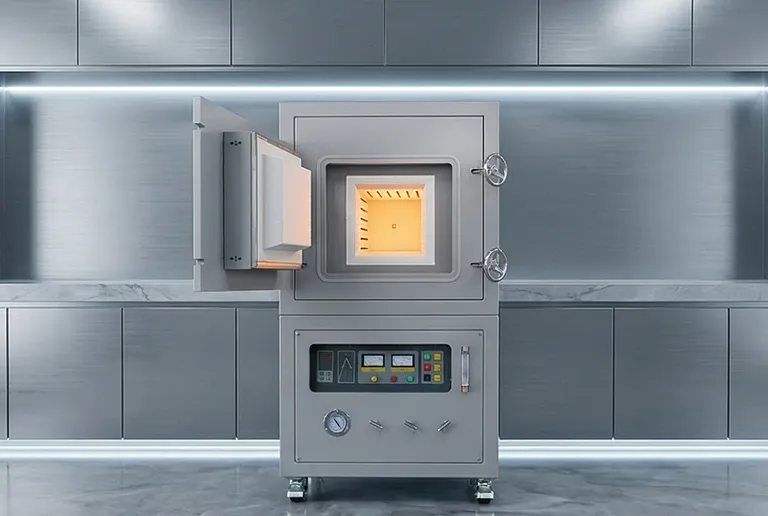
The Frustration of the "Inconsistent Batch"
Imagine this: you have spent weeks optimizing your thermal cycle. Your furnace is set to the exact temperature, and your Ti6Al4V (Grade 5 Titanium) components have been prepared with meticulous care. However, when the batch comes out, the results are baffling. Some parts show the classic golden hue of a perfect Titanium Nitride (TiN) layer, while others are dull or fail the micro-hardness test. Even more frustrating, the "strengthening zone" beneath the surface—the part that actually gives the component its fatigue resistance—is uneven across the load.
In high-stakes industries like aerospace, medical implants, or high-end automotive, these inconsistencies aren't just technical hiccups; they are expensive failures that lead to scrapped parts, missed deadlines, and questions about process reliability.
Why "More Heat" Isn't the Answer
When surface hardness is insufficient, the instinctive reaction is often to increase the processing time or raise the temperature. However, in the gas nitriding of Ti6Al4V, these "brute force" adjustments often backfire.
Over-heating can lead to grain growth in the titanium substrate, compromising the core's mechanical properties. Meanwhile, simply extending the time without controlling the environment leads to a "white layer" that is too brittle, prone to delamination under stress.
The hidden cost of these failed adjustments is high. You aren't just losing nitrogen gas; you are burning through energy, occupying expensive furnace time, and putting the integrity of high-cost titanium alloys at risk. The problem isn't that you aren't "cooking" the parts long enough—it's that the "atmosphere" isn't being managed with the precision the chemistry requires.
The Science of Stability: It’s About "Nitriding Potential"
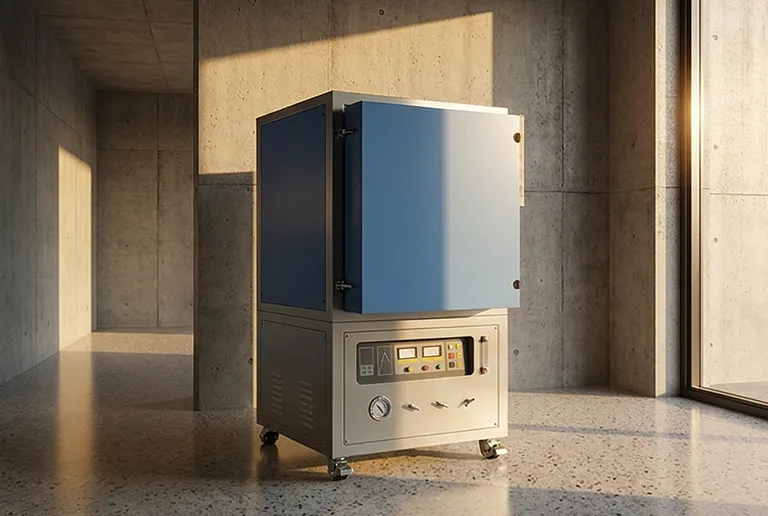
To understand why nitriding fails, we have to look at the interface where the gas meets the metal. Gas nitriding isn't just about surrounding a part with nitrogen; it is a complex chemical exchange.
The quality of the TiN phase and the subsurface interstitial solid-solution layer depends on a specific metric called Nitriding Potential ($K_N$). In a typical process involving a mix of nitrogen and ammonia, $K_N$ must be held at a precise value—for example, $0.254$ at $913 K$—to ensure that active nitrogen atoms are desorbed uniformly onto the surface.
If the gas flow fluctuates even slightly, the partial pressure of the nitrogen shifts. This causes the following:
- Non-uniform Diffusion: Nitrogen atoms don't "push" into the titanium lattice consistently, leading to variations in the strengthening layer's depth.
- Unstable TiN Phase: Instead of a dense, wear-resistant coating, you get a porous or patchy surface.
The "common struggle" of inconsistent results is almost always rooted in a failure to control this gas-flow equilibrium. Without a stable injection of high-purity gas, the subsurface chemistry becomes unpredictable.
Precision Regulators: The Brain of the High-Temperature Furnace
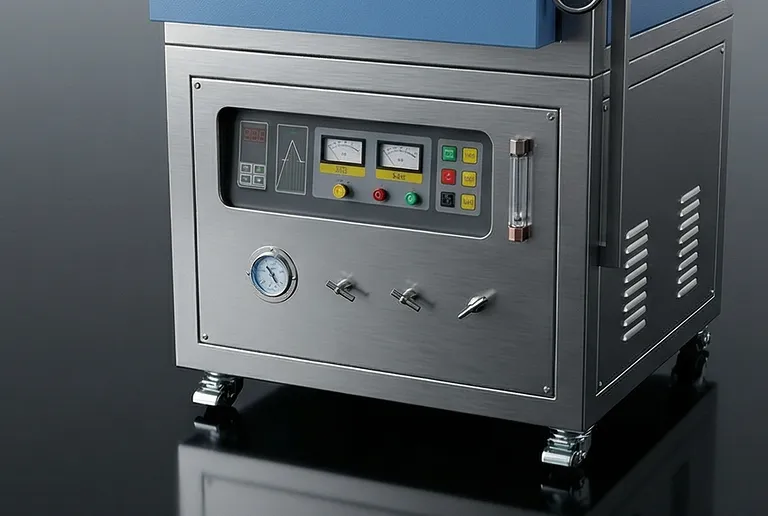
To solve the root cause of instability, you need a system where the gas flow is not a "set and forget" manual valve, but a precision-regulated stream. This is where KINTEK’s advanced atmospheric control comes into play.
Our high-temperature furnaces are engineered with integrated precision gas flow regulators designed specifically to tackle the narrow win-rate of Ti6Al4V nitriding. Here is how they address the fundamental problem:
- Mass Flow Control (MFC): Unlike traditional rotameters that vary with temperature and pressure changes, our regulators maintain a precise nitrogen flow rate (e.g., $1 m^3/h$) and ammonia intake (e.g., $10 L/min$) with digital accuracy.
- Partial Pressure Stability: By accurately controlling the intake ratio, the system stabilizes the nitriding potential. This ensures that every square millimeter of the component surface sees the same concentration of active nitrogen.
- Customizable Atmosphere Zones: Whether you are using a tube furnace for research or a large vacuum furnace for production, our systems can be customized to maintain high-purity nitrogen environments that prevent oxidation—the arch-enemy of titanium nitriding.
Our equipment isn't just a heat source; it is a controlled chemical reactor that ensures the TiN phase grows at a predictable, repeatable rate.
Beyond the Fix: New Possibilities for Titanium Engineering
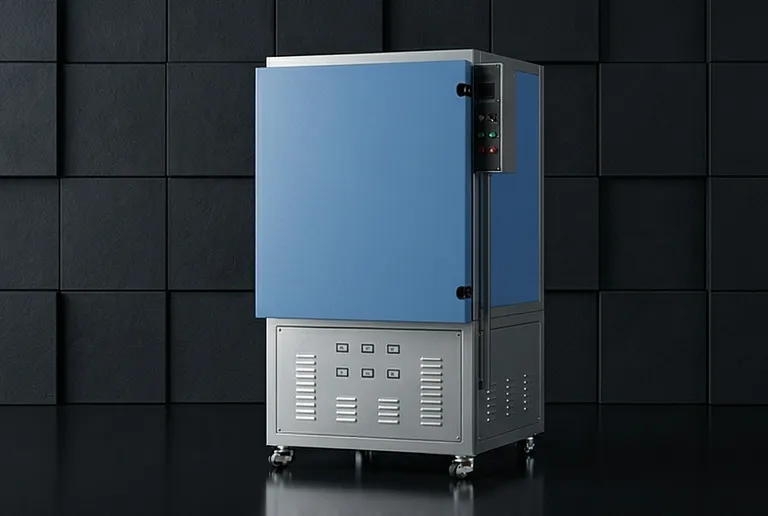
When you move from "variable results" to "precision control," the potential of your laboratory or production line transforms. Solving the stability issue does more than just reduce your scrap rate; it opens doors to higher-tier engineering.
With the ability to precisely control the thickness of the TiN layer and the uniformity of the solid-solution zone, you can now:
- Produce "Thin-Film" Precision: Create ultra-precise wear layers for medical instruments where every micron matters.
- Accelerate R&D: Run experiments with the confidence that your data reflects the material's potential, not the furnace's instability.
- Enhance Fatigue Life: Achieve the exact subsurface strengthening required for aerospace components subject to high cyclic loading.
By mastering the gas flow, you aren't just fixing a process—you are unlocking the full performance potential of Titanium alloys.
At KINTEK, we understand that your work depends on more than just temperature; it depends on the total control of every process variable. Whether you are dealing with inconsistent hardness in Ti6Al4V or looking to upgrade your atmospheric nitriding capabilities, our team of experts is ready to help you design a customized furnace solution that meets your exact technical requirements.
Contact Our Experts today to discuss your project specifications and see how our precision gas control systems can transform your results.
Related Products
- Controlled Inert Nitrogen Hydrogen Atmosphere Furnace
- 1700℃ Controlled Inert Nitrogen Atmosphere Furnace
- 1400℃ Controlled Inert Nitrogen Atmosphere Furnace
- 1200℃ Controlled Inert Nitrogen Atmosphere Furnace
- 2200 ℃ Tungsten Vacuum Heat Treat and Sintering Furnace
Related Articles
- The Invisible Contaminant: Why Your Furnace Atmosphere is Sabotaging Your Results
- Why Your High-Temperature Materials Fail: The Hidden Enemy in Your Furnace
- Why Your High-Temp Experiments Fail: It’s Not the Heat, It’s the Atmosphere
- Why Your Silicon Carbide Ceramics Are Brittle: The Invisible Role of Argon Atmosphere
- Why Your Galfenol Sheets Fail to Recrystallize—And How Precise Atmosphere Control Unlocks High Performance



















