The Frustrating Mystery of the "White Ash" Failure
You have spent weeks perfecting your precursor mix, carefully calculating the ratios of silica and carbon. You place your samples into the high-temperature furnace, confident in your parameters. But when the cooling cycle ends and you open the chamber, the result is a disaster: instead of the dense, high-strength Silicon Carbide (SiC) you expected, you find a brittle, grayish-white mass or a sample riddled with structural voids.
For many materials scientists and engineers, this inconsistency is a common roadblock. Despite following the "recipe" for carbothermal reduction, the final ceramic lacks the mechanical integrity and purity required for high-performance applications. The problem usually isn't the temperature or the dwell time—it is what is happening in the invisible space surrounding your sample.
The Common Struggle: Why "Sealing" Isn't Enough
When faced with poor sintering results or oxidation impurities, the instinctual reaction is often to "tighten the seals" or simply ramp up the heat. Some attempt to use lower-grade inert gases or rely on a standard furnace environment, hoping the volume of raw materials will shield the core from the air.
However, these half-measures lead to a cascade of expensive failures:
- Oxidative Ablation: Carbon components, essential for the formation of SiC, are "burned off" by trace oxygen before they can react.
- Property Degradation: At temperatures exceeding 1500°C, Silicon Carbide reacts readily with oxygen to form Silicon Dioxide (SiO2), fundamentally changing the material's chemistry and destroying its semiconductor or structural properties.
- Equipment Corrosion: In materials like Boron Carbide, oxidation creates volatile oxides (like B2O3) that can actually corrode your furnace’s heating elements, leading to frequent, costly maintenance.
These issues don't just ruin a single batch; they cause project delays, inflated R&D costs, and a lack of confidence in the final product's reliability.
The Root Cause: The High-Temperature Oxygen Trap
To understand why these failures happen, we have to look at the chemistry of the carbothermal reduction reaction. To successfully form high-purity Silicon Carbide, silica and carbon must react in an environment with almost zero oxygen partial pressure.
At the extreme temperatures required for sintering (often 1500°C to 1700°C for SiC fibers and even higher for dense ceramics), oxygen is incredibly aggressive. If even a microscopic amount of oxygen is present, the carbon in your raw material will prioritize reacting with that oxygen over the silica. This results in "oxidation loss," where your carefully balanced stoichiometry is thrown off-balance.
Furthermore, the process of controlled pyrolysis—turning organic resins into carbon-rich ceramic phases—requires the constant removal of volatile impurities. Without a high-purity, moving stream of inert gas, these volatiles can re-deposit on your sample, creating structural defects and "soot" that prevent grain bonding.
The Solution: A Precision-Engineered Argon Environment
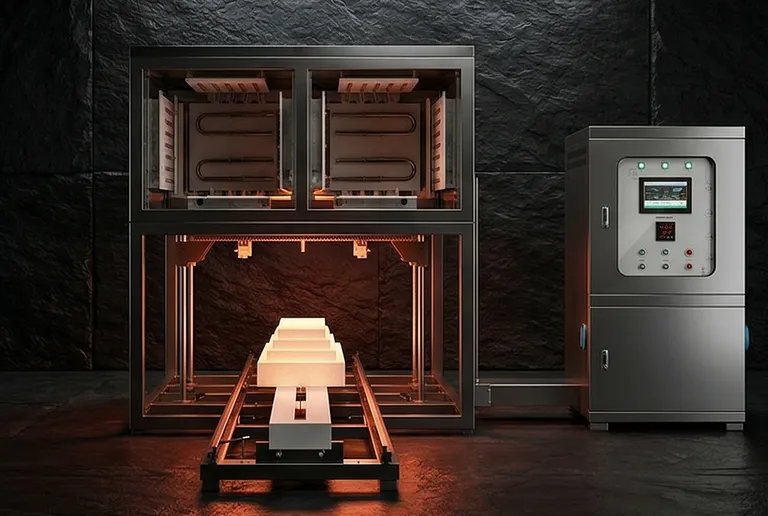
True success in SiC production requires more than just heat; it requires an Atmosphere Tube Furnace designed to act as a high-purity chemical reactor. This is where the KINTEK series of atmosphere furnaces changes the equation.
To solve the root cause of oxidation, our systems provide a controlled Argon (Ar) environment that achieves three critical objectives:
- Total Oxygen Exclusion: By utilizing high-vacuum systems followed by a 99.999% pure Argon purge, the furnace replaces the reactive air with an odorless, colorless, and completely non-reactive shield.
- Chemical Stability: In this inert state, the carbothermal reduction reaction can proceed as intended. Carbon stays in the mix to form SiC rather than escaping as CO2, ensuring high-purity ceramics free of SiO2 impurities.
- Vapor Management: KINTEK’s precise atmosphere control maintains specific flow rates and pressures. This effectively "sweeps" away volatile impurities and dehydrogenation byproducts, ensuring that nothing interferes with the direct bonding between Silicon Carbide grains.
Our furnaces are not just containers for heat; they are tools designed specifically to manage the delicate physics of non-oxide ceramic sintering.
Beyond the Fix: Opening the Door to High-Performance Ceramics
When you eliminate the "hidden variable" of atmospheric contamination, your lab’s potential expands. By mastering the Argon environment with a KINTEK atmosphere tube furnace, you move from "troubleshooting" to "innovating."
With consistent, oxygen-free sintering, you can achieve the ultra-high densities required for aerospace components, the high-purity phases needed for semiconductor wafers, and the chemical stability essential for advanced SiC fibers. You can reduce your sintering cycles, eliminate material waste, and produce ceramics that meet the most stringent industry standards.
Solving the oxidation problem is the first step toward the next generation of material science. Whether you are working on nitrogen-doped carbon skeletons or boron carbide densification at 2300°C, the foundation of your success is a controlled environment.
Ready to eliminate oxidation and achieve the ultimate purity in your ceramic sintering? Our technical team specializes in customizing atmosphere and vacuum solutions for the most challenging high-temperature processes. Contact us today to discuss how we can tailor a furnace system to your specific research or production requirements.
Related Products
- 1400℃ Controlled Inert Nitrogen Atmosphere Furnace
- 1700℃ Controlled Inert Nitrogen Atmosphere Furnace
- Controlled Inert Nitrogen Hydrogen Atmosphere Furnace
- 1200℃ Controlled Inert Nitrogen Atmosphere Furnace
- Mesh Belt Controlled Atmosphere Furnace Inert Nitrogen Atmosphere Furnace
Related Articles
- Why Your Galfenol Sheets Fail to Recrystallize—And How Precise Atmosphere Control Unlocks High Performance
- Why Your High-Temperature Materials Fail: The Hidden Enemy in Your Furnace
- The Hidden Flaw in Your Heat Treatment: It’s Not the Temperature, It’s the Air
- Why Your High-Temp Experiments Fail: It’s Not the Heat, It’s the Atmosphere
- Beyond the Alarm: The Hidden Safety Risks in Your High-Temperature Furnace



















