The High-Stakes Failure of "Close Enough"
Imagine this: your team has spent weeks casting or machining critical components from Inconel 713C. This nickel-based superalloy is the backbone of high-stress environments like gas turbine blades and turbocharger rotors. It is chosen specifically for its ability to withstand extreme temperatures without deforming—a property known as creep resistance.
However, during final quality testing, the batch fails. The mechanical properties are brittle, or the material fails the creep test at a fraction of its expected lifespan. You checked the furnace settings; the display read 1170°C. In the world of industrial manufacturing, being off by less than 1% usually doesn't spell disaster. But with superalloys, "close enough" is the recipe for catastrophic failure.
The Common Struggle: Why Standard Heat Treatment Isn't Enough
When faced with inconsistent material properties, many labs and manufacturers attempt to "brute force" the solution. They might increase the "soak time," hoping that longer exposure to heat will fix the issue. Or, they might try to calibrate their equipment based on external sensors that don't reflect the actual environment inside the furnace tube.
The results of these struggles are often costly:
- Wasted High-Value Material: Inconel is expensive; scrapping a batch is a significant financial hit.
- Project Delays: Failed tests mean restarting the casting and heat treatment cycles, pushing back delivery dates for aerospace or energy clients.
- Geometric Integrity Issues: Without precise ramp rates, parts can accumulate residual stress, leading to warping or cracking when they are finally integrated into a system.
The frustration stems from a simple misunderstanding: heat treatment isn't just about getting the part "hot"; it is about precision-engineering the material’s microscopic architecture.
The Root of the Problem: The Gamma Prime Battleground
To understand why Inconel 713C is so demanding, we have to look at its microstructure. Its strength comes primarily from a "strengthening phase" called gamma prime ($\gamma'$).
For Inconel 713C to achieve its legendary creep resistance, it must undergo a Solution and Stabilization treatment. This requires maintaining a precise and uniform temperature of exactly 1176°C.
Here is what is happening at the atomic level:
- Full Dissolution: At 1176°C, the gamma prime phases must fully dissolve into the nickel matrix. If the furnace is even slightly too cool, these phases don't dissolve completely, leaving "clumps" that act as weak points.
- Controlled Precipitation: If the furnace has "cold spots" or "hot spots" (thermal gradients), the subsequent precipitation of these phases happens unevenly.
- The Oxidation Trap: Inconel 713C contains active elements like Aluminum and Titanium. If your furnace cannot maintain a high-purity inert atmosphere (like Argon) or a vacuum, these elements will oxidize at high temperatures. This ruins the chemical purity of the alloy and compromises its foundational mechanical properties.
Standard furnaces often lack the thermal uniformity and atmosphere seal integrity to manage these variables. When the temperature fluctuates, the microstructure evolves in ways you didn't intend, resulting in a part that looks right on the outside but is structurally compromised on the inside.
The Solution: Precision Engineering for Precision Alloys
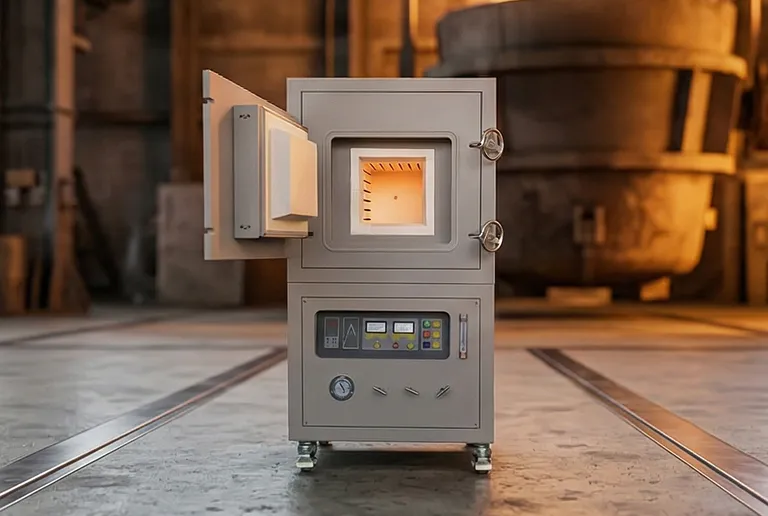
To solve the root cause of superalloy failure, you need a tool designed for the specific physics of the 1176°C threshold. This is where a High-Precision Industrial Tube Furnace becomes an essential investment rather than just a piece of lab equipment.
The KINTEK range of industrial tube furnaces is engineered to address the "invisible" variables that ruin Inconel 713C treatments:
- Zonal Uniformity: Unlike standard muffle furnaces, our tube furnaces provide a highly controlled "constant temperature zone." This ensures that every millimeter of your Inconel part experiences the exact 1176°C required for gamma prime dissolution.
- Atmospheric Integrity: Our systems are designed to maintain high-purity Argon or Nitrogen environments. By effectively excluding oxygen, we prevent the oxidation of the stainless steel matrix and critical alloying elements, ensuring your sintered or treated microstructure meets the strictest design requirements.
- Programmed Thermal Cycles: Precision isn't just about the peak temperature; it’s about the journey. Our controllers allow for exact heating rates (such as 2°C per minute), which is critical for preventing thermal shock and managing the precursor conversion of complex materials.
Beyond the Fix: Unlocking New Engineering Potential
When you move from "fighting the furnace" to "mastering the environment," the possibilities for your laboratory or production line expand significantly.
By achieving total control over the Solution Treatment and Aging (STA) process, you can do more than just pass a QC test. You can:
- Optimize Creep Life: Fine-tune the morphology of precipitates (moving from granular to needle-like shapes) to push the limits of material longevity.
- Integrate Additive Manufacturing: Use precise stress-relief annealing to stabilize 3D-printed Inconel 625 or 718 parts before they are even removed from the build plate.
- Accelerate Innovation: With predictable, repeatable results, your R&D team can focus on developing new alloy compositions or ceramic precursors (like SiCN/BN) rather than troubleshooting why the last batch failed.
Mastering Inconel 713C is not about luck; it is about providing the atoms with the exact environment they need to align.
At KINTEK, we understand that your work involves more than just heat—it involves the future of aerospace, energy, and advanced manufacturing. Whether you need a customizable vacuum induction furnace for oxygen-free melting or a high-precision tube furnace for stabilizing superalloys, our team is ready to help you solve your most complex thermal processing challenges. Contact Our Experts today to discuss how we can bring precision to your next project.
Related Products
- 2200 ℃ Graphite Vacuum Heat Treat Furnace
- 2200 ℃ Tungsten Vacuum Heat Treat and Sintering Furnace
- 1700℃ Controlled Inert Nitrogen Atmosphere Furnace
- Molybdenum Vacuum Heat Treat Furnace
- 1400℃ High Temperature Laboratory Tube Furnace with Alumina Tube
Related Articles
- Why Your Ti-6Al-4V Parts Crack Under Pressure—The Hidden Science of Vacuum Heat Treatment
- Why Your High-Strength Titanium Biomaterials Are Brittle—and How Vacuum Heat Treatment Fixes It
- The Unseen Failure Point: Why Your Vacuum Furnace's Graphite Is Costing You More Than You Think
- Why Your 3D-Printed Maraging Steel Parts Aren't Performing—And How to Fix the Structural Weakness
- The Art of Absence: How Vacuum Furnaces Forge Material Perfection



















