The Titanium Paradox: Strength That Shatters
You chose titanium for your biomaterial project because of its legendary strength-to-weight ratio and biocompatibility. But after the final heating cycle, the result is a disappointment: the material is brittle, the surface is discolored, and it fails the most basic stress tests.
In the world of high-performance alloys, titanium is a "double-edged sword." At room temperature, it is incredibly stable. However, as soon as you apply the heat necessary for shaping or strengthening, it becomes one of the most reactive elements on the periodic table. If your lab is struggling with inconsistent mechanical properties or unexpected material failure, the culprit isn't your alloy—it’s likely your heating environment.
The Cost of "Almost Pure" Environments
Many researchers attempt to solve material inconsistencies by using standard furnaces or basic inert gas shields. Unfortunately, titanium has such a high affinity for oxygen, nitrogen, and hydrogen at elevated temperatures that even "trace" amounts of these gases in the atmosphere lead to catastrophic results.
When these elements penetrate the titanium surface, they create an "alpha case"—a hard, brittle layer that acts as a site for crack initiation. For a medical implant or a high-strength aerospace component, this isn't just a technical flaw; it’s a liability. The business consequences are clear: wasted batches of expensive raw materials, failed quality audits, and months of R&D delays as teams struggle to identify why their "high-strength" material is behaving like glass.
The Root Cause: Why Surface Cleaning Isn’t Enough
To understand why titanium fails, we have to look at the crystal lattice. High-strength titanium-based biomaterials often rely on "solid solution strengthening." This process requires zirconium and oxygen atoms to migrate and dissolve completely into the alpha-Ti matrix.
If the temperature or timing is slightly off—or if external contaminants are present—two things happen:
- Atom Enrichment Zones: Instead of migrating uniformly throughout the lattice, atoms cluster in localized zones. This creates "gradients" in the material, where some areas are strong and others are weak.
- Atmospheric Contamination: Oxygen and nitrogen from the air don't just stay on the surface; they integrate into the metal, causing irreversible embrittlement.
Standard heating methods cannot provide the "thermal activation energy" needed for uniform migration while simultaneously isolating the metal from the air. Without a high-vacuum environment, you are effectively "baking" impurities into your high-performance material.
The Solution: Precision Engineering Through Vacuum Heat Treatment
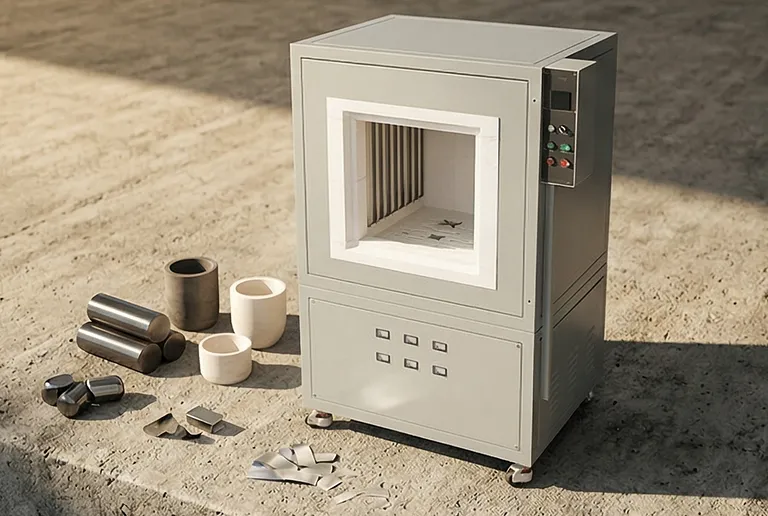
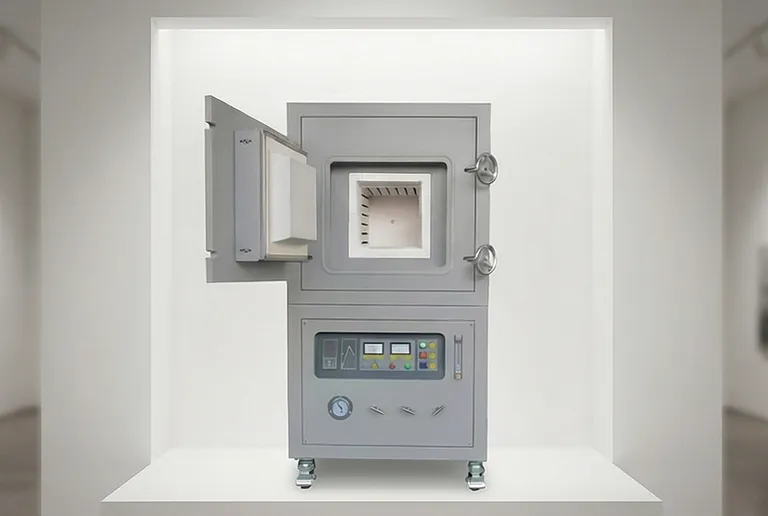
Solving this problem requires more than just a hot box; it requires a controlled environment where the laws of physics work in your favor. A high-temperature vacuum furnace acts as a protective sanctuary for the material.
By reducing the partial pressure of oxygen and nitrogen to near-zero levels, a vacuum furnace achieves three critical goals:
- Absolute Purity: It isolates the titanium foil or alloy from atmospheric gases, ensuring the reaction interface remains clean and the material’s natural ductility is preserved.
- Forced Diffusion: To achieve a uniform grain structure (often around 65 micrometers), the material must be held at precise temperatures, such as 973 K, for extended periods. The vacuum environment allows for long-duration "soaks"—sometimes up to 24 hours—without the risk of oxidation.
- Phase Transformation: For parts made via additive manufacturing (3D printing), rapid cooling often creates "alpha prime martensite," a brittle phase. Vacuum heat treatment at 800°C allows this martensite to decompose into stable alpha and beta phases, restoring toughness to the final part.
At KINTEK, our vacuum furnaces are engineered specifically for these delicate balances. Whether it is a rotary, tube, or customized muffle furnace, we provide the uniform thermal field necessary to eliminate residual stresses and ensure consistent mechanical properties from the core to the surface.
Beyond the Fix: Unlocking the Future of Biomaterials
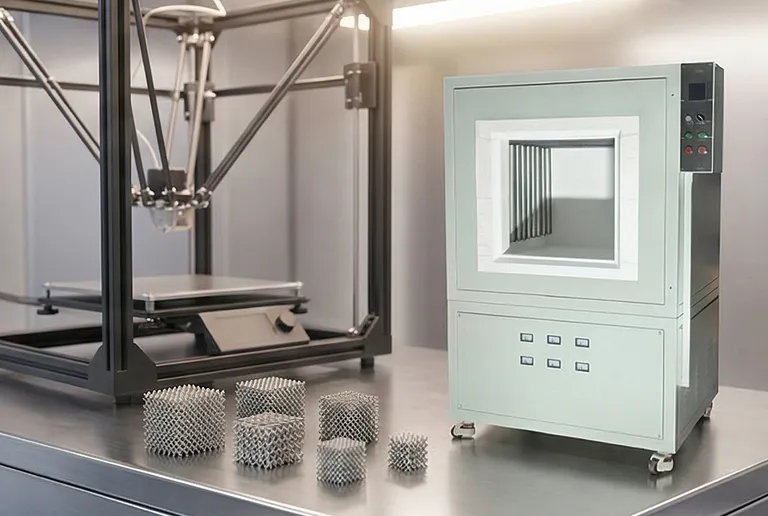
When you master the environment, you master the material. By eliminating the variable of contamination, your lab can move past "troubleshooting" and into true innovation.
With a reliable vacuum heat treatment process, you can achieve surface brightness that requires no secondary polishing. You can produce complex, 3D-printed titanium scaffolds that possess the fatigue strength of forged parts. Most importantly, you gain the confidence that every batch of material will meet the rigorous standards required for life-critical applications.
The path to high-performance biomaterials isn't just about the alloy you choose—it's about the precision of the thermal environment you create.
Mastering the complexities of titanium and other reactive alloys requires more than off-the-shelf equipment; it requires a partner who understands the underlying science of heat treatment. At KINTEK, we don't just supply furnaces; we provide the controlled environments that turn your most ambitious R&D goals into scalable, high-quality realities. Whether you are dealing with embrittlement issues, phase transformation challenges, or need a custom solution for a unique material, our team is ready to help you optimize your process. Contact Our Experts today to discuss how we can support your next breakthrough.
Related Products
- 2200 ℃ Graphite Vacuum Heat Treat Furnace
- 2200 ℃ Tungsten Vacuum Heat Treat and Sintering Furnace
- Molybdenum Vacuum Heat Treat Furnace
- Vacuum Heat Treat Sintering Furnace Molybdenum Wire Vacuum Sintering Furnace
- 9MPa Air Pressure Vacuum Heat Treat and Sintering Furnace
Related Articles
- Why Your Ti-6Al-4V Parts Crack Under Pressure—The Hidden Science of Vacuum Heat Treatment
- The Unseen Failure Point: Why Your Vacuum Furnace's Graphite Is Costing You More Than You Think
- Why Your 3D-Printed Maraging Steel Parts Aren't Performing—And How to Fix the Structural Weakness
- The Art of Absence: How Vacuum Furnaces Forge Material Perfection
- Strength in the Heat: The Counterintuitive Physics of Graphite in Vacuum Furnaces



















