The Unseen Architect of Perfection
Imagine a single turbine blade for a jet engine. It's a masterpiece of metallurgy, designed to spin thousands of times per minute in a storm of fire. Its final, flawless properties are forged at temperatures that would turn most metals into molten puddles.
We obsess over the alloy, the design, the final product. But we rarely ask a simpler question: in the heart of the furnace, what is holding it? What cradle can withstand such hellish heat without warping, sagging, or contaminating the very part it’s meant to perfect?
The answer isn't some exotic superalloy. It's a refined form of carbon—graphite. This is a common psychological blind spot in engineering; we see the outcome, but we overlook the environment that makes it possible. In high-temperature processing, graphite is that environment.
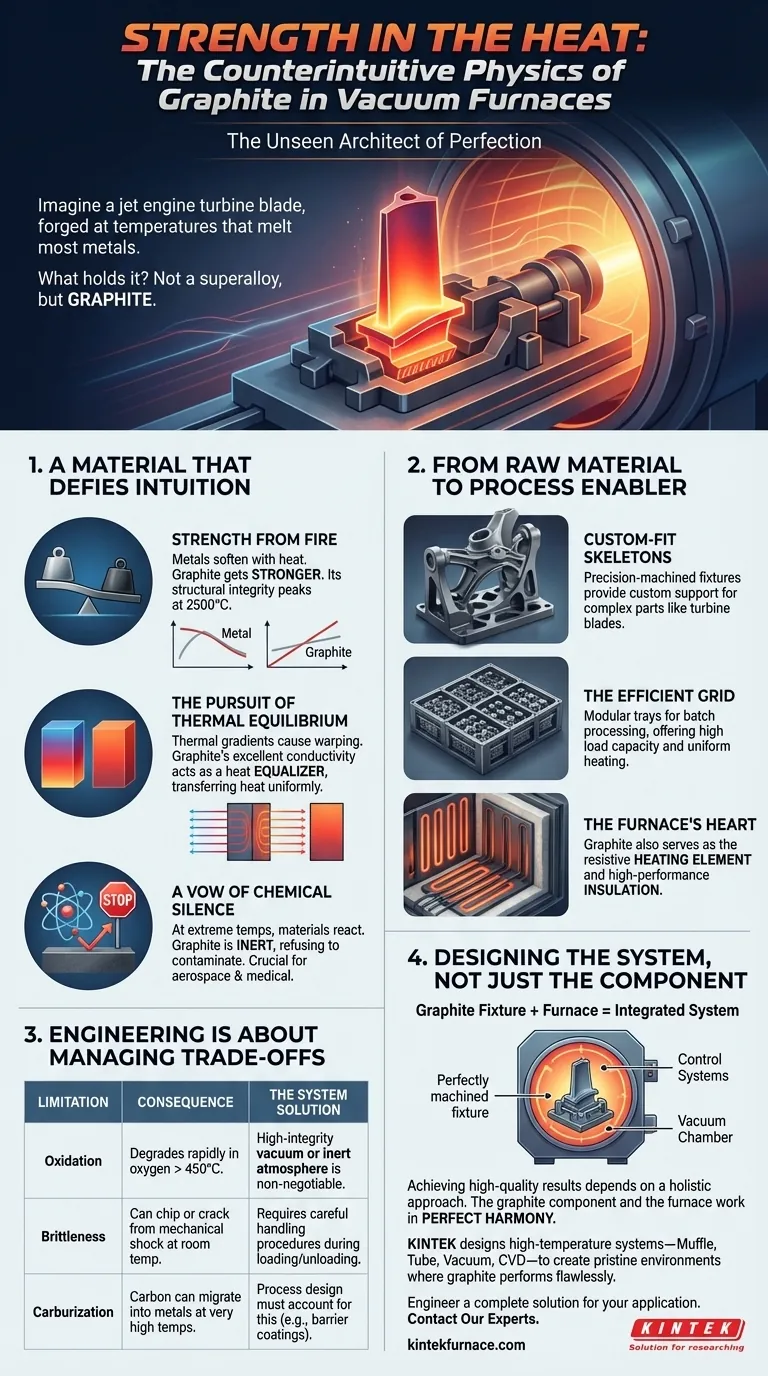
A Material That Defies Intuition
The reason graphite dominates the internal landscape of vacuum furnaces is that it solves the fundamental challenges of high-temperature metallurgy: dimensional stability, thermal uniformity, and chemical purity. It does this through properties that are often counterintuitive.
Strength from Fire
Metals soften as they get hot. It’s a foundational concept. We heat them to bend, forge, and shape them.
Graphite does the opposite.
Its structural integrity and tensile strength actually increase with temperature, peaking at an astonishing 2500°C. A fixture that seems brittle at room temperature becomes a titan of strength when it matters most. This means that a precisely machined graphite support holding a heavy component will not fail mid-cycle. It gets stronger for the task.
The Pursuit of Thermal Equilibrium
Internal stress is the enemy of a perfect part. It's caused by uneven temperatures—thermal gradients—that make different parts of a component expand or contract at different rates, leading to warping or cracking.
Graphite's excellent thermal conductivity acts as a great equalizer. It rapidly and uniformly transfers heat from the furnace’s elements, through the fixture, and into the workpiece. This minimizes thermal gradients, ensuring the entire part heats and cools as one cohesive unit.
A Vow of Chemical Silence
At extreme temperatures, atoms become agitated and eager to react. Processing highly reactive materials like titanium or certain superalloys is like trying to have a confidential conversation in a crowded room.
Graphite is the one material that takes a vow of silence. It is remarkably inert, refusing to react with or leach contaminants into the workpiece. This chemical purity is non-negotiable for aerospace and medical applications, where even parts-per-million contamination can lead to catastrophic failure.
From Raw Material to Process Enabler
These unique properties are not just theoretical advantages. They translate directly into the physical components that form the heart of a high-temperature furnace system.
- Custom-Fit Skeletons (Fixtures & Supports): Because graphite is easily machined, it can be crafted into intricate fixtures that provide precise, custom support for complex parts like turbine blades or medical implants, preventing distortion.
- The Efficient Grid (Trays & Racks): For batch processing smaller parts in sintering applications, modular graphite trays and racks provide the perfect combination of load capacity and uniform heating.
- The Furnace's Heart (Heating Elements & Insulation): In many advanced furnace designs, graphite plays a dual role. It serves as the resistive heating element itself, and in felt form, it becomes the high-performance insulation lining the hot zone.
Engineering is About Managing Trade-offs
No material is perfect. Acknowledging graphite’s limitations is key to designing a successful and reliable process. Its strengths are magnified in the right environment, but it has weaknesses that must be managed.
| Limitation | Consequence | The System Solution |
|---|---|---|
| Oxidation | Graphite rapidly degrades in the presence of oxygen above 450°C. | A high-integrity vacuum or inert atmosphere is not optional; it's the core operating principle. |
| Brittleness | At room temperature, it can chip or crack from mechanical shock. | Requires careful handling procedures during loading and unloading. |
| Carburization | Carbon can migrate into certain metals at very high temperatures. | Process design must account for this, sometimes using ceramic barrier coatings or precise controls. |
Designing the System, Not Just the Component
The critical insight is that the graphite fixture and the furnace are not separate entities. They are a single, integrated system.
A perfectly machined graphite support is useless in a furnace that cannot hold a deep vacuum. Uniform heating depends as much on the furnace's control systems and hot zone design as it does on the fixture's conductivity. Preventing contamination requires both high-purity graphite and a clean, leak-tight furnace chamber.
This is why achieving repeatable, high-quality results depends on a holistic approach. At KINTEK, we design high-temperature systems—from Muffle and Tube Furnaces to advanced Vacuum and CVD systems—built to create the pristine, controlled environments where materials like graphite can perform their function flawlessly. Our expertise in deep customization ensures that the furnace, its internal graphite components, and your unique process parameters work in perfect harmony.
Ultimately, perfecting advanced materials is about total control over the environment. Graphite provides the stable, silent stage, but a high-performance, purpose-built furnace directs the play. If you're ready to engineer a complete solution for your high-temperature application, Contact Our Experts.
Visual Guide
Related Products
- 2200 ℃ Graphite Vacuum Heat Treat Furnace
- Vacuum Hot Press Furnace Machine Heated Vacuum Press
- Molybdenum Vacuum Heat Treat Furnace
- Dental Porcelain Zirconia Sintering Ceramic Vacuum Press Furnace
- Vacuum Dental Porcelain Sintering Furnace for Dental Laboratories
Related Articles
- Why Your Ti-6Al-4V Parts Crack Under Pressure—The Hidden Science of Vacuum Heat Treatment
- Why Your High-Strength Titanium Biomaterials Are Brittle—and How Vacuum Heat Treatment Fixes It
- The Unseen Failure Point: Why Your Vacuum Furnace's Graphite Is Costing You More Than You Think
- Why Your 3D-Printed Maraging Steel Parts Aren't Performing—And How to Fix the Structural Weakness
- The Art of Absence: How Vacuum Furnaces Forge Material Perfection



















