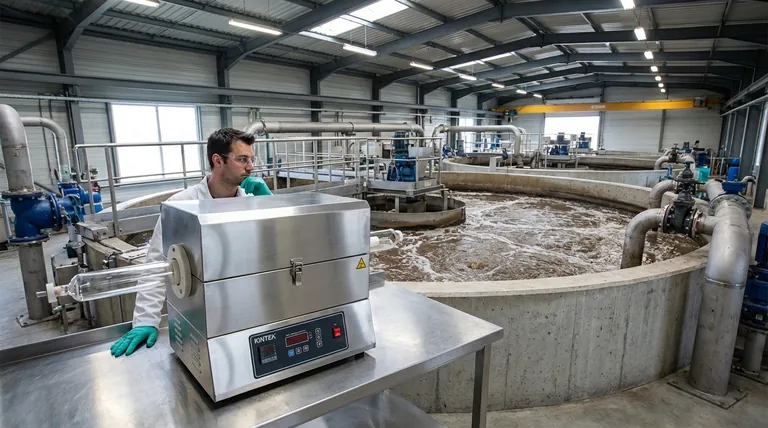
The Right Tool for the Wrong Job
An engineer faces a persistent pollutant in an industrial waste stream—a "forever chemical" that resists conventional treatment. In the corner of the lab sits a powerful tool: a high-temperature tube furnace, capable of reaching temperatures that can break any organic bond.
The thought is immediate and tempting: Can we just burn the problem away?
This is a classic case of the "law of the instrument," the cognitive bias where we favor familiar tools for every problem we encounter. The instinct is logical, but applying a high-precision thermal instrument to a bulk liquid problem reveals a fundamental misunderstanding of physics, economics, and scale. It's an elegant solution for an entirely different problem.
The Unforgiving Physics of Water
The primary obstacle isn't the pollutant; it's the water itself. Applying a tool designed for controlled reactions on solids or gases to a massive volume of liquid runs into several non-negotiable physical laws.
The Tyranny of Specific Heat
Water has an incredibly high specific heat capacity. This means it requires a colossal amount of energy to raise its temperature by even one degree.
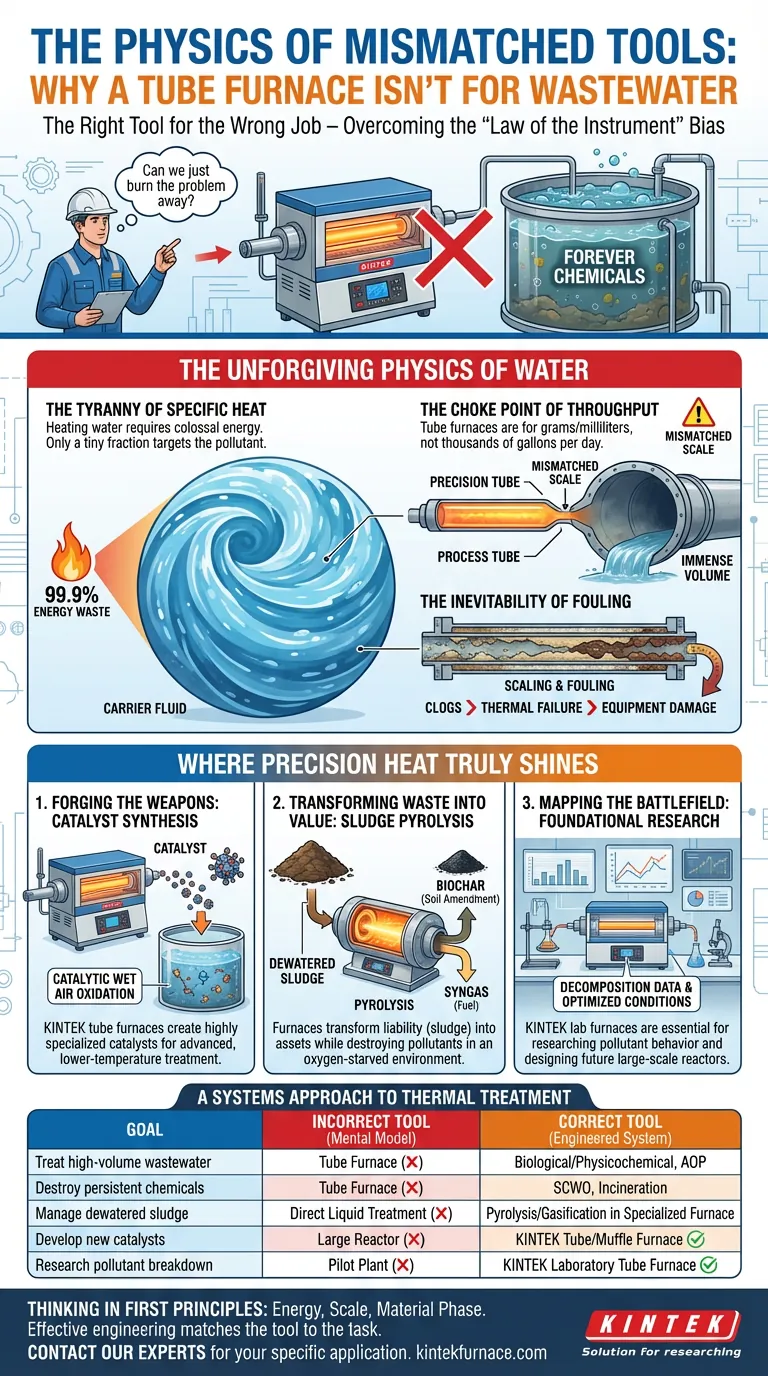
When you heat wastewater in a furnace, over 99.9% of your energy and operational cost is spent just heating the water—the carrier fluid. The actual contaminants are a tiny fraction of the mass. It's the equivalent of trying to eliminate a single line of text in a book by burning the entire library. It's brutally inefficient and economically impossible at any meaningful scale.
The Choke Point of Throughput
Tube furnaces are instruments of precision, not volume. Their process tubes are narrow, designed for controlled reactions on grams or milliliters of material.
Wastewater treatment plants, in contrast, are systems of immense volume, processing thousands or millions of gallons per day. The physical design of a tube furnace is fundamentally mismatched for this high-throughput world. It's like trying to drain a lake with a laboratory pipette.
The Inevitability of Fouling
Wastewater is a soup of dissolved minerals, salts, and organic compounds. As you heat it, these substances precipitate and solidify, a process known as scaling or fouling.
This mineral buildup would rapidly clog the narrow process tube of the furnace. The result is a cascade of failures: blockages, catastrophic drops in thermal efficiency, and ultimately, equipment damage. It’s a guaranteed failure mode.
Where Precision Heat Truly Shines
So, if a tube furnace isn't for direct liquid treatment, what is its role in the environmental sector? Its value lies not in brute-force application, but in enabling more sophisticated, targeted solutions. This is where its precision becomes its greatest strength.
1. Forging the Weapons: Catalyst Synthesis
Many advanced wastewater treatments, like catalytic wet air oxidation, depend on highly specialized catalysts to break down pollutants efficiently at lower temperatures.
A KINTEK tube furnace is the perfect environment for creating these materials. It provides the exact high-temperature, atmospherically controlled conditions needed to synthesize complex catalytic compounds. In this role, the furnace doesn't treat the water; it creates the key that unlocks the chemical solution.
2. Transforming Waste into Value: Sludge Pyrolysis
Wastewater treatment creates sludge, a semi-solid byproduct. Once dewatered, this sludge is a perfect candidate for thermal processing.
In a furnace, sludge can be heated in an oxygen-starved environment (pyrolysis) to create valuable products like biochar (a soil amendment) or syngas (a fuel). Here, a furnace like a KINTEK rotary or tube furnace transforms a liability into an asset, destroying pollutants while recovering value.
3. Mapping the Battlefield: Foundational Research
In the laboratory, the tube furnace is an indispensable research tool. Scientists use it to answer the most fundamental questions: At what temperature and under what conditions does this new pharmaceutical pollutant decompose?
This data, gathered in the controlled environment of a precision KINTEK lab furnace, is essential for designing the next generation of large-scale, purpose-built reactors. It provides the map before the real battle begins.
A Systems Approach to Thermal Treatment
Choosing the right technology requires matching the tool to the specific waste stream, volume, and goal. The mistake is not in considering thermal treatment, but in failing to see it as a diverse field of specialized tools.
| Goal | Incorrect Tool (Mental Model) | Correct Tool (Engineered System) |
|---|---|---|
| Treat high-volume, dilute wastewater | Tube Furnace | Biological/Physicochemical treatment, Advanced Oxidation |
| Destroy persistent chemicals in a concentrated stream | Tube Furnace | Supercritical Water Oxidation (SCWO), Incineration |
| Manage and reduce dewatered waste sludge volume | Direct Liquid Treatment | Pyrolysis or gasification in a specialized furnace/reactor |
| Develop new catalysts for advanced treatment | A Large Reactor | A high-precision KINTEK Tube or Muffle Furnace |
| Research thermal breakdown of a new pollutant | A Pilot Plant | A highly controllable KINTEK Laboratory Tube Furnace |
Thinking in first principles—of energy, scale, and material phase—is what separates effective engineering from costly failure. The power of a tool is not in its brute strength, but in its proper application.
Whether you are developing next-generation catalysts, researching pollutant decomposition, or optimizing sludge-to-value processes, having the right thermal equipment is non-negotiable. Contact Our Experts to discuss your specific application.
Visual Guide
Related Products
- Vacuum Sealed Continuous Working Rotary Tube Furnace Rotating Tube Furnace
- 1400℃ High Temperature Laboratory Tube Furnace with Alumina Tube
- 1700℃ High Temperature Laboratory Tube Furnace with Alumina Tube
- Magnesium Extraction and Purification Condensing Tube Furnace
- High Pressure Laboratory Vacuum Tube Furnace
Related Articles
- Beyond Heat: Mastering the Controlled Universe Inside a Tube Furnace
- Mastering the Void: How Tube Furnaces Forge the Atoms of Innovation
- Why Your Crystal Growth Experiments Are Failing: The Hidden Culprit in Your Tube Furnace
- The Art of Isolation: Mastering Material Properties with Tube Furnaces
- Beyond Heat: The Art of Control in a Tube Furnace



















