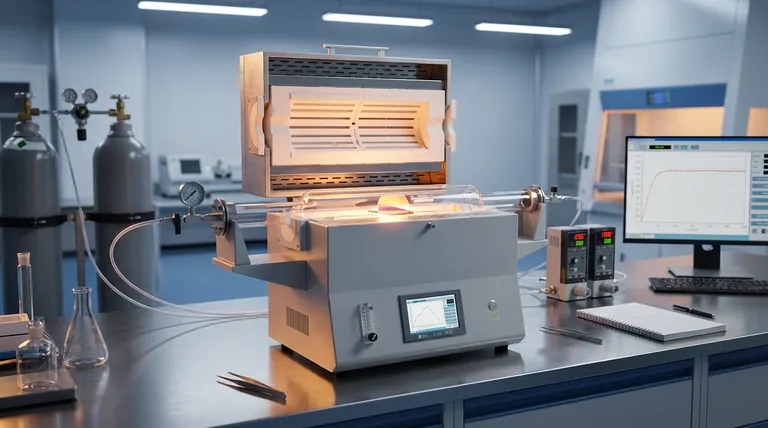
The Enemy of Innovation Isn't Failure; It's Uncontrolled Variables
Imagine a materials scientist on the verge of a breakthrough. Their goal is to grow a perfect single crystal, one with a flawless lattice structure that could revolutionize semiconductor technology. Their biggest obstacle isn't a flaw in their theory, but a stray oxygen molecule, an imperceptible temperature fluctuation, or an unknown contaminant in the process chamber.
This is the central challenge in advanced material processing. Success doesn't just hinge on reaching a high temperature. It hinges on creating a perfect, isolated universe where a reaction can unfold exactly as intended. The choice of equipment, therefore, becomes a psychological one—a decision to invest in control and eliminate the chaos of uncertainty.
Heat is Easy, Control is Hard
Any insulated box with a heating element can get hot. A simple muffle furnace does this job brilliantly for countless applications. But a tube furnace is chosen for a fundamentally different reason.
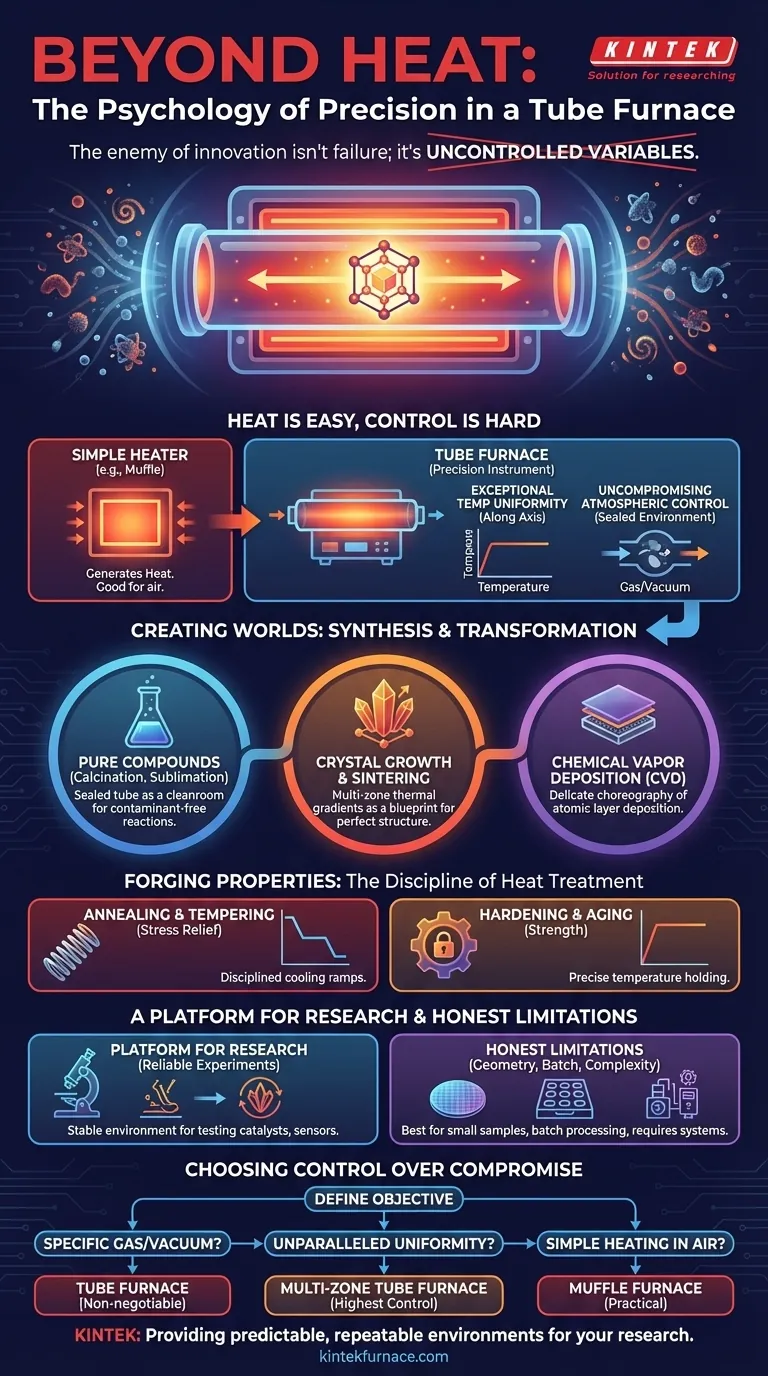
Its value lies not in its ability to generate heat, but in its unique power to command the environment within its enclosed tubular chamber. It offers two things that are paramount for sensitive work: exceptional temperature uniformity along a defined axis and uncompromising atmospheric control. This combination is what transforms a simple heater into a precision instrument.
Creating Worlds: Synthesis and Transformation
The core purpose of a tube furnace is to use heat to alter a material's state in a meticulously controlled setting. It’s a chemical reactor designed for purity and precision.
From Raw Elements to Pure Compounds
Synthesizing a new inorganic compound or purifying an existing one is like performing surgery. You cannot work in an unsterile environment. The sealed tube of the furnace acts as a cleanroom, allowing reactant gases to be introduced and byproducts to be contained or vented without contamination. Processes like calcination and sublimation depend on this hermetically sealed world.
The Architecture of a Crystal
Growing a high-quality crystal or sintering a powder into a dense solid is an act of construction. It requires a stable foundation and a precise blueprint. A multi-zone tube furnace provides the exact thermal gradients—the blueprint—needed to guide crystallization or ensure a powder densifies uniformly, preventing cracks and defects. Any fluctuation is a crack in the foundation.
Layering the Future with Chemical Vapor Deposition (CVD)
CVD is perhaps the ultimate expression of control. In this process, precursor gases flow through the heated tube and decompose to deposit an ultra-thin film, one atomic layer at a time, onto a substrate. The tube furnace becomes the reaction chamber where this delicate choreography happens, forming the backbone of the semiconductor and optics industries.
Forging Properties: The Discipline of Heat Treatment
A material's final properties are often determined not by its composition alone, but by its thermal history. Heat treatment is a disciplinary regimen that instills strength, ductility, or hardness.
- Annealing and Tempering: These processes are about relieving stress. They require heating a material to a precise temperature and, crucially, cooling it along a controlled, often slow, trajectory. A programmable tube furnace executes these cooling ramps with perfect discipline.
- Hardening and Aging: These treatments are designed to lock in strength by manipulating a material's microstructure. They demand holding a material at an exact temperature for a specific duration. The stability of a tube furnace ensures the process is held to account.
The Search for Truth: A Platform for Research
In a laboratory, the tube furnace is the stage upon which reliable experiments are performed. Its controlled environment is the constant against which variables can be truly tested.
When researchers test a new catalyst, they need to pass a specific gas mixture over it at a stable temperature. The tube furnace provides the ideal enclosed reactor to ensure the results are due to the catalyst's performance, not environmental noise. This same principle is critical for testing fuel cell components or calibrating other temperature sensors, where the furnace's known uniformity makes it the benchmark for accuracy.
A Tool's Honest Limitations
No tool is universal. The tube furnace's strength—its constrained, controlled geometry—is also its limitation.
- Geometry: It is perfect for wafers, powders, small samples, or cylindrical parts. It is impractical for large, bulky, or irregularly shaped objects.
- Throughput: It is fundamentally a batch processing tool. Samples are loaded, processed, and unloaded. This is ideal for R&D but can be a bottleneck for high-volume manufacturing.
- Complexity: Absolute atmospheric control requires a system. Achieving a high vacuum or managing a high-purity gas mixture requires pumps, controllers, and mixers.
Choosing Control Over Compromise
The decision to use a tube furnace is a declaration of your experimental priorities. The choice becomes clear when you define your primary objective.
- If you must process samples in a specific gas or vacuum, a tube furnace is the non-negotiable choice.
- If you require unparalleled temperature uniformity for small parts, a multi-zone tube furnace offers the highest level of control.
- If you simply need to heat a stable object in air, a muffle furnace is the more practical and efficient solution.
This philosophy of matching the right tool to the specific challenge is central to our work at KINTEK. We understand that your research demands more than just heat; it demands a predictable, repeatable environment. Our portfolio of Muffle, Tube, Vacuum, and CVD furnace systems—all supported by expert R&D and deep customization capabilities—is engineered to provide that certainty.
Whether your work involves pioneering new materials, perfecting heat treatment cycles, or conducting foundational research, having the right thermal processing partner is critical. Contact Our Experts
Visual Guide
Related Products
- Vacuum Sealed Continuous Working Rotary Tube Furnace Rotating Tube Furnace
- 1400℃ High Temperature Laboratory Tube Furnace with Alumina Tube
- 1700℃ High Temperature Laboratory Tube Furnace with Alumina Tube
- Magnesium Extraction and Purification Condensing Tube Furnace
- High Pressure Laboratory Vacuum Tube Furnace
Related Articles
- Beyond Heat: Mastering the Controlled Universe Inside a Tube Furnace
- Mastering the Void: How Tube Furnaces Forge the Atoms of Innovation
- Why Your Crystal Growth Experiments Are Failing: The Hidden Culprit in Your Tube Furnace
- The Art of Isolation: Mastering Material Properties with Tube Furnaces
- Beyond Heat: The Art of Control in a Tube Furnace



















