The Illusion of a Simple Oven
Imagine a materials scientist spending weeks synthesizing a novel precursor powder. The final step is a precise annealing process at 1300°C under an argon atmosphere. They place their precious sample in a furnace, set the temperature, and wait.
Hours later, they find the sample oxidized and useless.
The temperature was correct, but a microscopic leak in a flange contaminated the atmosphere. Or perhaps the sample was placed just two inches outside the true uniform heat zone, experiencing a 20°C temperature drop. This isn't a failure of the material; it's a failure to appreciate the psychology of the instrument.
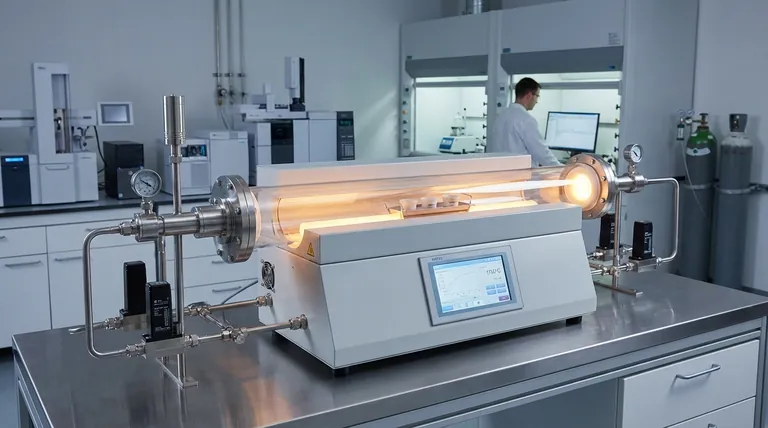
We tend to think of a furnace as a simple box that gets hot. This is a cognitive shortcut, but a dangerous one in research. A laboratory tube furnace is not an oven. It is a self-contained, controllable universe where temperature, its distribution, and the surrounding atmosphere are managed with precision. Its value lies not in its heat, but in its control.
The Three Pillars of a Controlled Universe
To achieve repeatable, high-fidelity results, a tube furnace must master three fundamental domains simultaneously. These aren't just features; they are the laws of physics governing your experiment.
Reaching for High Temperatures
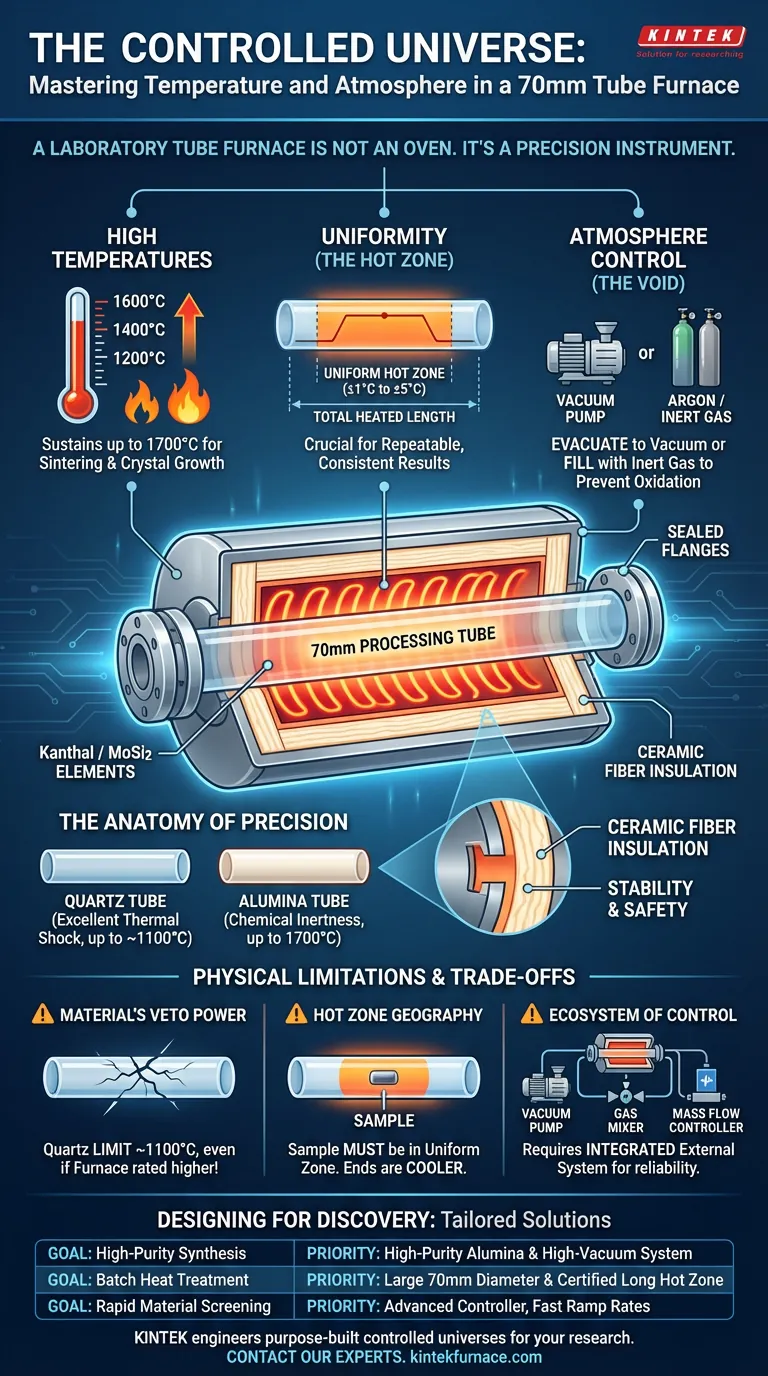
The ability to sustain temperatures of 1200°C, 1600°C, or even higher is the most obvious capability. This thermal energy is what drives processes like sintering, calcination, and crystal growth.
The power comes from resistive heating elements—often Kanthal or MoSi2—that envelop the processing tube. But raw temperature is only the starting point.
The Tyranny of the Gradient: Mastering Uniformity
Heat is chaotic; it wants to escape. The single most critical challenge in thermal processing is creating a uniform temperature zone—a defined "hot zone" where the temperature varies by a mere ±1°C to ±5°C.
While a furnace might have a total heated length of 40cm, the reliable uniform zone may only be 15cm in the very center. Placing your sample outside this zone guarantees inconsistent results. Excellence in furnace engineering is a relentless battle against thermal gradients to make this zone as large and stable as possible.
Taming the Void: Absolute Atmosphere Control
Many advanced materials are like shy creatures; they react unpredictably in the presence of air. A tube furnace's sealed design allows you to evacuate the chamber to a vacuum or fill it with an inert gas like argon.
This isn't just about preventing oxidation. It's about creating a perfectly clean, non-reactive stage for chemical reactions to proceed exactly as intended. It is the key to high-purity synthesis and processing air-sensitive materials.
The Anatomy of Precision
The physical design of the furnace is a direct reflection of its intended purpose. Every component represents a strategic choice.
The Chamber: More Than Just a Tube
The "70mm" designation refers to the inner diameter of the processing tube. This generous volume is a distinct advantage, allowing for larger samples, crucibles, or small-scale batch production, significantly improving throughput over smaller models.
The tube material itself is a critical choice:
- Quartz: Excellent for processes up to ~1100°C, offering great thermal shock resistance.
- Alumina: The workhorse for higher temperatures (up to 1700°C), prized for its chemical inertness.
The Heart of the Heat
Surrounding the tube, the heating elements and multi-layered ceramic fiber insulation work in tandem. The insulation does more than save energy; it stabilizes the thermal environment and ensures the outer casing remains safe to touch—a small but crucial detail in a busy lab.
The Physics of Compromise: What Spec Sheets Don't Tell You
Using a tube furnace effectively requires acknowledging the trade-offs baked into its design. We often fall victim to confirmation bias, focusing on the headline numbers on a spec sheet while ignoring the physical limitations.
The Material's Veto Power
A furnace might be rated for 1600°C, but if you are using a quartz tube inside, your absolute maximum temperature is ~1100°C. Pushing past that will cause the quartz to soften and fail. The process tube always has the final say. It's a hard physical limit that no controller can override.
The Geography of the Hot Zone
Always remember: the uniform temperature zone is shorter than the total heated length. The ends of the tube will always be cooler. Assuming otherwise is a recipe for failed experiments. Your sample must live entirely within the calibrated uniform region to ensure every part of it sees the same thermal history.
The Ecosystem of Control
The furnace provides the sealed chamber, but atmosphere control requires an entire external system: vacuum pumps, gas mixers, mass flow controllers, and leak-proof flanges. A common point of failure is viewing these as separate accessories rather than as one integrated system.
An off-the-shelf furnace provides the box; a true processing solution delivers the entire ecosystem. This is where standardized equipment often fails and integrated, purpose-built systems from specialists become essential for reliable results.
Designing for Discovery, Not Just for Heat
The ideal furnace configuration is not a one-size-fits-all solution. It is a direct extension of your scientific or production goals. The choices you make are critical.
| If Your Goal Is... | Your Priority Should Be... |
|---|---|
| High-Purity Synthesis | A high-purity alumina tube and a robust, high-vacuum system. |
| Batch Heat Treatment | A large 70mm diameter and a long, certified uniform hot zone. |
| Rapid Material Screening | An advanced temperature controller with fast ramp rates and programmability. |
Navigating these trade-offs is where standard equipment falls short and expert-led customization becomes essential. KINTEK's foundation in R&D and in-house manufacturing allows us to engineer furnace systems—from Muffle and Tube to complex CVD setups—that are precisely tailored to these choices. We don't just sell a furnace; we build the controlled universe your research demands.
If your work demands precision beyond what a standard box can offer, let's build the right tool for the job. Contact Our Experts
Visual Guide
Related Products
- Vacuum Sealed Continuous Working Rotary Tube Furnace Rotating Tube Furnace
- 1400℃ High Temperature Laboratory Tube Furnace with Alumina Tube
- 1700℃ High Temperature Laboratory Tube Furnace with Alumina Tube
- Magnesium Extraction and Purification Condensing Tube Furnace
- High Pressure Laboratory Vacuum Tube Furnace
Related Articles
- Beyond Heat: Mastering the Controlled Universe Inside a Tube Furnace
- Mastering the Void: How Tube Furnaces Forge the Atoms of Innovation
- Why Your Crystal Growth Experiments Are Failing: The Hidden Culprit in Your Tube Furnace
- The Art of Isolation: Mastering Material Properties with Tube Furnaces
- Beyond Heat: The Art of Control in a Tube Furnace



















