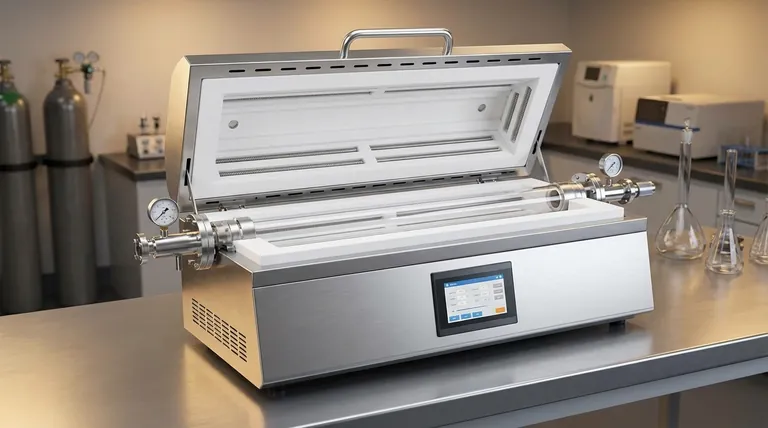
The Illusion of Simple Heat
Ask a novice what a furnace does, and they'll say "it gets things hot." They're not wrong, but they're missing the point.
In advanced materials science, semiconductor research, or chemical synthesis, heat is just one variable in a complex equation. The real challenge is controlling all the variables. The unseen enemy is often the air itself—a chaotic mix of oxygen, nitrogen, and moisture ready to corrupt a sensitive sample and invalidate weeks of work.
This is why choosing a furnace is a psychological decision as much as a technical one. It reveals what you value most. The tube furnace represents a deliberate choice to prioritize absolute control over sheer volume. It’s not just a heater; it’s an instrument for creating a small, perfect, and isolated universe.
The Core Principle: A Universe in a Tube
The power of a tube furnace lies in its elegant simplicity. By confining the process to a sealed tube, it systematically eliminates the variables that plague other methods.
Eliminating the Unseen Enemy: Atmosphere
Its single most important advantage is total mastery over the internal atmosphere. This isn't a feature; it's the entire philosophy of the design.
- Vacuum: You can remove the atmosphere entirely, creating a void where materials can be treated without any chance of oxidation or contamination.
- Inert Gas: You can introduce a neutral backdrop, like argon or nitrogen, to provide thermal transfer without chemical interference. It’s like conducting your experiment on a perfectly clean stage.
- Reactive Gas: You can introduce specific gases to become active participants in a chemical reaction, such as in Chemical Vapor Deposition (CVD), where new materials are grown layer by atomic layer.
This control ensures that the only reactions happening are the ones you designed.
The Pursuit of Uniformity
The cylindrical geometry isn't just for containment; it's a naturally efficient way to create a highly uniform temperature zone. For processes like annealing, where even slight temperature variations can alter a material's crystalline structure, this consistency is non-negotiable.
This uniformity is the foundation of reliable and repeatable results. It transforms an experiment from a one-off event into a scientific certainty.
The Inevitable Trade-Off: Certainty vs. Scale
No tool is perfect for every job. The focused design of a tube furnace comes with inherent trade-offs, but these are better understood as deliberate strategic choices.
The Constraint of Volume
The defining feature of the furnace—the tube—is also its primary limitation. It can only process small sample volumes.
But this isn't a flaw. It’s a commitment to precision. You sacrifice the ability to process large, bulky parts for the certainty that your smaller, more valuable sample is processed perfectly. A box furnace heats objects; a tube furnace orchestrates processes.
Navigating the Gradient
Physics dictates that the ends of the tube will always be cooler than the center. This creates a temperature gradient, meaning the effective "working zone" is smaller than the tube's full length.
Experienced researchers understand this. They work within this highly stable central zone. Addressing the need for longer uniform zones requires more sophisticated engineering, like multi-zone furnaces that create a precisely controlled temperature plateau.
Your Decision Framework
Choosing the right thermal equipment depends entirely on your primary goal. It’s a question of what you are trying to achieve.
| If Your Goal Is... | The Logical Choice Is... | Because You Prioritize... |
|---|---|---|
| High-Purity Material Synthesis | Tube Furnace | Absolute atmosphere control to prevent contamination. |
| Precise Annealing of Small Samples | Tube Furnace | Unmatched temperature uniformity for repeatable results. |
| Bulk Heat Treatment of Large Parts | Muffle / Box Furnace | Throughput and volume over atmospheric purity. |
| Foundational R&D on New Materials | Tube Furnace | Versatility and control for exploring critical variables. |
From Principle to Practice: Engineering for Perfect Control
The principles of a tube furnace are universal, but their execution is not. The difference between a basic heater and a scientific instrument lies in the engineering—the quality of the seals, the precision of the temperature controllers, and the design of the heating elements.
This is the engineering philosophy at KINTEK. Backed by expert R&D and in-house manufacturing, we build systems designed for scientists and engineers who cannot compromise on control. We understand that challenges like temperature gradients aren't just academic; they are practical problems that need solutions. That’s why our customizable multi-zone tube furnaces are engineered to extend and flatten the uniform heating zone to your exact specifications.
Our range of high-temperature solutions—from Tube and Muffle Furnaces to advanced CVD and Vacuum Systems—is built on the premise that perfect control enables groundbreaking discovery.
For processes where absolute certainty is the only acceptable outcome, engineering the right environment is everything. Contact Our Experts
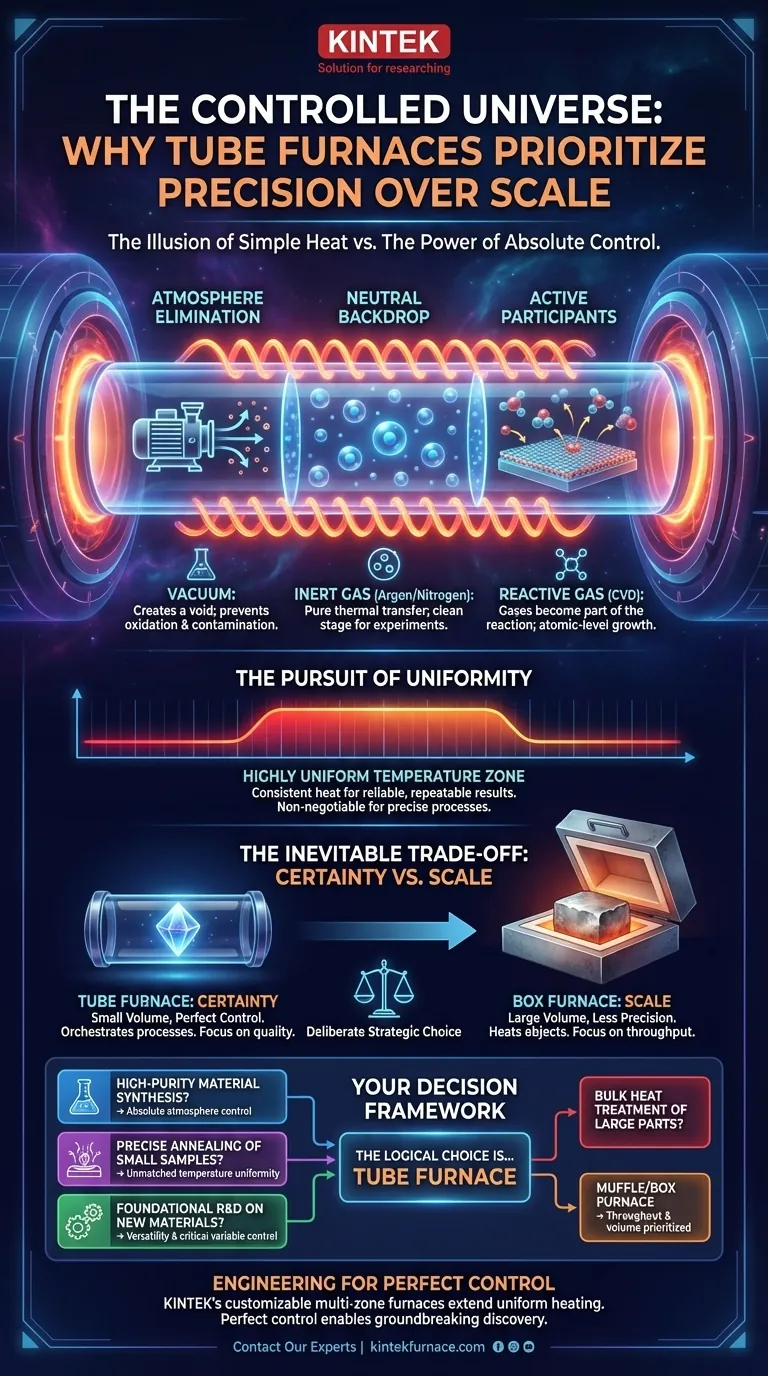
Visual Guide
Related Products
- Vacuum Sealed Continuous Working Rotary Tube Furnace Rotating Tube Furnace
- 1400℃ High Temperature Laboratory Tube Furnace with Alumina Tube
- 1700℃ High Temperature Laboratory Tube Furnace with Alumina Tube
- Magnesium Extraction and Purification Condensing Tube Furnace
- High Pressure Laboratory Vacuum Tube Furnace
Related Articles
- Beyond Heat: Mastering the Controlled Universe Inside a Tube Furnace
- Mastering the Void: How Tube Furnaces Forge the Atoms of Innovation
- Why Your Crystal Growth Experiments Are Failing: The Hidden Culprit in Your Tube Furnace
- The Art of Isolation: Mastering Material Properties with Tube Furnaces
- Beyond Heat: The Art of Control in a Tube Furnace



















