The Unseen Architecture of Our Digital World
Every tap on your phone, every calculation on your laptop, is a symphony of electrons dancing across silicon. This world isn't built on magic; it's built on a foundation of obsessive, atomic-level control.
The fundamental challenge of modern electronics has always been one of persuasion: how do you convince trillions of individual atoms to arrange themselves perfectly to create a transistor, a circuit, a processor?
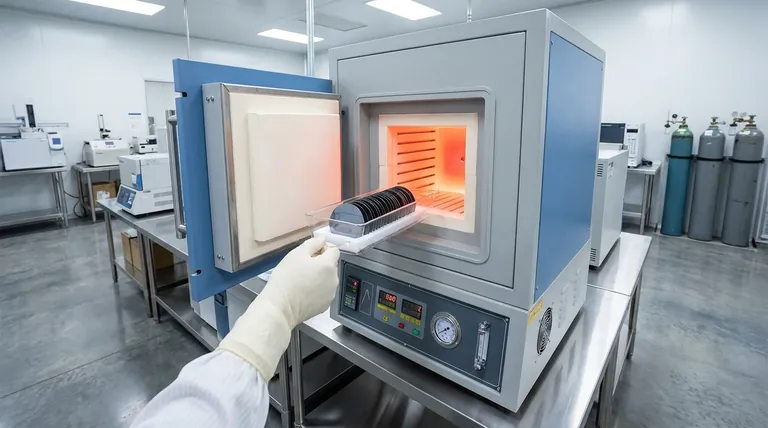
The answer, surprisingly, often begins inside one of the most foundational tools in materials science: the laboratory tube furnace. It’s not just an oven; it’s an environment for creation.
The Psychology of Perfection: Why Control is Non-Negotiable
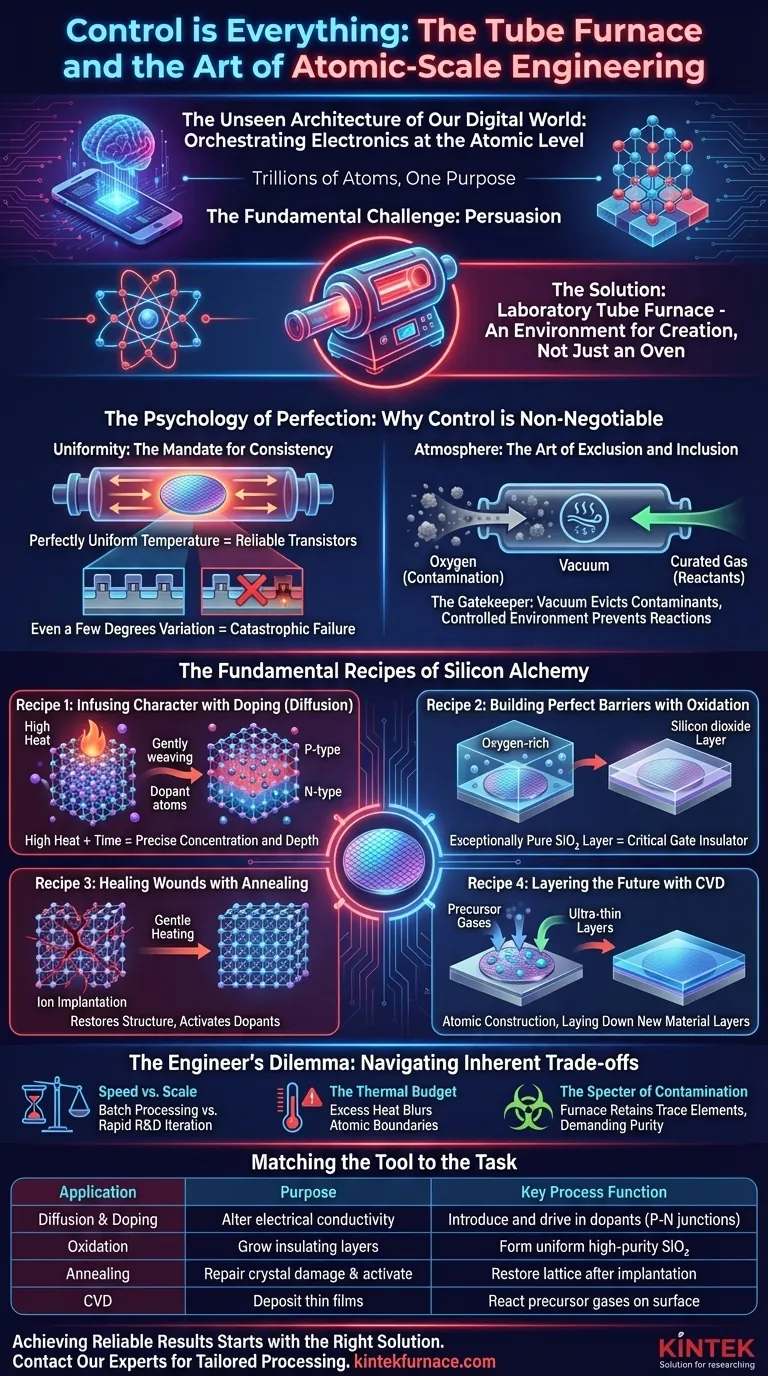
The value of a tube furnace isn’t its heat, but its precision. It masters the two physical parameters that dictate behavior at the atomic scale: temperature and atmosphere.
Uniformity: The Mandate for Consistency
Imagine a silicon wafer, destined to become a thousand microchips. Inside the furnace, it must experience a perfectly uniform temperature. A variation of even a few degrees across its surface means some transistors are "cooked" differently than others.
This isn't a minor flaw. It's a catastrophic failure in the making. A single faulty transistor can render an entire chip useless. The long, consistent heating zone of a quality tube furnace isn't a feature; it's an existential mandate for reliability.
Atmosphere: The Art of Exclusion and Inclusion
The second pillar of control is the atmosphere. A sealed process tube allows researchers to play the role of gatekeeper. First, you can create a vacuum, forcefully evicting every reactive particle like oxygen that could corrupt the silicon surface.
Then, you can introduce a specific, curated gas. This controlled environment prevents unwanted chemical reactions while supplying the exact reactants needed for the process, turning the furnace into a pristine chemical reactor.
The Fundamental Recipes of Silicon Alchemy
With this control over heat and chemistry, a tube furnace becomes the stage for several foundational processes in semiconductor fabrication.
Recipe 1: Infusing Character with Doping
Pure silicon is a poor conductor. To give it its electrical personality, it must be "doped" with impurity atoms. The furnace facilitates this through diffusion, using high heat to give dopant atoms the energy to gently weave themselves into the silicon's crystal lattice.
The temperature and time are not arbitrary variables; they are precise levers that control the depth and concentration of these new atoms, creating the essential P-type and N-type regions that form the basis of all transistors.
Recipe 2: Building Perfect Barriers with Oxidation
Transistors need insulators—perfect, impenetrable barriers to direct the flow of electrons. Thermal oxidation is the process of growing an exceptionally pure layer of silicon dioxide (SiO₂) on the wafer.
By heating the silicon in an oxygen-rich atmosphere, the furnace facilitates the growth of this flawless glass-like layer, which serves as the critical gate insulator.
Recipe 3: Healing Wounds with Annealing
Some fabrication steps, like ion implantation, are inherently violent. They fire dopant atoms into the silicon, knocking the crystal lattice out of alignment and causing significant damage.
Annealing is the quiet, therapeutic counter-process. By gently heating the wafer, the furnace gives the displaced atoms enough mobility to settle back into their proper crystalline homes. This step not only repairs the structural damage but also electrically "activates" the new dopants.
Recipe 4: Layering the Future with CVD
Beyond modifying silicon, furnaces can be used to add entirely new layers of material. In Chemical Vapor Deposition (CVD), precursor gases flow through the hot tube and react on the wafer's surface, depositing ultra-thin films of polysilicon or silicon nitride.
This process transforms the furnace into a machine for atomic construction, laying down the building blocks for more complex device structures. Specialized CVD systems are an evolution of this principle, optimized for the highest levels of purity and control.
The Engineer's Dilemma: Navigating Inherent Trade-offs
This level of control comes with its own set of strategic challenges that every researcher and engineer must confront.
-
Speed vs. Scale: Tube furnaces are batch tools, processing many wafers at once. This is a gift for mass production but a curse for R&D, where the goal is rapid iteration on a single design, not bulk output.
-
The Thermal Budget: Every high-temperature process "spends" from the device's finite thermal budget. Too much heat for too long can cause previously placed dopants to diffuse further than intended, blurring the sharp atomic boundaries that make a device work.
-
The Specter of Contamination: In semiconductor fabrication, purity is a paranoid obsession. A furnace used for one process can retain trace elements that contaminate the next batch. This risk demands either meticulous cleaning protocols or dedicated, high-quality furnaces for specific tasks.
Matching the Tool to the Task
Successfully engineering a material means choosing the right recipe for your goal. The versatility of a controlled thermal environment is its greatest strength.
| Application | Purpose | Key Process Function |
|---|---|---|
| Diffusion & Doping | Alter electrical conductivity | Introduce and drive in dopants to form P-N junctions |
| Oxidation | Grow insulating layers | Form a uniform, high-purity silicon dioxide (SiO₂) |
| Annealing | Repair crystal damage & activate | Restore lattice structure after ion implantation |
| CVD | Deposit thin films of new material | React precursor gases on the wafer surface |
Navigating these processes and their trade-offs requires more than just equipment; it requires a solution tailored to your specific research objective. Whether your work demands the foundational precision of a Tube Furnace for doping and annealing, or the advanced capabilities of a dedicated CVD System for thin-film deposition, the underlying need for absolute control remains the same. The quality of your tools directly dictates the quality of your innovation.
For any of these applications, achieving reliable and repeatable results starts with having the right thermal processing solution. Contact Our Experts
Visual Guide
Related Products
- Vacuum Sealed Continuous Working Rotary Tube Furnace Rotating Tube Furnace
- 1400℃ High Temperature Laboratory Tube Furnace with Alumina Tube
- 1700℃ High Temperature Laboratory Tube Furnace with Alumina Tube
- Magnesium Extraction and Purification Condensing Tube Furnace
- High Pressure Laboratory Vacuum Tube Furnace
Related Articles
- Beyond Heat: Mastering the Controlled Universe Inside a Tube Furnace
- Mastering the Void: How Tube Furnaces Forge the Atoms of Innovation
- Why Your Crystal Growth Experiments Are Failing: The Hidden Culprit in Your Tube Furnace
- The Art of Isolation: Mastering Material Properties with Tube Furnaces
- Beyond Heat: The Art of Control in a Tube Furnace



















