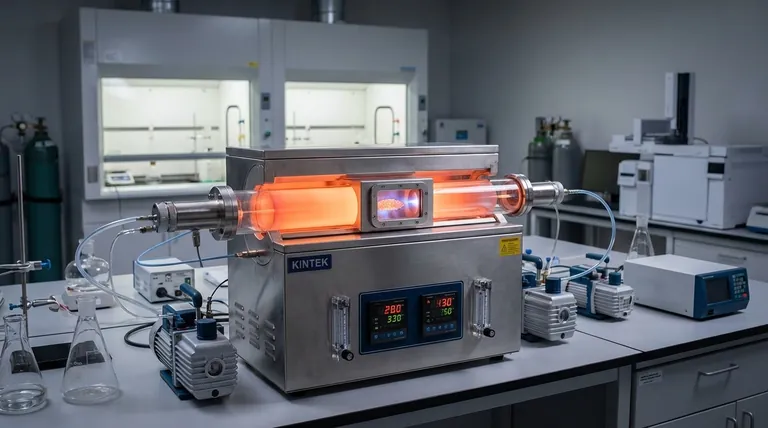
A Flaw in the Void
Imagine a materials scientist spending weeks designing a novel semiconductor. The calculations are perfect. The precursor materials are ultra-pure. The process runs for hours at 1100°C.
But the final measurement is a disaster. The material’s electrical properties are completely wrong. The cause? A microscopic leak in the system, allowing a few stray oxygen molecules—an invisible saboteur from the ambient air—to contaminate the sample.
This isn't a failure of heat. It's a failure of control. And it reveals a fundamental truth in materials science: the greatest challenge isn't reaching a high temperature, but creating a perfect, isolated universe where a material can be born without interference.
The Psychology of Purity
At its core, a tube furnace is a solution to this paranoia. Its primary function is not just to get hot, but to build a wall against the chemical chaos of the outside world.
The tubular chamber is the heart of this solution. It separates the sample from everything else: the heating elements, the insulation, and the very air we breathe. This isolation is the single most critical feature, the one that enables the creation of materials that simply could not exist otherwise.
This obsession with control isn't just for academic purity. In sensitive electronics or advanced ceramics, even parts-per-million contamination can be the difference between a breakthrough and a paperweight.
Anatomy of a Private Universe
The genius of the tube furnace lies in its elegant simplicity, where each component serves the mission of control.
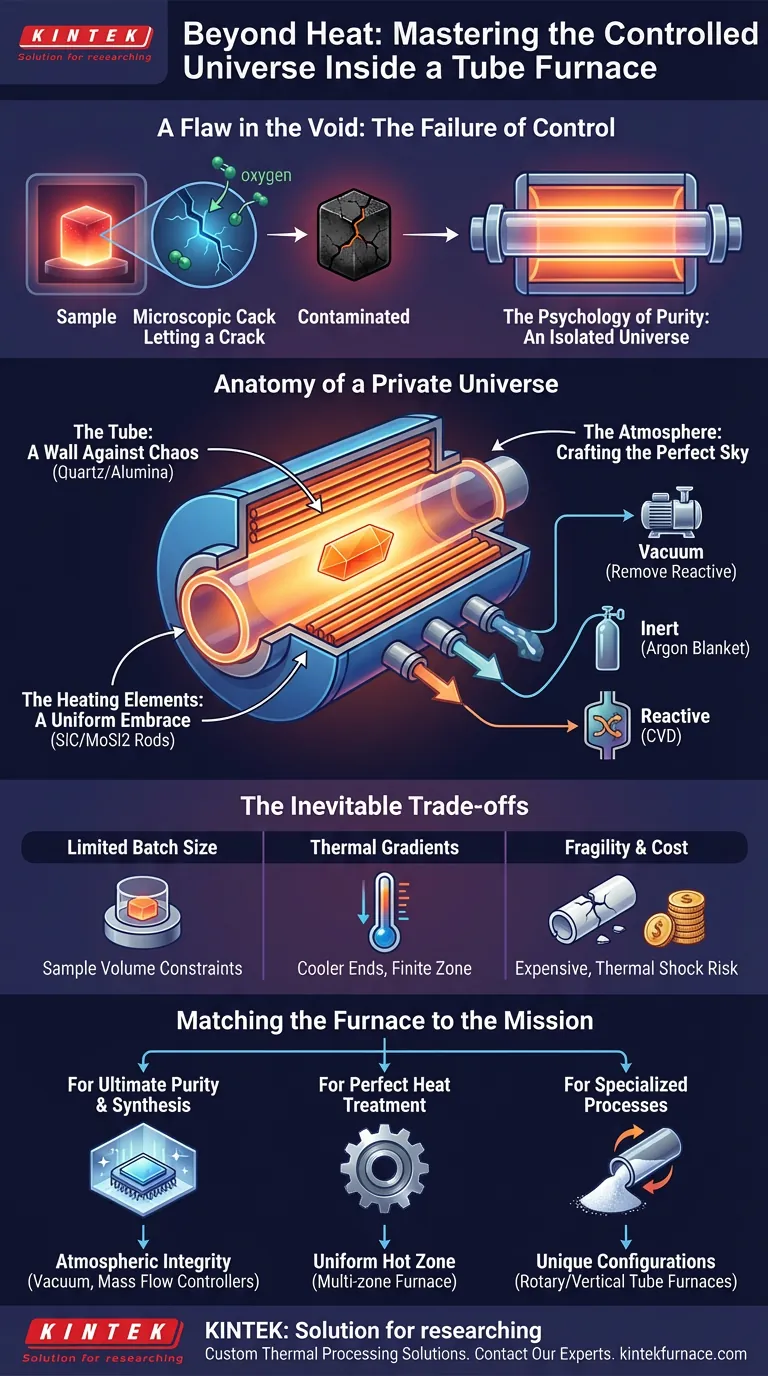
The Tube: A Wall Against Chaos
The process tube—typically made of quartz or high-purity alumina—is the physical barrier. It’s the crucible where new matter is forged. Choosing the right material is the first step in defining the boundaries of your experimental world, balancing temperature resistance against chemical inertness.
The Heating Elements: A Uniform Embrace
Heating elements (like SiC or MoSi2 rods) are wrapped around the tube. This cylindrical geometry isn't just for aesthetics; it's physics. It promotes a highly uniform temperature zone in the center of the tube.
This uniformity ensures every part of your sample experiences the same thermal journey, critical for processes like annealing, where consistent crystal growth is the entire point. It’s a guarantee of fairness on a microscopic scale.
The Atmosphere: Crafting the Perfect Sky
With the tube sealed, you become the master of its environment. You can pump it down to a high vacuum, removing almost every reactive molecule. You can fill it with an inert gas like argon to create a neutral, protective blanket. Or you can introduce a specific reactive gas to intentionally drive a chemical transformation, like in Chemical Vapor Deposition (CVD).
You are, in effect, designing the sky under which your material will form.
The Inevitable Trade-offs
No perfect universe comes without its own rules and limitations. A tube furnace is a specialized instrument, and its design creates inherent trade-offs.
| Limitation | The Practical Reality |
|---|---|
| Limited Batch Size | The tubular geometry that provides such great control also limits the physical volume of the sample. |
| Thermal Gradients | The ends of the tube will always be cooler than the center. The "perfect" uniform zone has a finite length. |
| Fragility & Cost | High-purity ceramic tubes are expensive and can crack from thermal shock if heated or cooled too aggressively. |
Understanding these trade-offs isn't about seeing failure; it's about mastering the tool. It’s knowing where the boundaries of your controlled universe lie.
Matching the Furnace to the Mission
Choosing the right tube furnace is about aligning its architecture with your scientific or engineering goal. The more precise the goal, the more specialized the tool must be.
-
For Ultimate Purity & Synthesis: If you're developing novel thin films with CVD or synthesizing air-sensitive materials, your primary need is atmospheric integrity. You need a system with superior vacuum capabilities and precise mass flow controllers for gas delivery.
-
For Perfect Heat Treatment: If your work involves annealing large single crystals or complex metal parts, the length and stability of the uniform hot zone is paramount. A multi-zone furnace, which uses several independent heating zones to flatten the temperature profile, becomes the ideal solution.
-
For Specialized Processes: For applications requiring continuous processing of powders or unique sample orientations, standard designs fall short. This is where variants like rotary or vertical tube furnaces are necessary.
This is where engineering meets intent. A generic furnace provides heat; a purpose-built system provides control. At KINTEK, we build our advanced Muffle, Tube, and CVD furnace systems around this principle. Leveraging in-house R&D and manufacturing, we specialize in customizing thermal processing solutions that provide the exact, isolated environment your work demands. Whether it’s optimizing a hot zone, integrating complex gas systems, or designing a unique furnace configuration, the goal is to give you absolute control over your small corner of the universe.
To build the perfect environment for your next material breakthrough, Contact Our Experts.
Visual Guide
Related Products
- Vacuum Sealed Continuous Working Rotary Tube Furnace Rotating Tube Furnace
- 1400℃ High Temperature Laboratory Tube Furnace with Alumina Tube
- 1700℃ High Temperature Laboratory Tube Furnace with Alumina Tube
- 1200℃ Split Tube Furnace Laboratory Quartz Tube Furnace with Quartz Tube
- Vertical Laboratory Quartz Tube Furnace Tubular Furnace
Related Articles
- Mastering the Void: How Tube Furnaces Forge the Atoms of Innovation
- Why Your Crystal Growth Experiments Are Failing: The Hidden Culprit in Your Tube Furnace
- The Art of Isolation: Mastering Material Properties with Tube Furnaces
- Beyond Heat: The Art of Control in a Tube Furnace
- Beyond Heat: The Unseen Power of Environmental Control in Tube Furnaces



















