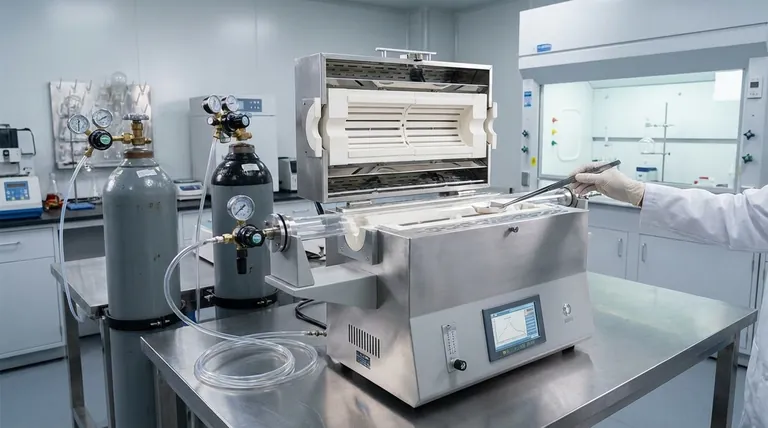
The Misconception of Heat
At first glance, a laboratory furnace seems to be about one thing: heat. We see a tool designed to reach extreme temperatures, and we assume its primary function is thermal energy.
But that’s a profound misunderstanding of its purpose, especially with a tube furnace.
The heat is merely the catalyst. The real work—the genius of the design—is in creating a perfectly controlled, isolated micro-environment. You don’t buy a tube furnace for heat; you buy it for control.
The Elegant Separation of Powers
The core operating principle of a tube furnace is indirect heating. It’s an elegant design choice that solves the fundamental problem of high-temperature processing: contamination.
Heating elements, by their nature, can shed microscopic particles. The ambient air is filled with oxygen, moisture, and other reactive elements. For advanced materials science, this is chaos.
The tube furnace creates order by establishing a simple, non-negotiable separation.
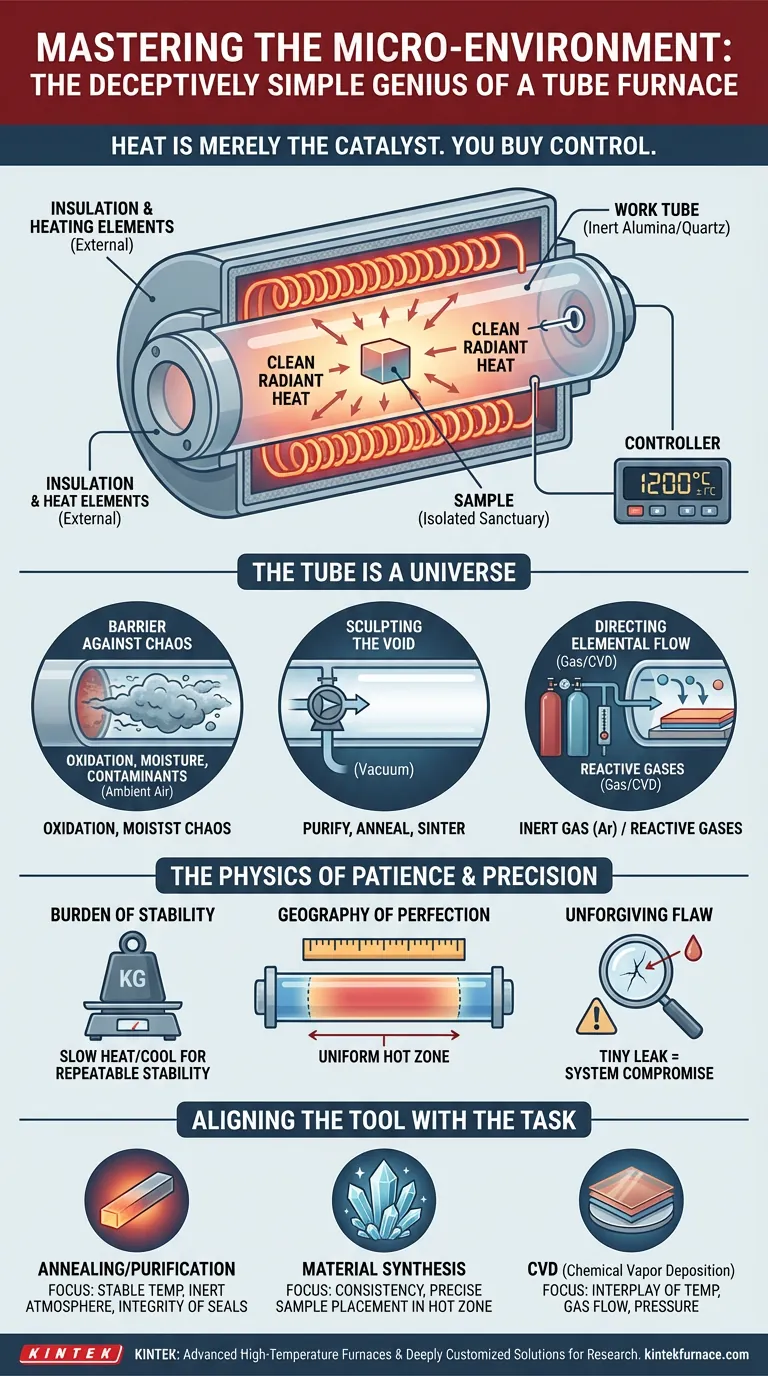
- The Sample is Isolated: The material is placed within a sealed work tube, typically made of inert alumina or high-purity quartz. This tube is the sanctum.
- The Heat is External: Electric heating elements wrapped around the furnace chamber heat the outside of the tube. They never touch the sample.
- The Transfer is Clean: Heat radiates inward, passing through the tube wall to the sample. The cylindrical geometry ensures this energy arrives uniformly from all directions.
- The Control is Absolute: A thermocouple measures the temperature, feeding data to a controller that modulates power with single-degree precision.
This process transforms the furnace from a brute-force oven into a surgical instrument. The tube acts as a sterile barrier, protecting the delicate operation happening within.
The Tube is Not a Container; It's a Universe
The work tube is the heart of the system. It’s what elevates the furnace from a heater to a sophisticated processing reactor. It allows an operator to define the very "universe" the sample experiences.
A Barrier Against Chaos
First and foremost, the sealed tube isolates the sample from the outside world. This prevents oxidation from ambient air—a critical failure point in synthesizing metals, ceramics, and nanomaterials.
Sculpting the Void
By fitting the tube with sealed end flanges and connecting a pump, you can evacuate the atmosphere, creating a vacuum. This isn't just about removing air; it’s about creating a perfect, empty canvas. In a vacuum, materials can be purified, annealed, or sintered without the interference of unwanted chemical reactions.
Directing the Elemental Flow
The same flanges allow for the introduction of specific gases. You can flood the chamber with an inert gas like argon to prevent reactions or introduce reactive gases to intentionally create them. This is the foundation of Chemical Vapor Deposition (CVD), where gases react and deposit as a solid thin film on a substrate—building new materials one atomic layer at a time.
| Component | Primary Function | The Psychological Value |
|---|---|---|
| Heating Elements | Generate external heat | Power without contamination |
| Work Tube | Isolate the sample | Creating a perfect, known world |
| Flanges & Ports | Seal the tube and control atmosphere | The ability to design the environment |
| Controller | Regulate temperature precisely | Repeatability and confidence |
The Physics of Patience and Precision
To master the tube furnace, one must appreciate its inherent trade-offs. These aren't flaws; they are the physical consequences of its design for stability and precision.
The Burden of Stability
Heavy insulation and high thermal mass are required for temperature stability. This means the furnace heats and cools slowly. This trade-off of speed for stability is a conscious engineering choice. It demands patience but rewards it with repeatable results.
The Geography of Perfection
Temperature is never perfectly uniform along the entire length of the tube. A stable and consistent "hot zone" exists in the center. The ends are always slightly cooler. Successful processing depends on the mental discipline of placing the sample in this precise sweet spot, every single time.
The Unforgiving Nature of a Single Flaw
In vacuum or controlled gas work, the integrity of the system is paramount. A tiny leak in a flange gasket, almost invisible to the eye, can compromise the entire experiment by introducing rogue oxygen or moisture. It's a system that demands meticulous attention to detail.
Aligning the Tool with the Task
Understanding these principles allows you to approach the furnace not as an operator, but as a designer of experiments. Your goal dictates which aspect of control is most critical.
- For Annealing or Purification: Your focus is a stable temperature in an inert atmosphere. The integrity of your vacuum seals is the most critical variable.
- For Material Synthesis: Your goal is consistency. Placing your sample in the exact center of the uniform hot zone is essential for repeatable results.
- For Chemical Vapor Deposition (CVD): You are running a chemical reactor. The precise interplay of temperature, gas flow rates, and pressure defines the quality of your final product.
Achieving this level of control requires a furnace that is not just a commodity, but a well-engineered and often customized instrument. Backed by expert R&D and in-house manufacturing, KINTEK provides advanced high-temperature furnaces, including specialized Tube, Vacuum, and CVD systems, that are built for this purpose. Our ability to deeply customize solutions ensures your equipment is perfectly aligned with your research goals.
Visual Guide
Related Products
- Vacuum Sealed Continuous Working Rotary Tube Furnace Rotating Tube Furnace
- 1400℃ High Temperature Laboratory Tube Furnace with Alumina Tube
- 1700℃ High Temperature Laboratory Tube Furnace with Alumina Tube
- Magnesium Extraction and Purification Condensing Tube Furnace
- High Pressure Laboratory Vacuum Tube Furnace
Related Articles
- Beyond Heat: Mastering the Controlled Universe Inside a Tube Furnace
- Mastering the Void: How Tube Furnaces Forge the Atoms of Innovation
- Why Your Crystal Growth Experiments Are Failing: The Hidden Culprit in Your Tube Furnace
- The Art of Isolation: Mastering Material Properties with Tube Furnaces
- Beyond Heat: The Art of Control in a Tube Furnace



















