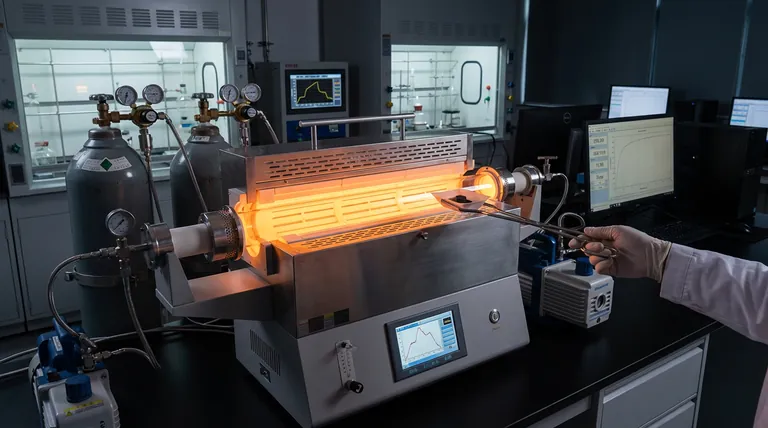
The Scientist's Dilemma: Hope vs. Repeatability
Every researcher knows the feeling. An experiment yields a promising result, but it can't be replicated. Was it a fluke? A subtle, unnoticed change in atmospheric pressure? A fluctuation in the power grid?
This is the fundamental challenge in advanced material science. The final properties of a crystal, a thin film, or a metal alloy are not just determined by the ingredients, but by the precise history of their creation.
A simple oven provides heat. A tube furnace provides a controlled universe. Its purpose is not merely to get something hot, but to eliminate every variable except the ones you intend to control. It's a tool for moving from hope to engineering.
The Anatomy of Control
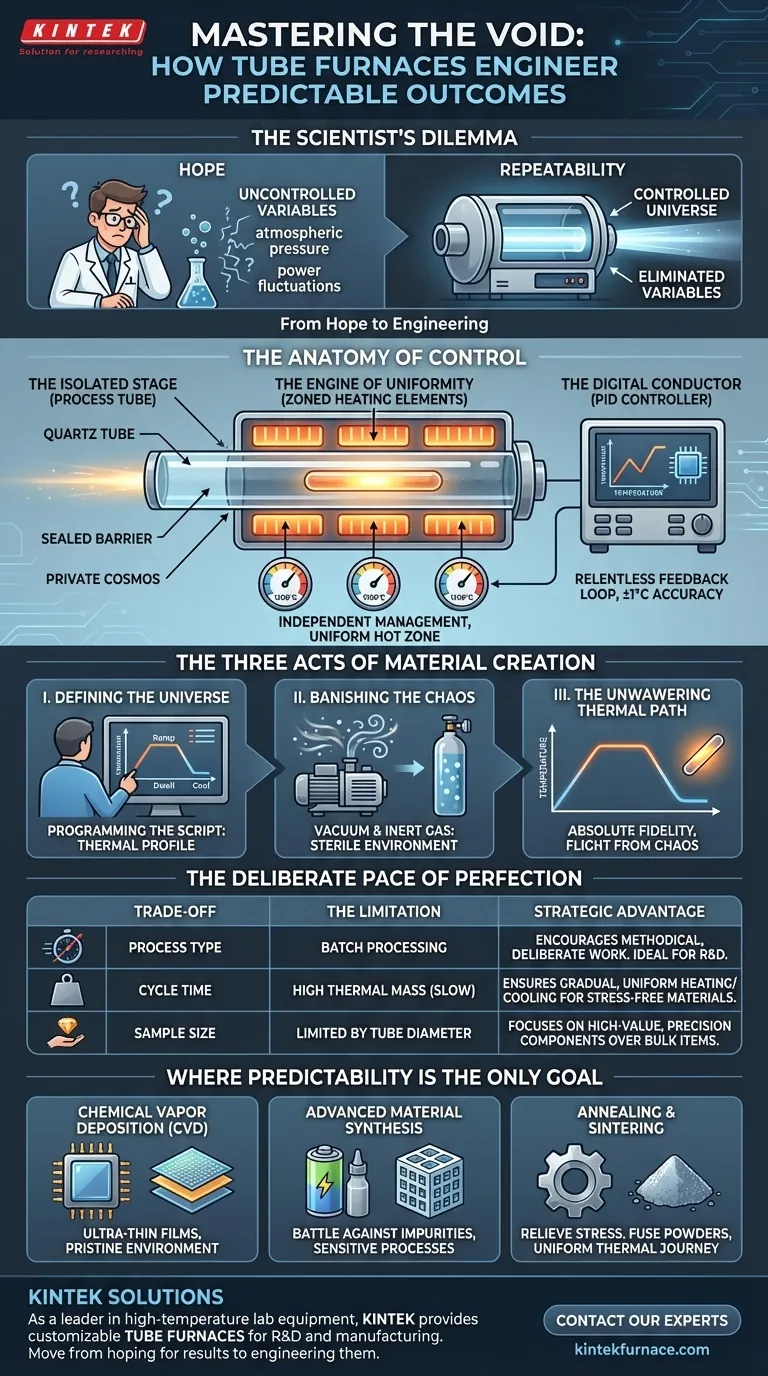
At first glance, a tube furnace is a simple concept: a tube surrounded by heaters. But its design is a masterclass in isolating a process from the chaos of the outside world. Each component serves a single purpose: absolute control.
The Isolated Stage: The Process Tube
The heart of the furnace is a ceramic or quartz tube. This is more than a container; it's a sealed stage, a private cosmos for your sample. It isolates the material from the heating elements and, more importantly, from the reactive, unpredictable atmosphere of the room.
The Engine of Uniformity: Zoned Heating Elements
Surrounding the tube are electric heating elements. In a basic furnace, this provides generalized heat. But in a high-precision system, these elements are divided into multiple zones.
Why? Because heat is unruly. It pools and dissipates, creating hot and cold spots. A temperature gradient of just a few degrees across a sample can ruin a semiconductor wafer or introduce flaws into a crystal lattice. Multi-zone heating allows a central controller to independently manage each section, forcing the temperature to be perfectly uniform along the entire length of the hot zone.
The Digital Conductor: The PID Controller
The brain of the system is the PID (Proportional-Integral-Derivative) controller. This isn't a simple thermostat. It’s a relentless feedback loop, constantly measuring the temperature, comparing it to the setpoint, and calculating the precise power adjustments needed to counteract any deviation.
It anticipates, it corrects, and it holds the line with staggering accuracy, often within ±1°C at temperatures exceeding 1200°C. It is the unwavering hand that guides the entire thermal process.
The Three Acts of Material Creation
Using a tube furnace is like directing a three-act play at the atomic level. The operator sets the script, and the furnace ensures every actor performs their part flawlessly.
Act I: Defining the Universe
The process begins when the user programs the thermal profile. This is the script: the ramp rate, the dwell temperature, the cooling profile. You are defining the laws of physics for this specific process.
Act II: Banishing the Chaos
For many materials, oxygen is a poison. Before heating, the tube is sealed with flanges. A vacuum pump is engaged, not just to remove air, but to create a near-perfect void—a clean slate. Then, a controlled flow of an inert gas like argon can be introduced, creating a sterile, predictable environment where only the desired chemical reactions can occur.
Act III: The Unwavering Thermal Path
With the stage set and the atmosphere controlled, the heating cycle begins. The PID controller and the zoned elements execute the programmed thermal profile with absolute fidelity. The sample is heated, transformed, and cooled exactly as designed, free from the random influences of the outside world.
The Deliberate Pace of Perfection
Tube furnaces are not designed for speed or massive throughput. They embody a different philosophy, one that aligns with the mindset of research and development.
| Trade-Off | The Limitation | The Strategic Advantage |
|---|---|---|
| Process Type | Batch Processing | Encourages methodical, deliberate work. Ideal for R&D. |
| Cycle Time | High Thermal Mass (Slow) | Ensures gradual, uniform heating/cooling for stress-free materials. |
| Sample Size | Limited by Tube Diameter | Focuses on high-value, precision components over bulk items. |
The furnace's high thermal mass means it heats and cools slowly. This isn't a bug; it's a feature. For annealing metals or growing crystals, slow, controlled transitions are essential to achieving a perfect internal structure. The batch nature forces careful planning, making each run a deliberate act of creation rather than a mindless step in a production line.
Where Predictability is the Only Goal
The applications for tube furnaces are found wherever the cost of failure is high and repeatability is non-negotiable.
- Chemical Vapor Deposition (CVD): Creating the ultra-thin films on semiconductor chips requires a precursor gas to react at an exact temperature in a pristine environment. The furnace provides this environment, making modern electronics possible.
- Advanced Material Synthesis: Developing next-generation batteries, ceramics, or nanomaterials is a battle against impurities and inconsistencies. The sealed, controlled atmosphere of a tube furnace is the ideal laboratory for these sensitive processes.
- Annealing and Sintering: To relieve internal stresses in a metal part or fuse ceramic powders into a solid, every part of the material must experience the exact same thermal journey. The temperature uniformity of a multi-zone tube furnace guarantees it.
Ultimately, a tube furnace is an instrument for engineers and scientists who understand that exceptional materials are not discovered by chance—they are built with intention. This level of control is the product of meticulous design and manufacturing, transforming a simple heater into a powerful tool for innovation.
As a leader in high-temperature lab equipment, KINTEK provides a comprehensive range of solutions, from Muffle and Rotary Furnaces to advanced CVD systems. Our expertise in R&D and manufacturing allows us to deliver customizable Tube Furnaces engineered to provide the stability, uniformity, and atmospheric control your work demands.
If you're ready to move from hoping for results to engineering them, we can help you build the right system. Contact Our Experts
Visual Guide
Related Products
- Vacuum Sealed Continuous Working Rotary Tube Furnace Rotating Tube Furnace
- 1400℃ High Temperature Laboratory Tube Furnace with Alumina Tube
- 1700℃ High Temperature Laboratory Tube Furnace with Alumina Tube
- Magnesium Extraction and Purification Condensing Tube Furnace
- High Pressure Laboratory Vacuum Tube Furnace
Related Articles
- Beyond Heat: Mastering the Controlled Universe Inside a Tube Furnace
- Mastering the Void: How Tube Furnaces Forge the Atoms of Innovation
- Why Your Crystal Growth Experiments Are Failing: The Hidden Culprit in Your Tube Furnace
- The Art of Isolation: Mastering Material Properties with Tube Furnaces
- Beyond Heat: The Art of Control in a Tube Furnace



















