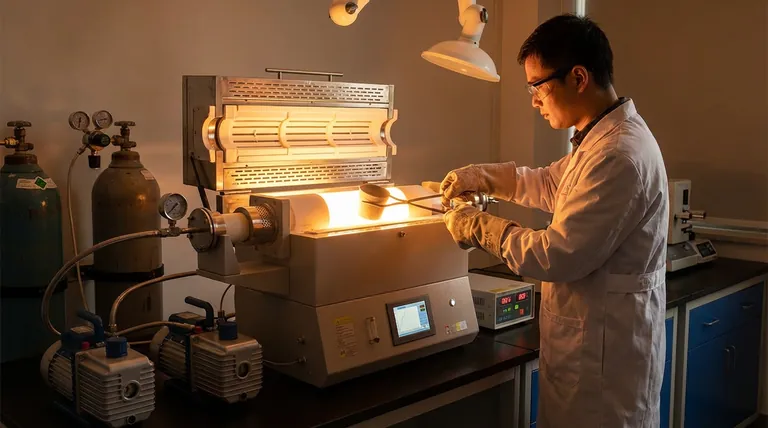
The Illusion of "Just Heat"
Every great endeavor, from surgery to cooking, is an exercise in controlling variables. A chef obsesses over their ingredients and flame; a surgeon works within a sterile field. They know that success hinges less on the grand action and more on eliminating the unseen agents of chaos.
In materials science, the greatest source of chaos is often the very air we breathe.
We tend to think of a furnace as a simple tool for generating heat. But for the scientist or engineer pushing the boundaries of what's possible, heat is the easy part. The truly difficult, and far more valuable, function is creating a perfect, isolated universe where an idea can become reality, free from atmospheric contamination. This is the core purpose of a tube furnace. It’s not an oven; it’s an environment controller.
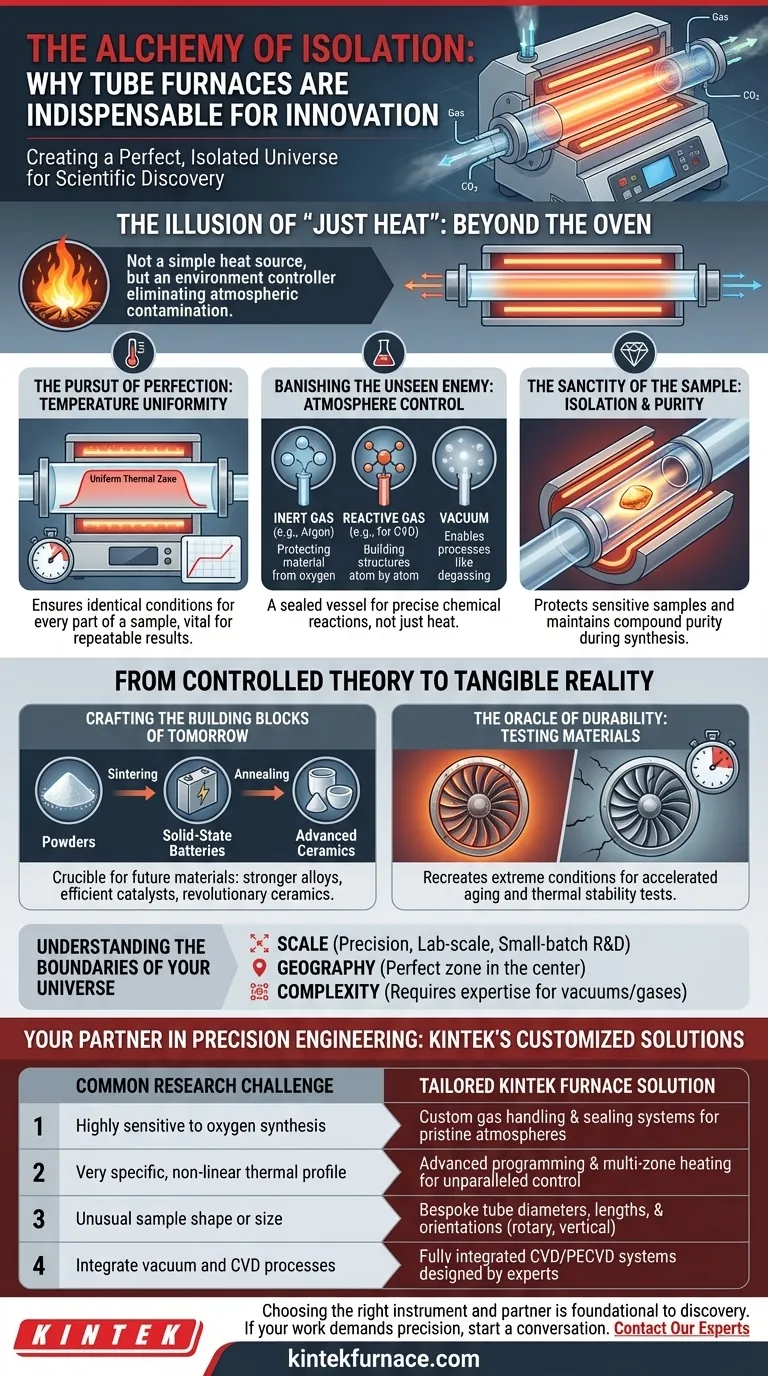
The Pursuit of Perfection: Temperature Uniformity
The frustration of a failed experiment is a universal feeling in any lab. When a result is skewed because of a five-degree temperature fluctuation along the sample, it’s not just a loss of material, but a loss of time and confidence.
A tube furnace is engineered to defeat this ambiguity. Its design creates an exceptionally uniform thermal zone, ensuring that every part of a sample experiences the exact same conditions. This repeatability is the foundation of credible research, from calibrating thermocouples to annealing a critical component.
Banishing the Unseen Enemy: Atmosphere Control
The defining feature of a tube furnace is the process tube itself. It’s a vessel that can be sealed off from the outside world, creating a stage for precise chemical reactions.
- Under an inert gas like argon, it becomes a sanctuary, protecting sensitive materials from the corrosive effects of oxygen.
- With a reactive gas, it transforms into a creative chamber for processes like Chemical Vapor Deposition (CVD), where new materials are literally built atom by atom.
- Under a vacuum, it allows for processes like degassing or brazing, which are impossible in a normal atmosphere.
This control over the atmosphere is not a secondary feature; it is the main event.
The Sanctity of the Sample: Isolation and Purity
A researcher’s sample is precious. It represents hours of work and the kernel of a new discovery. The tube furnace’s design inherently respects this by isolating that sample from the furnace's heating elements and the ambient environment.
This containment ensures that the purity of a compound is maintained during synthesis or that volatile precursors in battery research don't compromise safety or the experiment itself. It creates a clean, predictable space where the only reactions that occur are the ones you intend.
From Controlled Theory to Tangible Reality
When you can perfectly control the environment, you can move from theory to application. The tube furnace is the bridge between the two.
Crafting the Building Blocks of Tomorrow
Imagine synthesizing a novel powder for a next-generation solid-state battery. Its performance depends entirely on its crystalline structure and purity. The tube furnace provides the pristine, oxygen-free environment needed for its creation.
Then, processes like sintering (heating the powder to form a solid) or annealing (altering its properties with a precise thermal cycle) are performed in that same controlled space. The furnace becomes the crucible where the fundamental materials of our future—stronger alloys, more efficient catalysts, and revolutionary ceramics—are born.
The Oracle of Durability: Testing Materials
How will a new alloy behave on the turbine blade of a jet engine? How long will a ceramic component last in a high-heat industrial process? Guessing isn't an option.
A tube furnace acts as an oracle. By recreating extreme thermal conditions in a repeatable manner, engineers can perform accelerated aging and thermal stability tests. They aren't just heating a material; they are asking it a question about its future, and the furnace helps them get a reliable answer.
Understanding the Boundaries of Your Universe
Like any specialized tool, a tube furnace is designed for a specific purpose. Acknowledging its boundaries is key to using it effectively.
- Scale: It is an instrument of precision, ideal for lab-scale research and small-batch R&D, not mass production.
- Geography: The "perfect" uniform temperature zone is in the center of the tube. Understanding this geography is critical for proper sample placement.
- Complexity: Advanced applications involving vacuums or multiple gases require supporting equipment and expertise. It is a powerful instrument that rewards a thoughtful approach.
Your Partner in Precision Engineering
The challenge, then, isn't just acquiring a furnace. It's acquiring the right furnace—one configured to create the specific universe your research demands. An off-the-shelf solution rarely accounts for the unique variables of ambitious projects.
This is where deep customization becomes critical. Leading labs partner with manufacturers who understand that they aren't just selling a product, but engineering a solution. KINTEK's foundation in R&D and in-house manufacturing allows for this precise tailoring.
| Common Research Challenge | How a Tailored KINTEK Furnace Provides the Solution |
|---|---|
| My synthesis is highly sensitive to oxygen. | Custom gas handling and sealing systems for pristine inert or reactive atmospheres. |
| I need a very specific, non-linear thermal profile. | Advanced programming and multi-zone heating for unparalleled temperature control. |
| My sample is an unusual shape or size. | Bespoke tube diameters, lengths, and orientations (e.g., rotary, vertical). |
| I need to integrate vacuum and CVD processes. | Fully integrated CVD/PECVD systems designed by experts in both fields. |
Ultimately, the success of your work depends on the quality of your control. Choosing the right instrument, and more importantly, the right partner to configure it, is not a minor detail—it is foundational to the entire process of discovery.
If your work demands an environment as precise as your ambition, the first step is a conversation about your specific needs. Contact Our Experts
Visual Guide
Related Products
- Vacuum Sealed Continuous Working Rotary Tube Furnace Rotating Tube Furnace
- 1400℃ High Temperature Laboratory Tube Furnace with Alumina Tube
- 1700℃ High Temperature Laboratory Tube Furnace with Alumina Tube
- Magnesium Extraction and Purification Condensing Tube Furnace
- High Pressure Laboratory Vacuum Tube Furnace
Related Articles
- Beyond Heat: Mastering the Controlled Universe Inside a Tube Furnace
- Mastering the Void: How Tube Furnaces Forge the Atoms of Innovation
- Why Your Crystal Growth Experiments Are Failing: The Hidden Culprit in Your Tube Furnace
- The Art of Isolation: Mastering Material Properties with Tube Furnaces
- Beyond Heat: The Art of Control in a Tube Furnace



















