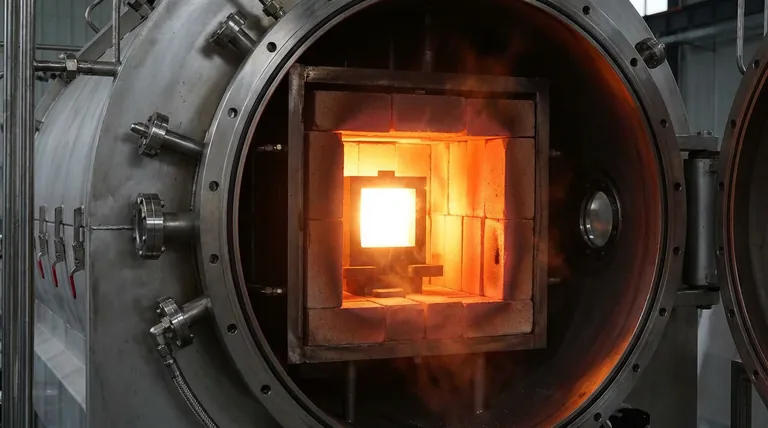
The Paradox of Heating in a Void
A vacuum is the ultimate insulator. It's a near-perfect void, devoid of the air molecules that typically transfer heat through convection. And yet, some of today's most advanced material processes require heating a component to thousands of degrees Celsius inside that very void.
This presents a fundamental engineering paradox: How do you generate and contain immense heat in an environment designed to stop its transfer? More critically, how do you do it without melting the very chamber that creates the vacuum?
The answer lies not in brute force, but in an elegant system of controlled energy and strategic insulation. It's about building a miniature sun in a box.
The Solution: A Sun in a Box
The most common and effective method is a form of direct resistive heating. Instead of heating the entire chamber, you create a small, intensely hot, and highly controlled "hot zone" precisely where it's needed.
This system has two heroes.
The Heart of the Fire: The Graphite Element
The heat source is a custom-designed graphite fixture. Graphite is an extraordinary material; it resists electricity, and when you force a current through it, that resistance generates immense heat—a phenomenon called Joule heating. It can also withstand temperatures that would vaporize most metals.
This fixture isn't just a passive holder for the workpiece. It is the heating element. By passing a controlled current directly through it, the heat is born exactly where the work is being done.
The Shield: The Refractory Hot Zone
Surrounding this glowing graphite heart is a box built from refractory materials. These are advanced ceramics engineered to act like a thermal mirror, reflecting heat inward.
This box creates the "hot zone." Its job is to contain the thermal energy, concentrating it on the workpiece for maximum efficiency and temperature uniformity. It's the shield that protects the rest of the universe—the vacuum chamber—from the star burning within.
The Unseen Battle: Thermal Load and System Integrity
Without that refractory shield, the graphite element would radiate heat indiscriminately. The cold walls of the vacuum chamber, often water-cooled, would act as a massive energy sink, constantly pulling heat away.
This would be incredibly inefficient, like trying to boil water over a bonfire in an open field. You'd need a far larger power supply to compensate for the continuous heat loss.
More importantly, the chamber walls must stay cool. Vacuum integrity depends on elastomeric seals (O-rings) that would fail at high temperatures. The structural integrity of the steel itself could be compromised.
By containing the vast majority of the radiant energy, the refractory box dramatically reduces the thermal load on the chamber walls. This means the cooling system can be simpler, more reliable, and less costly to operate. It wins the unseen battle before it even begins.
The Engineer's Dilemma: Navigating the Trade-Offs
This elegant solution is a masterclass in engineering trade-offs. There is no perfect choice, only the right choice for a specific goal. Every decision carries weight.
The Purity Question: The Ghost of Outgassing
Graphite, for all its strengths, can contain trapped gases. When heated in a vacuum, these gases are released in a process called outgassing. For sensitive applications like semiconductor manufacturing or medical implants, this invisible contaminant can be disastrous.
The solution demands a psychological shift from "what works" to "what is clean." This involves selecting ultra-high-purity grades of graphite and running a pre-process "bake-out" cycle to purge these volatile ghosts from the system.
The Design Challenge: More Than Just a Shape
The graphite fixture itself is a complex piece of engineering. It must:
- Heat the part uniformly.
- Provide stable mechanical support at extreme temperatures.
- Manage the electrical current without creating hot or cold spots.
The design of the electrical contacts, the cross-sectional area, and the geometry are all critical variables. It's a multi-physics problem balancing electrical, thermal, and mechanical engineering in a single component.
Choosing Your Path: Aligning Design with Purpose
The suitability of this entire approach depends on your ultimate goal.
- For extreme temperatures (>1200°C): Direct resistive heating is one of the most efficient and controllable methods available.
- For high-purity processes: The focus shifts to material selection and pre-conditioning to mitigate outgassing.
- For operational efficiency: The design and quality of the refractory hot zone become paramount to minimizing power and cooling costs.
No single furnace design can be optimized for all these variables simultaneously. True process control comes from a system designed for a specific application. This is why deep customization is not a luxury, but a necessity for cutting-edge research and manufacturing. Companies like KINTEK, with in-house R&D and manufacturing, build their furnace systems—from vacuum and CVD to tube and muffle furnaces—around this very principle. They understand that you aren't just buying a furnace; you're commissioning a tailored thermal environment.
Ultimately, a high-temperature vacuum furnace is a system of delicate balances. It's an engineered solution that contains a star while maintaining the perfect void around it, proving that even in a vacuum, heat can be mastered.
For processes that demand this level of precision and thermal control, collaborating with specialists is key. Contact Our Experts
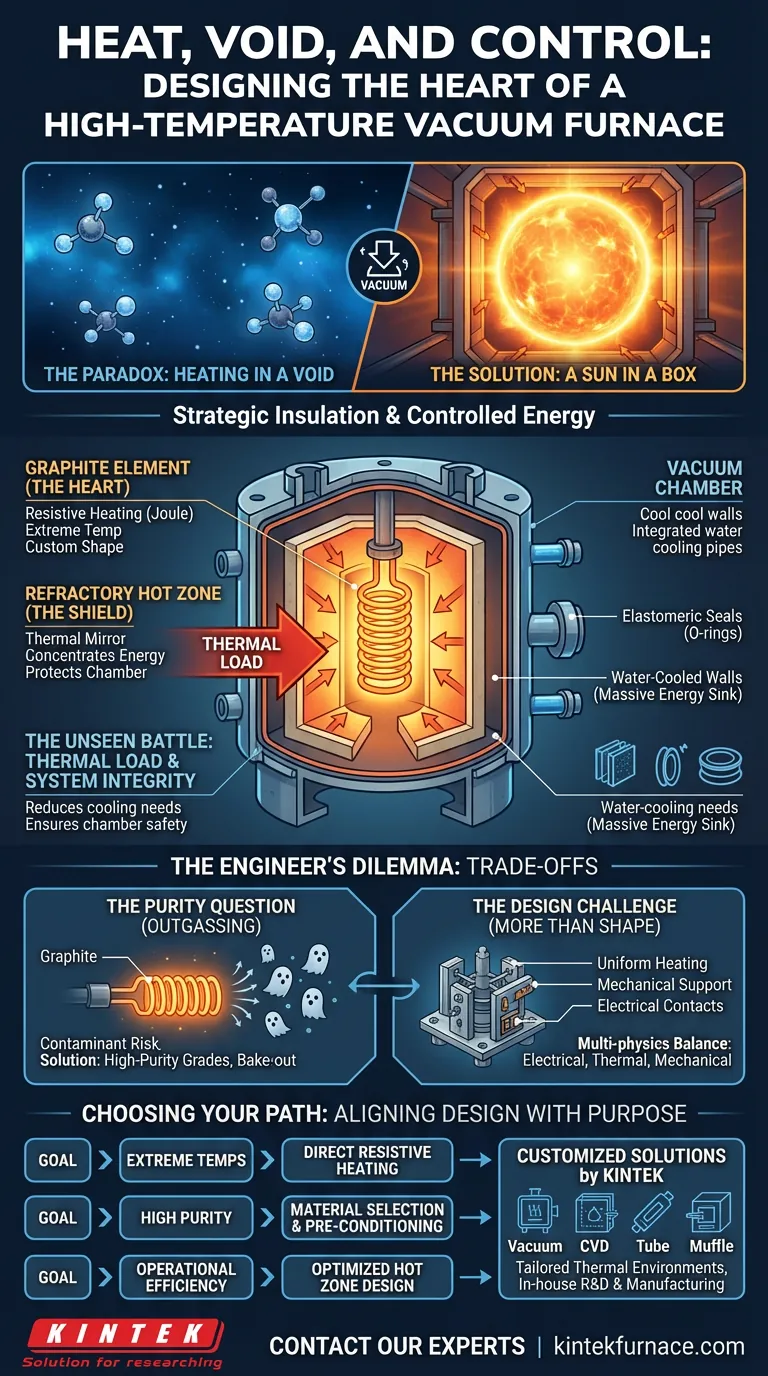
Visual Guide
Related Products
- 2200 ℃ Tungsten Vacuum Heat Treat and Sintering Furnace
- 2200 ℃ Graphite Vacuum Heat Treat Furnace
- Molybdenum Vacuum Heat Treat Furnace
- 1400℃ Controlled Inert Nitrogen Atmosphere Furnace
- Vacuum Heat Treat Sintering Furnace Molybdenum Wire Vacuum Sintering Furnace
Related Articles
- Why Your High-Strength Titanium Biomaterials Are Brittle—and How Vacuum Heat Treatment Fixes It
- Why Your Alloy Phase Separation Observations Are Inconsistent—And the "Invisible" Variable You’re Missing
- The Unseen Engine: Why Graphite Dominates High-Temperature Vacuum Furnaces
- The Paradox of Strength: Why Graphite Dominates High-Temperature Vacuum Furnaces
- Your Furnace Reached Temperature. So Why Did Your Experiment Fail?



















