Why Your Precision Tools Crack Just When They Should Be Getting Stronger
Imagine this: you’ve spent hours precisely machining a high-speed steel (HSS) milling cutter. It has been carefully heated to over 1,000°C in your furnace, and the metallurgy looks perfect. But the moment it hits the quenching medium, the unthinkable happens—a sharp ping or a subtle warp that ruins the dimensional integrity of the tool.
Whether it is micro-cracking or "banana" warping, these failures usually happen at the final hurdle. For many labs and manufacturers, this inconsistency is a nightmare that leads to high scrap rates, wasted energy, and missed delivery deadlines. The question is: why does a process meant to harden the steel so often end up destroying it?
The Common Struggle: Why "Faster" Isn't Always Better
When a tool fails during quenching, the traditional response is often to "tweak" the liquid medium. Technicians might try heating the quenching oil, changing the agitation speed, or switching from water to a specialized polymer.
The goal is always to achieve a high-hardness martensitic structure. However, liquid quenching is notoriously difficult to control. Even with the best oils, you are often fighting a losing battle against physics. When these traditional methods fail, the business consequences are immediate:
- Dimensional Inaccuracy: Tools that require expensive post-heat-treatment grinding.
- Thermal Stress: Invisible internal tensions that cause the tool to fail prematurely in the hands of the end-user.
- Inconsistency: One batch is perfect; the next is brittle.
The Root Cause: The Invisible Barrier of the "Vapor Film"

To understand why liquid quenching often fails precision tools, we have to look at the Leidenfrost phenomenon, also known as the vapor film effect.
When a red-hot tool is plunged into a liquid, the liquid immediately boils, creating a thin envelope of steam around the metal. This vapor film acts as an insulator, slowing down the cooling process in some areas while others cool rapidly. This creates massive thermal gradients—a fancy way of saying one part of your tool is shrinking faster than the part next to it.
This uneven contraction is what causes the steel to warp or snap. If you don't cool the steel fast enough to transform the austenite structure into martensite, the tool remains soft. But if you cool it unevenly with liquids, you get "stressed" martensite that is prone to cracking.
The Solution: Harnessing the Precision of High-Pressure Nitrogen
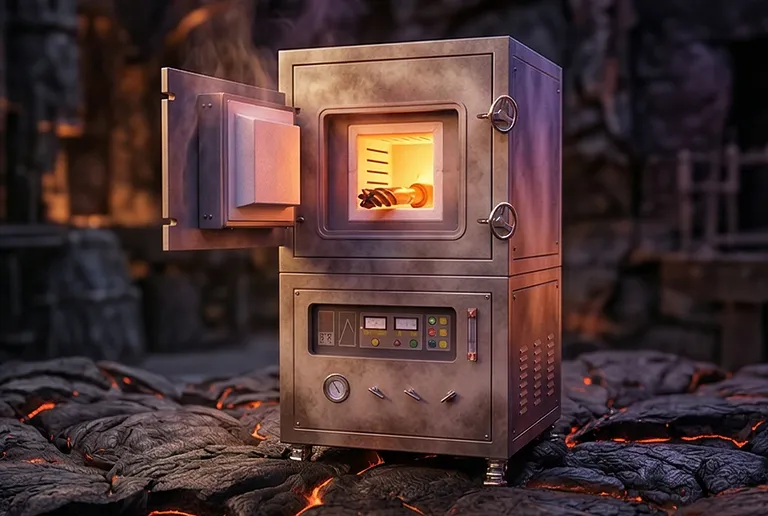
The most effective way to solve the quenching dilemma is to remove the liquid entirely and replace it with high-pressure nitrogen flow.
Unlike oil or water, nitrogen gas does not undergo a phase change. It doesn't boil, meaning the Leidenfrost effect is completely eliminated. Instead, the gas provides rapid and uniform forced convection cooling. By using high-pressure nitrogen, we can achieve the "Goldilocks" zone of heat treatment:
- Uniformity: The gas flows evenly around complex geometries, ensuring every tooth of a gear or flute of a drill cools at the exact same rate.
- Controllability: By precisely adjusting the pressure and flow velocity of the nitrogen, you can dial in the exact cooling rate required for your specific alloy. You aren't stuck with the "fixed" cooling rate of an oil bath.
- Structural Integrity: This controlled approach facilitates a smooth transformation from austenite to high-hardness martensite without the violent thermal shocks that cause cracking.
Beyond the Fix: Unlocking New Potential in Tool Manufacturing

When you solve the problem of quenching distortion, you do more than just save a few parts from the scrap bin. You redefine what your lab or facility is capable of.
With the precision of high-pressure nitrogen quenching, you can move toward "near-net-shape" heat treatment. Because distortion is minimized, the need for expensive and time-consuming post-quench machining is drastically reduced. You can process more complex tool designs that were previously considered too "risky" for traditional quenching. Ultimately, this leads to a faster time-to-market and a reputation for producing tools with superior longevity and performance.
At KINTEK, we don't just build furnaces; we engineer solutions for the most demanding metallurgical challenges. Whether you are working with high-speed steels or complex aerospace alloys, our customizable vacuum and atmosphere furnaces are designed to give you total control over the quenching environment. Our team of experts is ready to help you optimize your thermal cycles to eliminate scrap and maximize throughput. To discuss how our high-pressure gas quenching technology can transform your production outcomes, Contact Our Experts.
Related Products
- HFCVD Machine System Equipment for Drawing Die Nano Diamond Coating
- 1400℃ Controlled Inert Nitrogen Atmosphere Furnace
- 1700℃ Controlled Inert Nitrogen Atmosphere Furnace
- Custom Made Versatile CVD Tube Furnace Chemical Vapor Deposition CVD Equipment Machine
- Vacuum Induction Melting Furnace
Related Articles
- Why Your High-Temperature Synthesis Results Are Unreliable—And How to Fix It
- Solving the Bonding Dilemma: Why High-Strength Alloys Need More Than Just Pressure
- How CVD Diamond Synthesis Methods Compare for Industrial Applications
- Why Your High-Speed Steel Tools Fail Prematurely—And How Plasma Nitriding Rewrites the Science of Durability