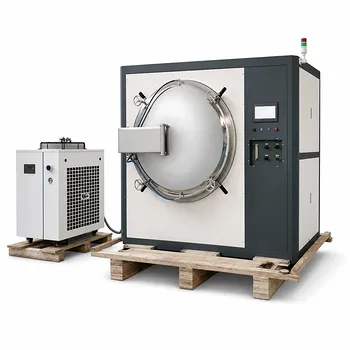
The Perfection That Disappears Overnight
You’ve spent weeks meticulously calibrating your synthesis process. Your Cadmium Sulfide (CdS) nanorods or silver nanoparticles have been grown to the exact dimensions required. They are washed, purified, and ready for characterization. But after a night in the drying oven, the result is disheartening: instead of a fine, active powder, you are left with a hard, discolored crust that has lost its catalytic edge.
This is a common "silent killer" in materials science. Many researchers view drying as a mundane utility step—a simple matter of removing water or solvents. However, for nanomaterials, the drying phase is just as chemically volatile as the synthesis itself. Choosing the wrong method doesn't just dry your sample; it fundamentally alters its morphology and destroys the very properties you worked so hard to create.
The Common Struggle: Why Standard Ovens Fail the Nano-Scale
When faced with wet nanocomposites or catalysts, the instinctive reaction is to turn up the heat in a standard convection oven to drive off moisture. On the surface, this seems logical. In practice, it often leads to three project-stalling outcomes:
- Thermal Oxidation: High temperatures in the presence of atmospheric oxygen can cause "oxidative deterioration." For high-activity nanocatalysts or metallic nanoparticles like silver, this means the active surface is "poisoned" before it ever reaches the testing phase.
- Hard Agglomeration: High-temperature drying often causes "cracking" at the micro-level, leading nanoparticles to fuse together into irreversible clumps.
- Structural Restacking: For materials like reduced graphene oxide, standard drying allows capillary forces to pull nanosheets together, causing severe overlapping and restacking that eliminates the material's high specific surface area.
The commercial consequence is clear: inconsistent research data, wasted high-value precursors, and months of project delays as teams struggle to replicate "lost" results.
The Root of the Problem: Pressure vs. Temperature
Why do these failures occur? The answer lies in the physics of evaporation. In a standard laboratory environment, moisture and solvents like ethanol require significant thermal energy to overcome atmospheric pressure and transition into vapor.
For nanomaterials, this heat is the enemy. At the nano-scale, those high temperatures trigger surface atoms to become highly mobile, leading to the "fusing" (agglomeration) mentioned above. Furthermore, the presence of air at high temperatures accelerates the chemical reaction between the material and oxygen.
To solve this, we must decouple "drying" from "high heat." By reducing the ambient pressure within the drying chamber, we can lower the boiling point of the solvents. This allows moisture to evaporate rapidly at temperatures as low as 60°C to 80°C—well below the threshold for thermal damage.
The Solution: Precision Vacuum Environments
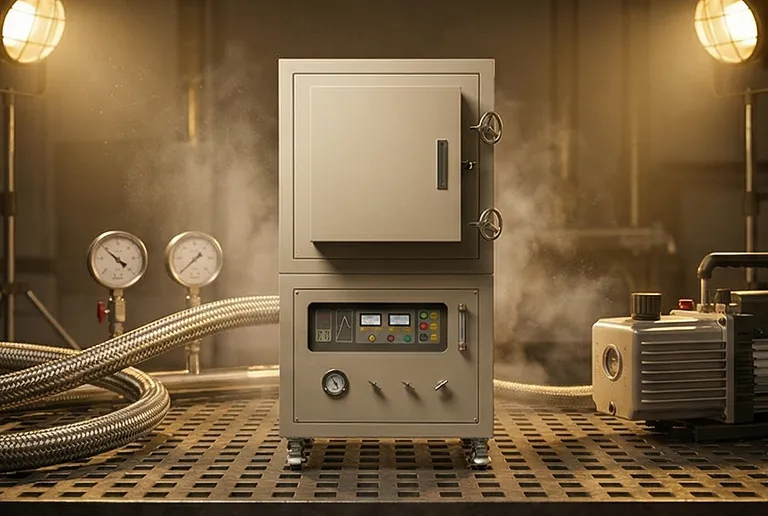
To protect the integrity of delicate structures like CdS nanorods or nickel foam arrays, a laboratory vacuum oven is not just an option—it is a necessity. KINTEK’s vacuum drying technology is engineered to address the root causes of material degradation directly:
- Low-Temperature Volatilization: By creating a low-pressure environment, our ovens accelerate the evaporation of water and organic solvents without subjecting the sample to high thermal stress. This preserves the "loose, porous" characteristics essential for catalysts and biochar composites.
- Atmosphere-Free Protection: Drying in a vacuum removes the oxygen that causes surface oxidation. This ensures that the crystallinity of precursors and the activity of surface functional groups remain intact.
- Preserving Morphology: By mitigating the capillary forces that occur during standard evaporation, vacuum drying prevents the "restacking" of nanosheets and maintains the high specific surface area of your particles.
Our ovens are designed not just to heat, but to provide a controlled environment where the physical activity and chemical stability of your powder are the top priorities.
Beyond the Fix: Unlocking New Research Potential
When you master the drying process, the focus of your lab shifts from "troubleshooting failures" to "exploring possibilities." By ensuring that every batch of nanorods or Co-Zr doped nanopowder maintains its intended fluidity and purity, you can achieve more reliable characterization and faster publication cycles.
Suddenly, you can explore more complex multi-porous structures and highly sensitive nano-arrays that were previously too "fragile" to survive the drying process. You gain the confidence that the performance you measure in the lab is a true reflection of your synthesis, not a byproduct of a compromised drying step.
At KINTEK, we understand that in the world of high-temperature processing and nanomaterial synthesis, the difference between a breakthrough and a setback often lies in the precision of your tools. Our team specializes in providing the exact thermal and vacuum environments required for the most demanding laboratory applications. Whether you are working with specialized CVD processes or sensitive nanoparticle drying, our experts are ready to help you optimize your workflow.
Contact Our Experts today to discuss your specific project requirements and find the ideal vacuum solution for your lab.
Related Products
- Vacuum Heat Treat Sintering and Brazing Furnace
- Vacuum Heat Treat Sintering Furnace Molybdenum Wire Vacuum Sintering Furnace
- Dental Porcelain Zirconia Sintering Ceramic Vacuum Press Furnace
- Vacuum Hot Press Furnace Machine for Lamination and Heating
- Vacuum Hot Press Furnace Machine Heated Vacuum Press
Related Articles
- Why 10⁻⁶ mbar Vacuum Isn’t Enough for Perfect Brazing—And the Missing Link to Oxide-Free Surfaces
- Why Your High-Temperature Aerospace Joints Fail—and the Science of the Perfect Vacuum Weld
- Why Your 3D-Printed Maraging Steel Parts Aren't Performing—And How to Fix the Structural Weakness
- Why Your Vacuum Brazed Joints Are Failing—And the Precise Pressure Fix You’ve Been Missing
- Beyond Inert: The Physics and Psychology of Perfecting Joints in a Vacuum Furnace