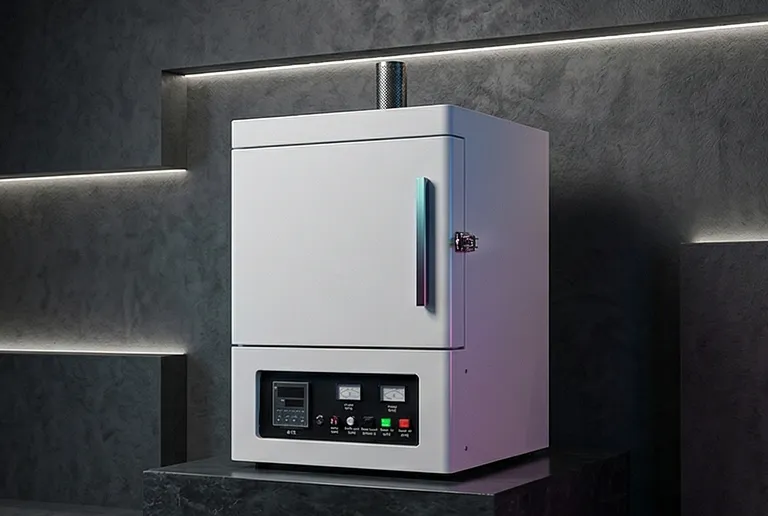
The 3D Printing Paradox: Why "Perfect" Titanium Parts Fail
You’ve just finished a complex Ti-6Al-4V component using Selective Laser Melting (SLM). On the surface, the part looks flawless—intricate geometries that were impossible just a decade ago. But beneath that surface, the material is "screaming."
Because of the rapid melting and near-instantaneous solidification inherent in laser-based manufacturing, the internal structure of the titanium is riddled with residual stresses. If you put that part into service immediately, it will likely warp, crack, or fail prematurely. You know you need to heat treat it to "relax" the metal, but this is where many engineers encounter a second, more frustrating problem: the part comes out of the furnace looking fine, but it has become as brittle as glass.
The Cost of Traditional Annealing: When the Solution Becomes the Problem
The standard industry response to residual stress is annealing. To the uninitiated, this seems simple: put the part in a furnace, heat it up, and let the stress bleed away.
However, many laboratories and manufacturers attempt this using standard atmosphere furnaces or even basic inert gas setups. The results are often disastrous. You might notice a yellowish or blue tint on the surface—the dreaded "alpha case"—or worse, the part passes visual inspection but fails the ductility test.
The commercial consequences are severe. A single batch of "embrittled" aerospace or medical components can represent tens of thousands of dollars in wasted material, machine time, and project delays. When your material properties don't meet industrial standards, your entire production line grinds to a halt.
The Chemistry of Failure: Why Titanium "Breathes" at High Temperatures
To solve this, we have to look at the atomic level. Ti-6Al-4V is what metallurgists call "chemically active." It has a voracious appetite for gaseous elements like oxygen, nitrogen, and hydrogen.
When you heat titanium above 400°C in the presence of even trace amounts of air, it doesn't just "rust" on the surface; it absorbs these gases into its crystalline lattice. These are known as interstitial contaminants. They wedge themselves between the metal atoms, locking them in place and preventing the material from stretching. This is the root cause of embrittlement.
Furthermore, the 3D printing process leaves the titanium in a "martensitic" state—a needle-like microstructure that is incredibly hard but lacks the toughness required for critical applications. To transform this into a stable, "alpha + beta" lamellar structure, you must reach temperatures near 850°C to 1050°C. At these temperatures, if your environment isn't perfect, the titanium will essentially "choke" on the surrounding atmosphere before the structural transformation can even begin.
The High-Vacuum Shield: Re-Engineering the Microstructure from Within
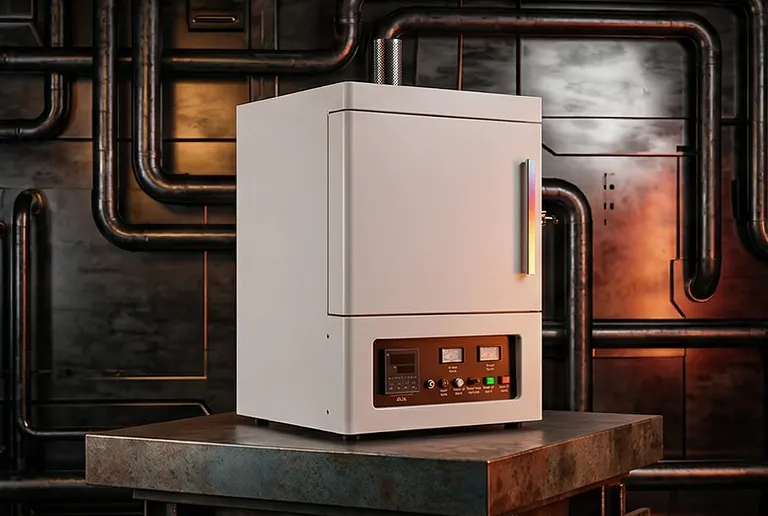
The only way to escape this "Titanium Paradox" is to remove the environment entirely. This is where a High-Vacuum High-Temperature Furnace becomes an essential tool rather than a luxury.
By processing Ti-6Al-4V in an extreme vacuum—often as low as 10⁻⁵ mbar—you are doing more than just heating a part; you are creating a sanctuary for the metal. Here is how the process works to fix the root cause:
- Elimination of Contaminants: At 10⁻⁵ mbar, there are virtually no oxygen or nitrogen molecules left to react with the titanium. This prevents the formation of the brittle alpha case and ensures the chemical purity of the alloy.
- The Two-Stage Stress Relief: A controlled vacuum environment allows for precise soaking stages. For example, a 350°C soak begins the relaxation of macro-stresses, while an 850°C soak facilitates the critical phase transformation.
- Phase Homogenization: Under high vacuum, the furnace can safely hold the material at high temperatures long enough for the brittle martensite to decompose into a stable alpha+beta lamellar structure. This "unlocks" the material's ductility, ensuring it meets or exceeds industrial standards.
KINTEK’s high-vacuum furnaces are engineered specifically for this level of precision. Unlike general-purpose ovens, our systems are built to maintain deep vacuum integrity even at 1200°C, providing the stable thermal and atmospheric environment required for solid-state atomic diffusion.
From Brittle to Breakthrough: Unlocking New Potential
When you master the environment, you master the material. By using a high-vacuum solution to solve the embrittlement problem, you move beyond mere "repair" and into the realm of advanced engineering.
With the residual stress gone and the microstructure stabilized, your Ti-6Al-4V components are no longer just "printed parts"—they are high-performance assets. You can now explore:
- Aerospace-Grade Fatigue Resistance: Ensuring parts can withstand millions of cycles without crack initiation.
- Advanced Laser Polishing: Creating a stable material foundation for superior surface finishes.
- Complex Layered Structures: Utilizing vacuum hot pressing to bond metal layers without melting, creating pores-free, high-performance composites.
The bottleneck in your production isn't the 3D printer; it's the thermal environment that follows. By addressing the root cause of titanium reactivity, you turn a volatile process into a predictable, high-yield manufacturing powerhouse.
At KINTEK, we understand that every titanium application has its own set of challenges, from dental implants to turbine blades. Our team specializes in designing customizable high-vacuum thermal solutions that bridge the gap between "printed" and "proven." If you are struggling with inconsistent material properties or embrittlement in your reactive alloy projects, we are here to help you engineer a solution. Contact Our Experts to discuss your specific high-temperature vacuum requirements today.
Related Products
- Vacuum Heat Treat Furnace with Ceramic Fiber Liner
- 2200 ℃ Graphite Vacuum Heat Treat Furnace
- Molybdenum Vacuum Heat Treat Furnace
- 2200 ℃ Tungsten Vacuum Heat Treat and Sintering Furnace
- Vacuum Heat Treat Sintering Furnace with Pressure for Vacuum Sintering
Related Articles
- Why Your 3D-Printed Maraging Steel Parts Aren't Performing—And How to Fix the Structural Weakness
- From Brute Force to Perfect Control: The Physics and Psychology of Vacuum Furnaces
- The Most Important Number in a Vacuum Furnace Isn't Its Temperature
- Mastering the Void: How Custom Vacuum Furnaces Forge the Future of Materials
- Why Your Advanced NiTi Coatings Fail Post-Deposition—and How to Fix It



















