
The Frustration of the "Perfect" Growth That Wasn't
You’ve spent weeks meticulously preparing your precursors, calculating the stoichiometry, and setting up the growth parameters for a new superconducting single crystal. You initiate the Bridgman process, wait through the slow cooling cycle, and finally open the chamber—only to find a polycrystalline mess, a cracked ingot, or a sample riddled with oxide impurities.
In the world of high-performance materials, there is nothing more frustrating than "almost correct." For researchers and manufacturers working with superconductors, the difference between a breakthrough and a wasted month often comes down to what is happening inside the furnace at a microscopic level. If your data is inconsistent or your crystals are failing to reach the required scale, the problem likely isn't your chemistry—it’s your thermal environment.
The Struggle: Why Conventional Heating Falls Short
Many laboratories begin their journey using standard resistance furnaces. On paper, these furnaces reach the necessary temperatures. However, when the goal is a high-quality superconducting single crystal, "hot enough" is only half the battle.
Standard furnaces often struggle with two critical factors:
- Atmospheric Contamination: Even at high temperatures, residual oxygen can cause oxidation or decarburization of the metallic matrix. This alters the superconducting properties and introduces defects that kill conductivity.
- Thermal Instability: A standard furnace might claim to be stable within 5°C or 10°C. But for methods like the Bridgman technique, where the solidification front must be moved with extreme precision, a fluctuation of even a few degrees can cause spontaneous nucleation, leading to multiple small crystals rather than one large, perfect single crystal.
The commercial consequences are clear: project delays, high material waste, and the inability to produce the large-scale samples required for industrial applications or advanced structural analysis.
The Root Cause: The Physics of the Solidification Front
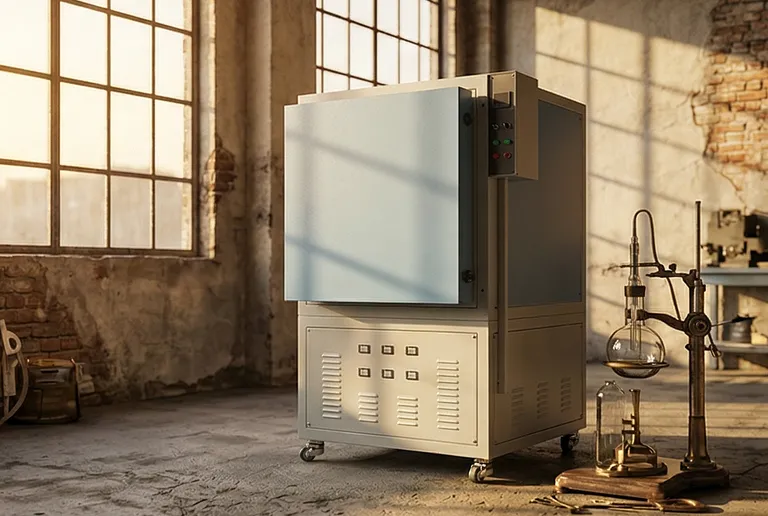
To understand why these failures happen, we have to look at the underlying physics of crystal growth. Growing a single crystal requires an exceptionally stable temperature gradient.
As the melt transitions to a solid, any "flicker" in temperature causes the solidification front to jump or recede. If the temperature drops too fast or unevenly, the atoms don't have time to align in a perfect lattice, resulting in grain boundaries and defects. Furthermore, at temperatures exceeding 1500°C, traditional heating elements in an open or low-vacuum environment begin to degrade, shedding particles or fluctuating in resistance, which further destabilizes the thermal field.
To solve this, you don't just need heat; you need thermal inertia combined with absolute atmospheric purity. This is where the physics of vacuum science and tungsten mesh technology become the only viable path forward.
The Solution: The High-Vacuum Tungsten Mesh Advantage
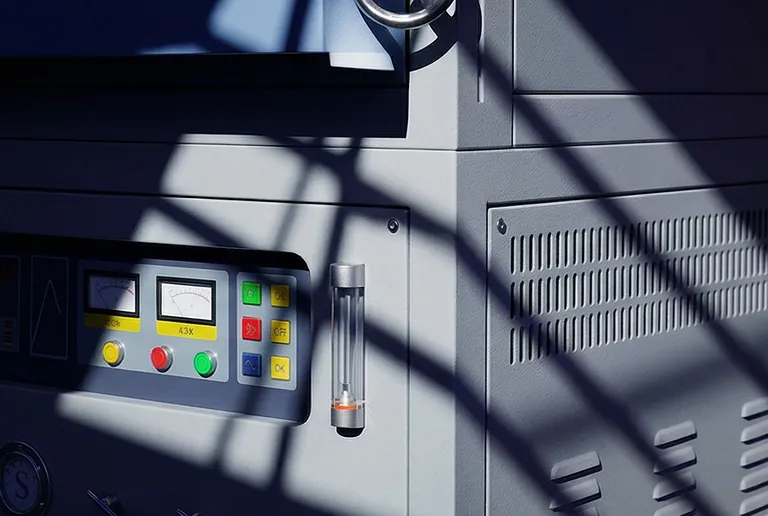
To overcome the limitations of standard heating, we must move toward a specialized environment. A High-Vacuum Tungsten Mesh Heating Furnace is not just a hotter oven; it is a precision instrument designed specifically to address the root causes of crystal defects.
- Absolute Purity via High Vacuum: By maintaining pressures as low as 10^-1 Pa, these furnaces eliminate oxygen and facilitate the removal of residual gases from within the material. This significantly lowers porosity and prevents the surface degradation that plagues samples grown in standard air or inert gas furnaces.
- The Power of Tungsten Mesh: Unlike standard wire-wound elements, tungsten mesh provides a highly uniform heating surface. Within a vacuum, tungsten is incredibly stable and offers an extended service life even at temperatures exceeding 1500°C.
- 0.1°C Precision: The core of the KINTEK system is a high-precision control loop capable of maintaining 0.1°C stability. This level of control allows you to manage the delicate temperature gradients required for the Bridgman method, ensuring the solidification front moves at a perfectly linear rate.
By choosing a tool built for this level of precision, you are no longer "hoping" for a good crystal; you are engineering the conditions that make a perfect crystal inevitable.
Beyond the Fix: Opening New Doors in Material Science
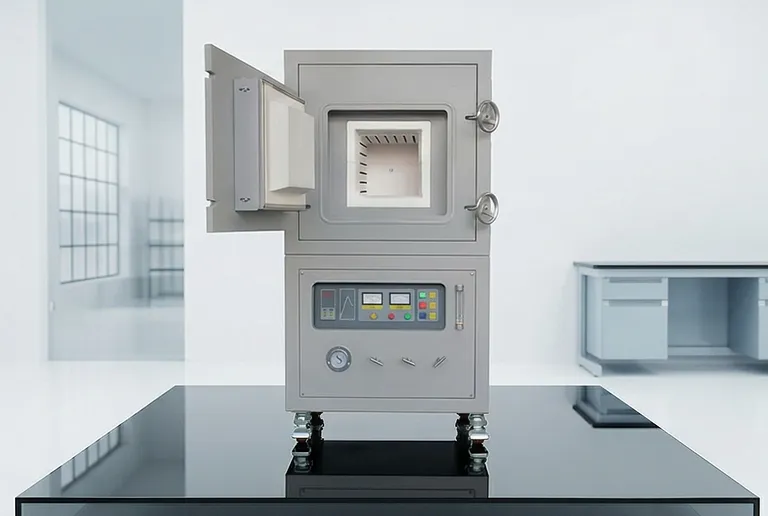
When you move from a "standard" furnace to a high-vacuum tungsten mesh system, you aren't just solving a technical problem—you are unlocking new research and production capabilities.
With a stable thermal environment and a compact furnace design, researchers can now perform in-situ structural analysis. Because the furnace can maintain precise linear heating rates (such as 10°C/min) while remaining transparent to synchrotron radiation or X-ray beams, you can characterize the crystal's structure in real-time as it forms.
Furthermore, the ability to produce large-scale, high-purity superconductors with repeatable results means moving faster from the lab to the market. Whether you are working on energy-efficient power grids, advanced medical imaging, or quantum computing components, the foundation of your success is the quality of the crystal you produce.
Choosing the right thermal environment is the most critical decision in your process. At KINTEK, we specialize in customizing these high-precision environments to meet the unique demands of your most challenging materials. Whether you are facing issues with oxidation, porosity, or thermal drift, our team is ready to help you engineer a solution that turns your technical hurdles into your next breakthrough.
To discuss your specific project requirements or to explore our range of customizable high-vacuum furnaces, Contact Our Experts.
Related Products
- Molybdenum Vacuum Heat Treat Furnace
- High Pressure Laboratory Vacuum Tube Furnace
- Vacuum Heat Treat Sintering Furnace with Pressure for Vacuum Sintering
- Split Chamber CVD Tube Furnace with Vacuum Station CVD Machine
- Vacuum Induction Melting Furnace
Related Articles
- Why Your Ti-6Al-4V Parts Crack Under Pressure—The Hidden Science of Vacuum Heat Treatment
- Why Your High-Strength Titanium Biomaterials Are Brittle—and How Vacuum Heat Treatment Fixes It
- Why Your 3D-Printed Maraging Steel Parts Aren't Performing—And How to Fix the Structural Weakness
- Why Your Alloy Phase Separation Observations Are Inconsistent—And the "Invisible" Variable You’re Missing
- Why Your Advanced Coatings Fail Under Stress—And How High-Vacuum Treatment Fixes the Root Cause



















