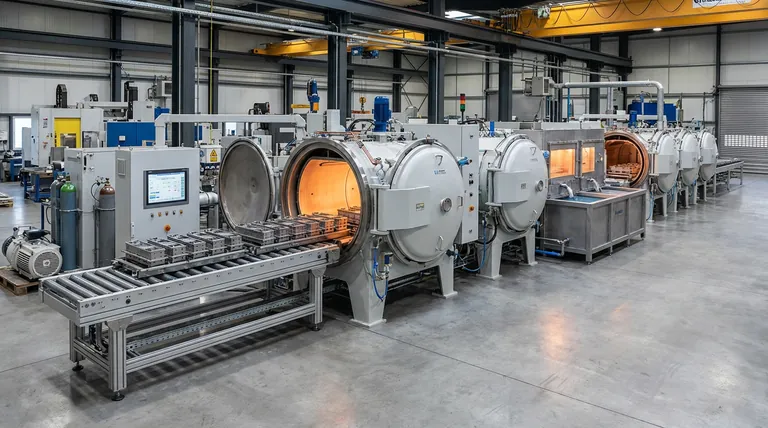
The Tyranny of the Batch Process
In materials science and advanced manufacturing, we often talk about breakthroughs in chemistry or metallurgy. We rarely talk about the silent bottleneck that governs them: the workflow.
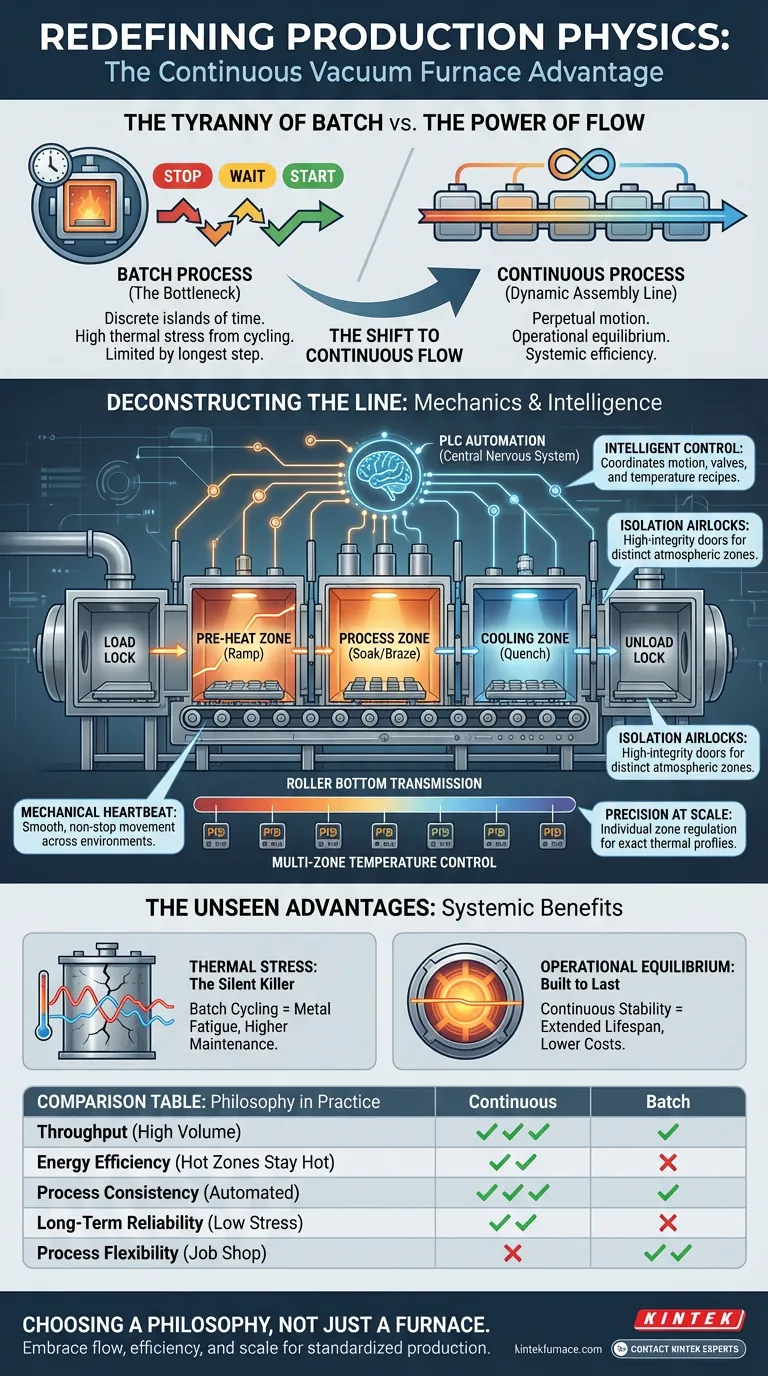
For decades, the single-chamber batch furnace has been the workhorse. Its cycle is familiar: load, seal, pump down, heat up, process, cool down, vent, unload. Each step is a discrete island of time. The entire system is held hostage by the longest step, usually heating and cooling. This is the tyranny of the batch process—a world of "hurry up and wait."
But what if the problem isn't the furnace, but the philosophy? The most significant leap in efficiency comes not from making a better furnace, but from rethinking the entire flow of work. This is the shift from a static workshop to a dynamic assembly line.
Deconstructing the Continuous Assembly Line
A multi-chamber continuous vacuum furnace isn't just a longer furnace. It's a physical manifestation of a process flow, an integrated system where each component serves the single purpose of perpetual motion.
The Grammar of Production: A Modular Design
Think of a manufacturing process as a sentence. It has verbs: load, pre-heat, braze, cool, unload. A continuous furnace builds this sentence with physical modules. Each chamber is a specialized clause, optimized for a single task.
This modularity allows you to construct the perfect process "sentence" for your application, whether it's sintering complex parts or vacuum brazing electronic components. The line is built to match the logic of your work, not the other way around.
The Mechanical Heartbeat: Transmission and Isolation
To make this assembly line work, two brilliant engineering solutions had to be perfected.
First, the roller bottom transmission system. This is the conveyor belt of the vacuum world, a robust mechanical backbone designed to move workloads smoothly from one hostile environment to the next without ever breaking vacuum. It's the physical pulse of the continuous process.
Second, the pneumatic gate valves. These are the airlocks between worlds. As a tray of parts moves from a 1200°C heating zone to a cooling zone, these high-integrity doors slide shut, isolating each chamber. This allows drastically different temperatures, pressures, and atmospheres to exist inches apart, a feat critical for complex thermal profiles.
The Intelligence of the System
A continuous furnace is more than just clever mechanics; it's a sophisticated, self-regulating organism. Its intelligence is what ensures precision and repeatability at a scale batch processing can't match.
Precision at Scale: Multi-Zone Temperature Control
Achieving a precise temperature profile across a long furnace is a monumental challenge. The solution is multi-zone PID closed-loop control.
Think of it not as one thermostat, but as an entire orchestra of them. Each heating "zone" has its own sensor and PID controller—a tiny, vigilant brain that constantly adjusts power to hold its temperature with incredible accuracy. Together, they create a perfectly harmonized thermal gradient tailored to the material's exact needs.
The Central Nervous System: Integrated PLC Automation
Coordinating the roller movements, valve timing, and dozens of temperature zones is a Programmable Logic Controller (PLC). This industrial computer is the central nervous system of the entire furnace.
It executes the pre-programmed recipe flawlessly, ensuring every part experiences the exact same process every time. Operators interact via a simple Human-Machine Interface (HMI), giving them a clear window into the process and logging every critical data point for quality assurance. The system runs itself.
The Psychological Shift: Why 'Continuous' Changes Everything
The true power of this approach lies in the second-order effects—the systemic benefits that emerge when you abandon the start-stop-start nature of batch work.
Escaping the Cycle of Thermal Stress
A batch furnace lives a hard life. It is constantly heated to extreme temperatures and then forced to cool down. This thermal cycling induces immense stress on heating elements, insulation, and the chamber itself, leading to metal fatigue and eventual failure.
A continuous furnace, by contrast, achieves a state of equilibrium. The hot zones stay hot, and the cool zones stay cool. This operational stability dramatically reduces thermal stress, leading to a significant increase in equipment lifespan and a drastic reduction in maintenance costs. It's a more reliable system because it's a less stressed system.
The Economics of Flow vs. The Flexibility of the Job Shop
This leap in performance comes with a clear trade-off. A continuous furnace is a strategic investment in high-volume, standardized production. It's less suited for a high-mix, low-volume R&D lab where process requirements change daily.
| Consideration | Multi-Chamber Continuous Furnace | Single-Chamber Batch Furnace |
|---|---|---|
| Throughput | Extremely high; eliminates dead time | Low to moderate; limited by cycle time |
| Energy Efficiency | High; hot zones remain at temperature | Lower; energy lost during each cool-down |
| Process Consistency | Exceptional; fully automated | Good, but operator-dependent |
| Long-Term Reliability | High; minimal thermal stress | Lower; constant thermal cycling causes wear |
| Initial Investment | High | Low |
| Process Flexibility | Low; optimized for a specific workflow | High; easily reconfigured for new jobs |
Choosing a Philosophy, Not Just a Furnace
Ultimately, adopting a multi-chamber continuous furnace is about more than upgrading equipment. It's a commitment to an industrial philosophy—one of flow, efficiency, and scale. It's for operations where consistency and cost-per-part are paramount.
At KINTEK, we specialize in engineering these advanced thermal systems. We understand that every production line is unique, which is why our Muffle, Tube, Vacuum, and CVD furnaces are built on a foundation of deep customization. We design and manufacture systems that embody your specific production philosophy.
If you're ready to move beyond the limitations of batch processing and embrace the physics of continuous flow, let's build the right system for you. Contact Our Experts
Visual Guide
Related Products
- Vacuum Sealed Continuous Working Rotary Tube Furnace Rotating Tube Furnace
- Electric Rotary Kiln Continuous Working Small Rotary Furnace Kiln for Pyrolysis Plant Heating
- Vacuum Heat Treat Sintering Furnace with Pressure for Vacuum Sintering
- Vacuum Heat Treat Sintering Furnace Molybdenum Wire Vacuum Sintering Furnace
- Vacuum Hot Press Furnace Machine Heated Vacuum Press Tube Furnace
Related Articles
- Beyond Heat: Mastering the Controlled Universe Inside a Tube Furnace
- Mastering the Void: How Tube Furnaces Forge the Atoms of Innovation
- Why Your Crystal Growth Experiments Are Failing: The Hidden Culprit in Your Tube Furnace
- The Art of Isolation: Mastering Material Properties with Tube Furnaces
- Beyond Heat: The Art of Control in a Tube Furnace



















