
Vacuum Consumable Arc Remelting (VAR) is a critical requirement for refining Ni-W-Co-Ta alloys because it provides deep purification and structural uniformity that initial melting processes cannot achieve alone. By utilizing a controlled electric arc in a vacuum, VAR eliminates microscopic defects to ensure the final material meets high-performance standards.
Core Takeaway While initial methods like Vacuum Induction Melting (VIM) create the base alloy, they often leave behind structural imperfections. VAR acts as the essential secondary refining step, effectively erasing porosity and segregation to produce a dense, chemically consistent ingot ready for advanced manufacturing.
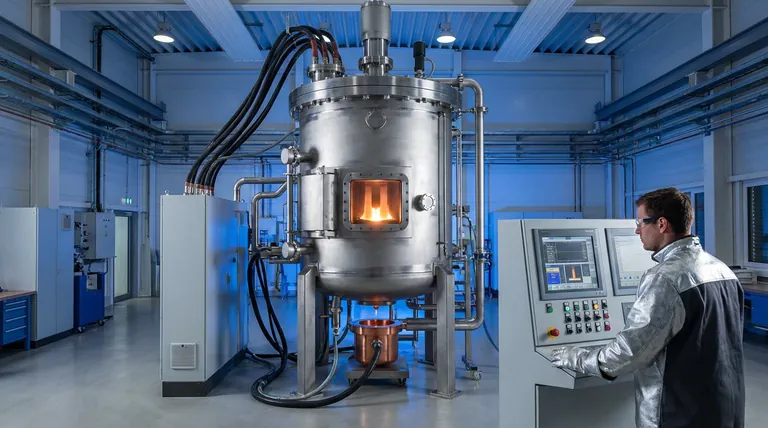
The Mechanism of Purification
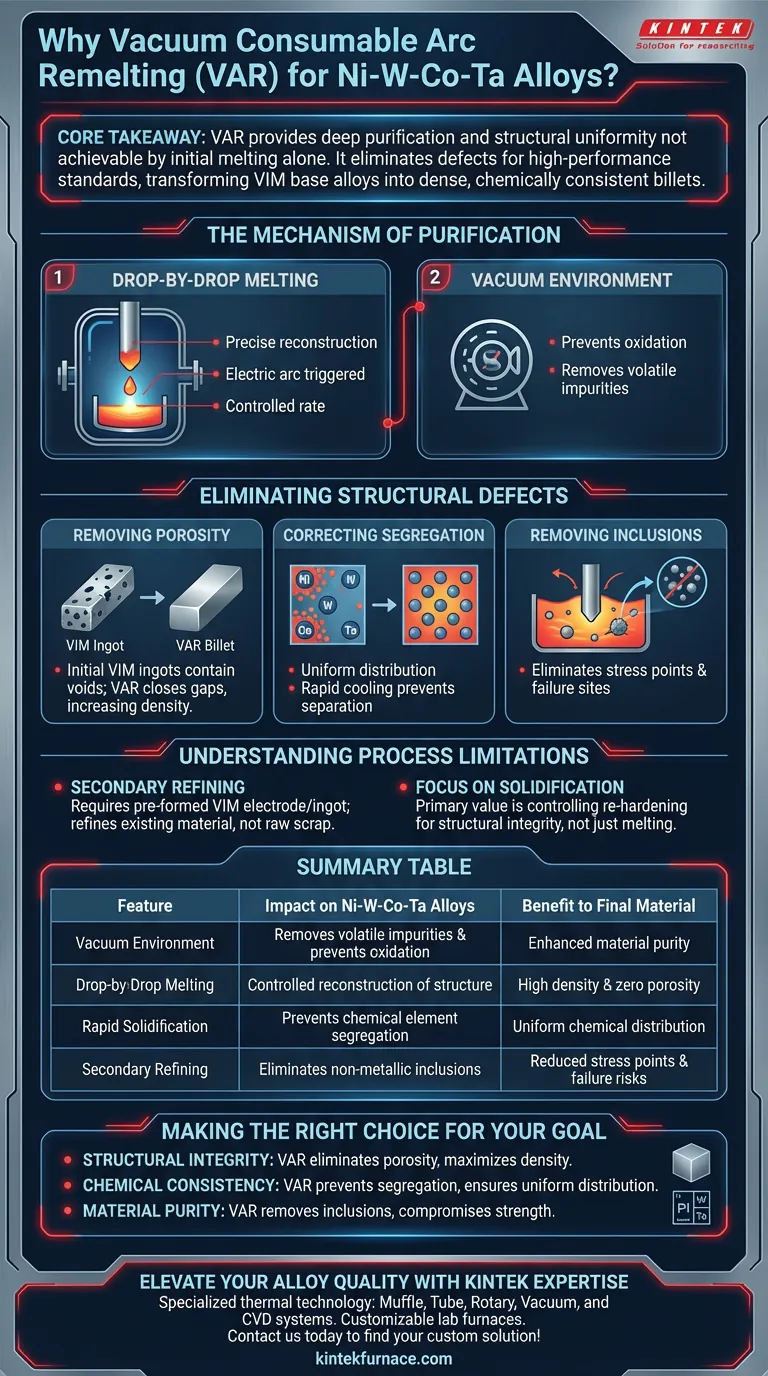
Drop-by-Drop Melting
The VAR process refines the Ni-W-Co-Ta alloy through a precise drop-by-drop melting and condensation cycle.
Triggered by an electric arc, the alloy is melted slowly and methodically. This controlled rate allows for the careful reconstruction of the ingot structure.
The Vacuum Environment
This process occurs entirely within a vacuum chamber.
The vacuum environment is essential for preventing oxidation and removing volatile impurities that would otherwise degrade the alloy's performance.
Eliminating Structural Defects
Removing Porosity
One of the primary reasons VAR is required is to eliminate porosity.
Initial ingots from Vacuum Induction Melting (VIM) often contain microscopic voids or gas pockets. VAR remelting closes these gaps, significantly increasing the alloy's density.
Correcting Segregation
Ni-W-Co-Ta alloys are complex mixtures, and elements can separate or "segregate" during initial cooling.
VAR ensures uniform distribution of these elements. The rapid cooling of the molten drops prevents the chemical components from separating, ensuring a consistent structure throughout the ingot.
Removing Inclusions
The process effectively removes non-metallic inclusions.
These impurities, which act as stress points and potential failure sites, are isolated and eliminated during the remelting process.
Understanding the Process Limitations
Dependency on Pre-Melting
It is important to note that VAR is a secondary refining process, not a primary melting technique.
It relies on the existence of a pre-formed electrode or ingot, typically produced via VIM. It refines existing material rather than creating new alloys from raw scrap.
Focus on Solidification
The primary value of VAR lies in controlling solidification, not just melting.
While it excels at cleaning the material, its main function is to dictate how the ingot re-hardens to ensure the structural integrity required for subsequent processing.
Making the Right Choice for Your Goal
To determine if VAR is necessary for your specific application of Ni-W-Co-Ta alloys, consider your quality requirements:
- If your primary focus is Structural Integrity: VAR is non-negotiable for eliminating porosity and maximizing the density of the final billet.
- If your primary focus is Chemical Consistency: Use VAR to prevent segregation and ensure the Nickel, Tungsten, Cobalt, and Tantalum are uniformly distributed.
- If your primary focus is Material Purity: VAR is required to remove non-metallic inclusions that could compromise the alloy's strength.
Ultimately, VAR transforms a standard cast ingot into a high-quality billet capable of withstanding rigorous downstream processing.
Summary Table:
| Feature | Impact on Ni-W-Co-Ta Alloys | Benefit to Final Material |
|---|---|---|
| Vacuum Environment | Removes volatile impurities & prevents oxidation | Enhanced material purity |
| Drop-by-Drop Melting | Controlled reconstruction of ingot structure | High density & zero porosity |
| Rapid Solidification | Prevents chemical element segregation | Uniform chemical distribution |
| Secondary Refining | Eliminates non-metallic inclusions | Reduced stress points & failure risks |
Elevate Your Alloy Quality with KINTEK Expertise
Precision in Ni-W-Co-Ta refining demands high-performance thermal technology. At KINTEK, we provide the specialized equipment needed to transform raw ingots into high-integrity billets. Backed by expert R&D and world-class manufacturing, we offer Muffle, Tube, Rotary, Vacuum, and CVD systems, along with customizable lab high-temp furnaces tailored to your unique metallurgical needs.
Ready to eliminate structural defects and achieve superior chemical consistency? Contact us today to find your custom solution!
Visual Guide
References
- Yong Li, Chunxu Wang. Effect of Aging Time on Microstructure and Properties of Cold-Rolled Ni-W-Co-Ta Medium–Heavy Alloy. DOI: 10.3390/coatings14020230
This article is also based on technical information from Kintek Furnace Knowledge Base .
Related Products
- Vacuum Induction Melting Furnace
- Vacuum Hot Press Furnace Machine for Lamination and Heating
- Small Vacuum Heat Treat and Tungsten Wire Sintering Furnace
- Vacuum Heat Treat Sintering Furnace Molybdenum Wire Vacuum Sintering Furnace
- Molybdenum Vacuum Heat Treat Furnace
People Also Ask
- What are the core functions of the High Vacuum Induction Melting (VIM) furnace? Optimize DD5 Superalloy Purification
- Why is a Vacuum Induction Melting furnace (VIM) used for Cu-Zn-Al-Sn alloys? Achieve Precision Composition Control
- What role does a Vacuum Induction Melting furnace play in the production of high-aluminum nickel-based superalloys?
- What are the advantages of using a VIM furnace to control residual oxygen pressure? Achieve Superior Metal Uniformity
- What is the role of VIM and directional solidification in aero-engine blade substrates? Engineering Extreme Durability






