
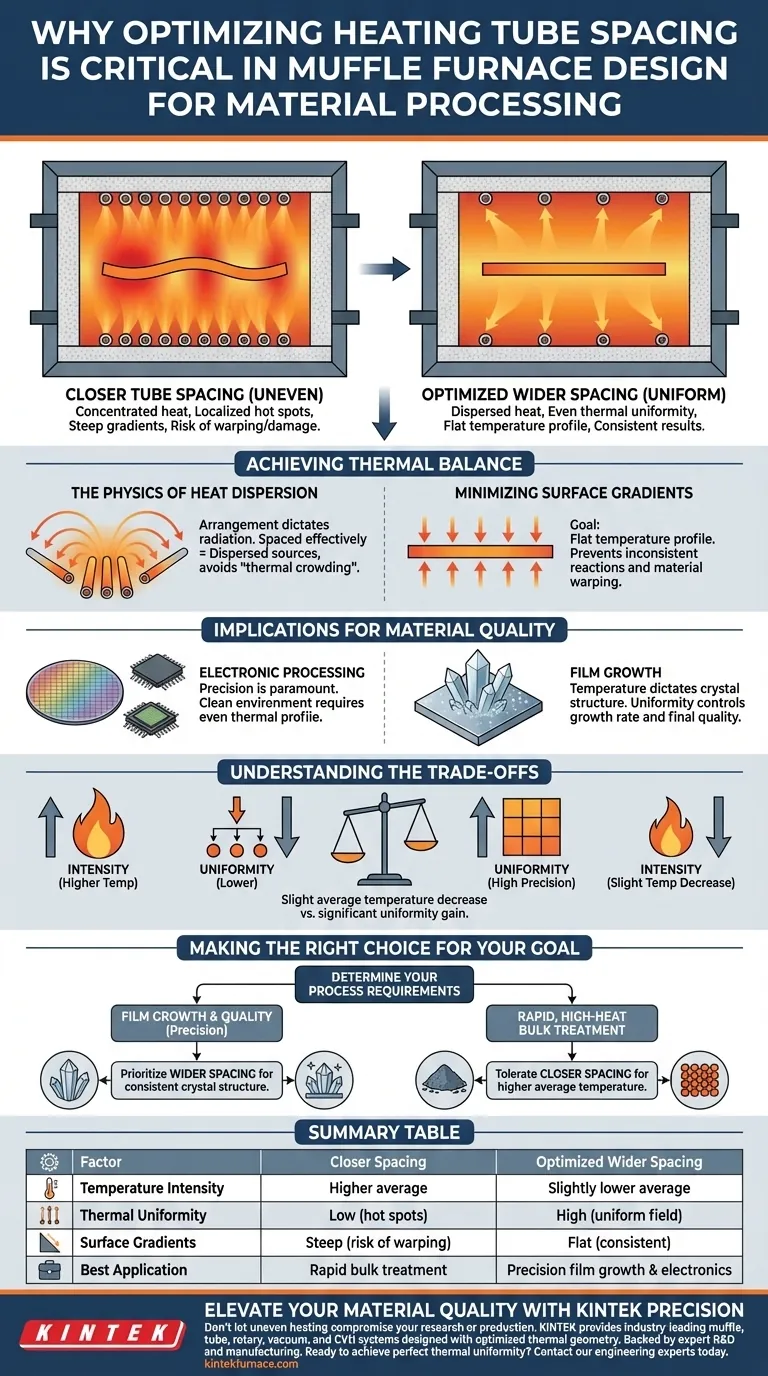
Optimizing heating tube spacing is the definitive factor in establishing thermal uniformity within a muffle furnace. By strategically adjusting the distance between these heat sources, you ensure that heat is dispersed evenly, preventing localized hot spots and minimizing temperature gradients across the surface of the workpiece.
While wider tube spacing may result in a slight reduction in the average overall temperature, it significantly enhances the uniformity of the temperature field, which is often the more critical metric for high-precision material processing.
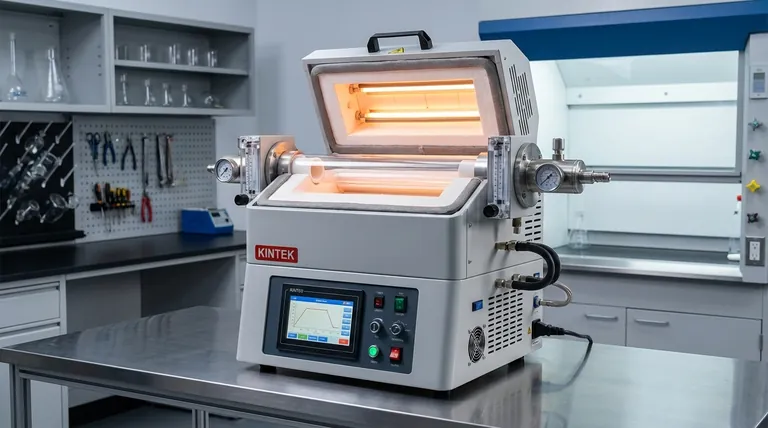
Achieving Thermal Balance
The Physics of Heat Dispersion
The arrangement of heating tubes dictates how energy radiates into the furnace chamber. When tubes are spaced effectively, the heat sources are dispersed rather than concentrated.
This dispersion is necessary to avoid "thermal crowding." If tubes are too close, heat creates intense, localized zones that can damage sensitive materials.
Minimizing Surface Gradients
For the workpiece inside the furnace, the goal is a flat temperature profile. Poor spacing leads to temperature gradients on the material's surface.
By optimizing the gap between tubes, you ensure the entire surface of the workpiece receives consistent thermal energy. This prevents warping or inconsistent chemical reactions across the material.
Implications for Material Quality
Criticality in Electronic Processing
In applications such as electronic material processing or optical material fabrication, precision is paramount.
Muffle furnaces are specifically chosen here because they isolate the material from combustion byproducts. However, a clean environment is useless if the thermal profile is uneven.
Controlling Crystal Structure
In processes like film growth, the temperature directly dictates the crystal structure and physical properties of the film.
Uniform heating allows for precise control over the atmosphere and temperature. This control improves both the rate of growth and the ultimate quality of the film, ensuring the final product meets strict specifications.
Understanding the Trade-offs
Intensity vs. Uniformity
There is a distinct trade-off when increasing tube spacing to gain uniformity.
As you widen the space between tubes to smooth out gradients, you may observe a slight decrease in the average temperature of the chamber.
Balancing Efficiency
Designers must balance the need for high heat with the need for even heat.
For most high-specification tasks, such as semiconductor work, the gain in uniformity vastly outweighs the minor loss in maximum temperature intensity.
Making the Right Choice for Your Goal
To determine the optimal design for your specific application, consider your process requirements:
- If your primary focus is Film Growth and Quality: Prioritize wider tube spacing to ensure the strict thermal uniformity required for consistent crystal structures.
- If your primary focus is Rapid, High-Heat Bulk Treatment: You may tolerate tighter spacing to maximize average temperature, provided surface gradients are acceptable for the material.
Precision in design leads to precision in results; prioritize geometry to control thermal outcome.
Summary Table:
| Factor | Closer Tube Spacing | Optimized Wider Spacing |
|---|---|---|
| Temperature Intensity | Higher average temperature | Slightly lower average temperature |
| Thermal Uniformity | Low (prone to localized hot spots) | High (uniform temperature field) |
| Surface Gradients | Steep (risk of warping) | Flat (consistent energy distribution) |
| Best Application | Rapid, high-heat bulk treatment | Precision film growth & electronics |
Elevate Your Material Quality with KINTEK Precision
Don't let uneven heating compromise your research or production. KINTEK provides industry-leading muffle, tube, rotary, vacuum, and CVD systems designed with optimized thermal geometry. Backed by expert R&D and manufacturing, our high-temp lab furnaces are fully customizable to meet your unique precision requirements.
Ready to achieve perfect thermal uniformity? Contact our engineering experts today to find the ideal furnace configuration for your application.
Visual Guide
References
- Yuchen Wang, Haisheng Fang. Research and optimization of temperature uniformity of high-precision muffle furnace. DOI: 10.1088/1742-6596/3009/1/012076
This article is also based on technical information from Kintek Furnace Knowledge Base .
Related Products
- 1400℃ Muffle Oven Furnace for Laboratory
- 1700℃ High Temperature Muffle Oven Furnace for Laboratory
- 1800℃ High Temperature Muffle Oven Furnace for Laboratory
- 1200℃ Muffle Oven Furnace for Laboratory
- High Temperature Muffle Oven Furnace for Laboratory Debinding and Pre Sintering
People Also Ask
- How does a high-temperature laboratory muffle furnace affect material properties? Transform Anodic Oxide Films Fast
- What is the primary function of a high-temperature laboratory muffle furnace in chemical synthesis? Achieve Precision.
- What are the primary objectives of using a muffle furnace in zirconia synthesis? Achieve precision phase control.
- How does a muffle furnace facilitate Ag/ATP catalyst preparation? Optimize Calcination for Superior Performance
- How is a laboratory high-temperature muffle furnace used in agloporite preparation? Optimize Material Synthesis



















