The moment oxygen infiltrates your process at levels as minute as 0.5 atomic percent, you have permanently forfeited the quest for true superhardness. This isn’t about simple surface contamination or a discolored coating. It is a catastrophic, atom-level failure where oxygen atoms aggressively substitute for nitrogen within the coating’s critical interfacial layer. The direct consequence is a collapse in mechanical integrity, plummeting the maximum achievable hardness from the superhard regime (50–100+ GPa) down to a mediocre ~35 GPa, while simultaneously gutting the coating’s oxidation and corrosion resistance.
The problem isn't just "avoiding rust." In high-temperature CVD or vacuum furnaces, oxygen acts as a systemic poison at the atomic level. It disintegrates the nano-engineered interfacial monolayer that gives superhard nanocomposites their strength, turning a near-impenetrable protective shield into a brittle, compromised shell.
The Nano-Architecture of Failure
To understand why oxygen is so devastating, you must look past the macro-scale furnace and into the nano-scale architecture of the coating. Superhardness is not magic; it is a engineered structure, and oxygen dismantles that structure atom by atom.
The Critical Interfacial Monolayer
Superhard nanocomposite coatings, like titanium silicon nitride, are not uniform slabs. They are a cleverly engineered mix of hard nanocrystals embedded in a matrix.
The secret to their strength is a single-monolayer interface, often composed of silicon nitride (SiNx). This layer is the "glue" that prevents nanocrystals from sliding past each other under stress. It is only one atom thick, meaning its purity defines the entire coating’s performance.
Atomic Substitution and Bond Weakening
This is the core destructive mechanism. Oxygen does not simply sit harmlessly as a separate particle. It directly attacks the monolayer's chemical structure by substituting for nitrogen atoms.
Because oxygen and nitrogen have different electronic structures and atomic sizes, this substitution creates a local defect. It fundamentally weakens the neighboring atomic bonds within the interface. The property on which everything depends—this one-atom-thick, perfectly bonded "glue"—is chemically degraded from the inside out.
The Catastrophic Drop in Protective Function
The immediate and measurable result of this bond weakening is a performance cliff-edge. Your data points show a clear threshold.
Maintaining oxygen impurity levels at or below 0.1 at. % (or a few hundred ppm) is required to achieve hardness values exceeding 40 GPa. The moment contamination rises to 0.5 at. % and substitution occurs, the maximum hardness collapses to around 35 GPa. You are no longer in the superhard regime, and the coating’s ability to resist oxidation and corrosion is severely compromised.
Beyond the Coating: A Systemic Threat
While the atomic substitution in the monolayer is the primary driver of your specific problem, in high-temperature systems, oxygen’s role as a universal disruptor magnifies the risk. Its presence triggers a cascade of secondary failures that destroy both the coating and the substrate.
The Vicious Cycle of Trapped Porosity
The degradation starts at the substrate level before the coating is even complete. During the final stage of sintering, pores in the material close off. If an oxygen-containing atmosphere was present, insoluble gases become trapped inside these pores.
As the furnace heats further, the internal gas pressure builds until it balances the capillary forces driving densification. The sintering process grinds to a halt, leaving a porous substrate with far less structural integrity than theoretical density would provide. A superhard coating on a weak, porous foundation is an engineering failure waiting to happen.
Fiber Degradation in Composite Substrates
If your substrate is a ceramic matrix composite—for example, silicon carbide (SiC) fiber-reinforced alumina (Al₂O₃)—oxygen is its direct executioner. At high temperatures, oxygen oxidizes the strong SiC fibers, converting them into a silicon dioxide (SiO₂) layer.
This newly formed SiO₂ then reacts chemically with the alumina matrix to form aluminosilicates. The reinforcing fibers, meant to provide strength and toughness, are chemically destroyed and replaced by brittle, weak reaction products. Exposure to oxygen doesn't just damage the surface; it completely eliminates the component’s internal reinforcement.
Understanding the Trade-offs
The pursuit of the perfect, oxygen-free atmosphere is a battle against physics and economics. Achieving the 0.1 at. % purity threshold is a non-trivial engineering challenge, and you must weigh its cost against performance.
Achieving such extreme purity requires impeccable vacuum integrity, ultra-high-purity inert gas with multiple stages of purification, and rigorous furnace conditioning. Every outgassing material, every seal, and every molecule of residual gas becomes a potential point of failure. The operational cost and process complexity soar as you chase the last few parts-per-million of oxygen.
For many industrial applications, a coating with 35 GPa hardness may be perfectly sufficient and far more cost-effective to produce. The “deep need” for extreme purity is only valid if your application truly demands extreme performance, where the extra 50%+ gain in hardness and the superior corrosion resistance are non-negotiable for the component’s survival.
Making the Right Choice for Your Goal
You define “critical” based on what problem you are trying to solve. Use this framework to dictate your level of atmospheric vigilance.
- If your primary focus is achieving ultimate superhardness (>50 GPa) for high-stakes cutting or wear applications: You must treat the furnace atmosphere as the most critical process variable. Invest in achieving and verifying the 0.1 at. % (hundreds of ppm) oxygen impurity level as the absolute ceiling, not a target.
- If your primary focus is processing non-oxide ceramic composites or ensuring maximum substrate density: Your enemy is any oxygen leak during the high-temperature ramp-up before pore closure. A high-purity vacuum purge to eliminate trapped air is non-negotiable to prevent internal fiber degradation and achieve near-theoretical density.
- If your primary focus is general protective coatings where standard hardness (30-35 GPa) is acceptable and cost is a major driver: “Strict control” takes on a different meaning. You still need to prevent wholesale oxidation and spallation, but the extreme technical effort and cost to reach sub-0.5 at. % purity may not be justified by the performance gain.
Ultimately, in the world of superhard coatings, the atmosphere is not just a process parameter; it is the primary constituent that either enables an atomically perfect, high-strength architecture or chemically poisons it at its most vulnerable point.
Summary Table:
| Oxygen Impurity Level | Atomic & Structural Impact | Hardness Output | Process/Application Impact |
|---|---|---|---|
| ≤ 0.1 at. % (PPM Level) | Intact SiNx monolayer interface; zero bond substitution | > 50 to 100+ GPa | Ultimate superhard cutting tools & extreme wear resistance |
| ≥ 0.5 at. % | Oxygen substitutes for nitrogen; chemical bond degradation | ~ 35 GPa | Standard protective coatings; non-superhard regime |
| High Atmosphere Contamination | Insoluble trapped gas pores; SiC fiber matrix oxidation | Severe Collapse | Brittle substrate failure & degraded corrosion resistance |
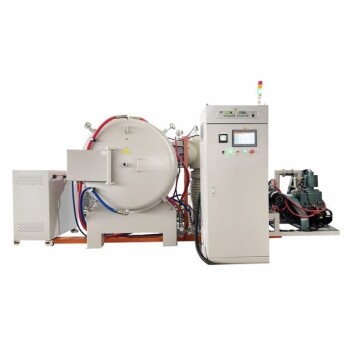
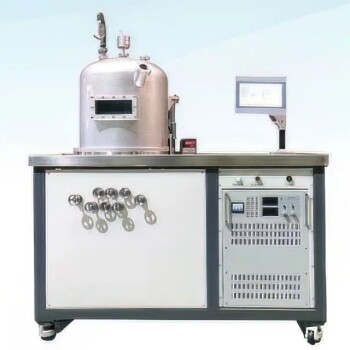
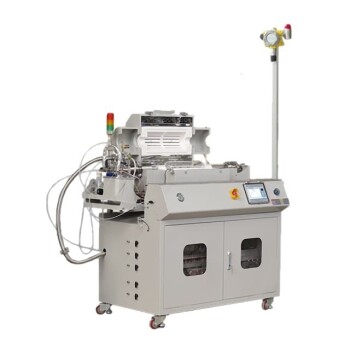
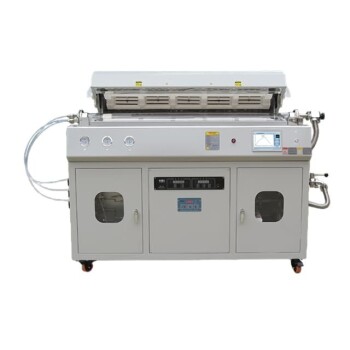
Prevent trace contamination from undermining your thin-film research and coating performance. KINTEK specializes in advanced laboratory equipment and consumables, offering a comprehensive range of ultra-high-purity high-temperature furnaces—including vacuum, CVD, tube, muffle, and controlled-atmosphere furnaces—all fully customizable to meet your strictest atmosphere purity requirements. Elevate your material processing standards and ensure optimal coating integrity—Contact KINTEK today!
Related Products
- Molybdenum Vacuum Heat Treat Furnace
- HFCVD Machine System Equipment for Drawing Die Nano Diamond Coating
- 2200 ℃ Graphite Vacuum Heat Treat Furnace
- 2200 ℃ Tungsten Vacuum Heat Treat and Sintering Furnace
- Custom Made Versatile CVD Tube Furnace Chemical Vapor Deposition CVD Equipment Machine
People Also Ask
- What is the primary application of vacuum heat treating furnaces in aerospace? Enhance Component Performance with Precision
- How does vacuum heat treating work in terms of temperature and time control? Master Precise Material Transformations
- How does a vacuum heat treating furnace improve the condition of metal alloys? Achieve Superior Metal Performance
- Why are vacuum heat treating furnaces essential for aerospace? Ensure Superior Material Integrity for High-Stakes Applications
- What is the process of vacuum heat treating? Achieve Superior Metallurgical Properties