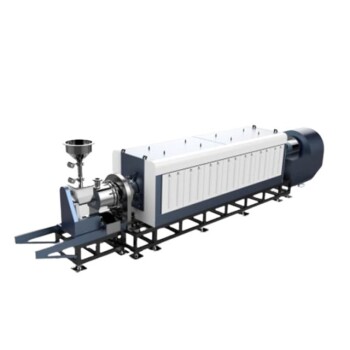
The short answer is that without precisely controlled heating, your 3D‑printed ceramic or bio‑glass part will simply not survive the journey from fragile “green” body to a dense, functional component. The as‑printed state is only a weak, binder‑held skeleton. To transform it into a mechanically strong, biocompatible, or phase‑pure part, you must apply a carefully orchestrated thermal profile. Any deviation leads directly to warping, cracking, trapped porosity, slumping, or incomplete densification.
Precise thermal processing is the fulcrum that balances multiple competing requirements—removing binders without destroying the part, achieving full amorphous densification before crystallization locks in defects, and keeping viscosity in a sweet spot that prevents both slumping and incomplete sintering. The consequences of imprecision are permanent structural flaws.
The Green‑to‑Sintered Transformation
Additive manufacturing deposits ceramics or bio‑glasses layer by layer, but the resulting green body has almost no load‑bearing capacity. The polymer or wax binders that hold the powder together must be completely removed, and the inorganic particles must then fuse into a dense monolithic structure.
Why shrinkage and thermal expansion cannot be ignored
Green parts typically contain 30–50% binder by volume. As that binder vaporizes during the initial heating stages, the part undergoes massive internal volume loss. If the temperature ramp is too fast, gas pressure builds up inside the part, causing blisters or delamination. Simultaneously, the ceramic particles themselves expand and contract according to their own coefficient of thermal expansion (CTE). Mismatches in local CTE or uneven heat distribution create stress gradients that lead to warping or cracking.
Atmosphere control determines chemistry and integrity
In many ceramic (especially bio‑glass) formulations, the sintering atmosphere directly affects phase stability. Oxidizing atmospheres burn away carbonaceous residues; inert or vacuum environments prevent unwanted oxidation of reactive elements. Precise atmosphere control inside a high‑temperature laboratory furnace ensures the part emerges with its intended stoichiometry and surface chemistry—critical for biomedical implants where dissolution rates and bioactivity depend on surface reactivity.
The Densification vs. Crystallization Race
One of the most insidious failure modes in crystallizable ceramics (including many sol‑gel‑derived glasses and bio‑glasses) is premature crystallization. The supplementary insight reveals a temporal competition: dense amorphous parts can be realized only if the material flows and fills pores before rigid crystals form.
Crystallization increases rigidity and halts densification
When a crystalline phase nucleates, it dramatically raises the effective viscosity of the surrounding glassy matrix. Further densification by viscous flow is essentially shut down. If this happens while porosity is still present, that porosity becomes permanently trapped. The result is a component that fails mechanically, lacks full translucency where required, or exhibits unpredictable dissolution behavior in physiological fluids.
Staging the thermal profile for success
The solution is a multi‑stage temperature program. A first hold in a temperature window just above the glass transition allows complete amorphous densification through viscous flow. Only after the part approaches full density does the furnace advance to a higher crystallization hold, where fine‑grained crystals nucleate and grow uniformly through the now‑dense matrix. High‑temperature laboratory furnaces with multi‑segment controllers make this sequence possible; a single‑setpoint oven would inevitably produce an under‑dense, flawed part.
The Viscosity Tightrope
The supplementary references highlight a second critical relationship: the exponential temperature‑dependence of glass viscosity, described by the Vogel–Fulcher equation. A mere 100°C change can alter viscosity by a factor of 1,000.
Too cold: insufficient flow, incomplete densification
If the furnace temperature is too low, the glassy phase remains too viscous. The characteristic densification time (inversely proportional to viscosity) becomes impractically long. The part will never reach full density within a reasonable firing schedule, leaving residual porosity that degrades strength and biocompatibility.
Too hot: slumping and geometric distortion
If the temperature overshoots and viscosity plummets, gravity alone will deform the component. Slumped walls, rounded edges, and collapsed internal channels destroy the very geometric complexity that 3D printing was meant to achieve. For biomedical scaffolds with intricate pore networks or aerospace components with tight tolerances, this is catastrophic.
Understanding the Trade‑offs
Precise thermal processing is not without inherent compromises and common pitfalls.
Aggressive heating rates vs. defect‑free binder burnout. Faster ramps save time but risk gas‑bubble defects. Slower ramps improve binder removal but prolong exposure to temperatures where unwanted pre‑crystallization might begin.
Densification temperature vs. grain growth. Pushing to higher temperatures accelerates densification, but also encourages excessive grain growth that can compromise mechanical strength and, for bio‑glasses, alter ion‑release profiles.
Complex shape challenges. Uniform heating becomes more difficult as part complexity increases. A profile optimized for a simple coupon may cause thin sections to over‑fire while thick sections remain porous. Tailored profiles must account for thermal inertia and geometry‑specific heat distribution.
Making the Right Choice for Your Goal
The precise thermal processing strategy you should adopt depends on what you need from the final part.
- If your primary focus is mechanical strength and full density: Prioritize a profile that completes amorphous densification before any crystallization onset. Use a dwell in the optimal viscous sintering window and verify density before moving to a crystallization step.
- If your primary focus is dimensional accuracy and intricate geometries: Keep peak temperatures conservative and extend the dwell time at a lower temperature where viscosity stays above the slumping threshold. Consider using a sacrificial support structure if gravity deformation is a high risk.
- If your primary focus is bioactivity and controlled resorption: Manage the crystallization step not only for density but for the target crystallinity fraction and grain size. Partial crystallization can be beneficial for tailoring dissolution rates—precise temperature and time control dictate this balance.
- If your primary focus is scaling from lab to production: Document the exact thermal profile that worked on a lab furnace, then verify its replication on a larger system using multiple thermocouples. Uniform heating and atmosphere consistency are your main scaling challenges.
Mastering the thermal processing of 3D‑printed ceramics and bio‑glasses is truly about controlling time, temperature, and atmosphere with surgical precision; when you do, you unlock the full potential of additive manufacturing for parts that are dense, strong, and functionally predictable.
Summary Table:
| Thermal Stage / Factor | Primary Purpose | Risk of Imprecision |
|---|---|---|
| Binder Burnout | Safely removes organic binders (30–50% vol) | Internal gas pressure, blistering, delamination |
| Viscous Densification | Promotes pore elimination before crystallization | Trapped porosity, low mechanical strength |
| Crystallization Hold | Controls crystal nucleation and grain growth | Premature rigidity, incomplete sintering, slumping |
| Atmosphere Control | Maintains stoichiometry and surface chemistry | Unwanted oxidation, phase instability, bioactivity loss |
Transforming fragile green bodies into dense, defect-free ceramic and bio-glass components requires uncompromising thermal precision. KINTEK specializes in high-performance laboratory equipment, offering a comprehensive lineup of customizable high-temperature furnaces—including muffle, tube, vacuum, atmosphere, and CVD systems—designed to give you surgical control over ramp rates, atmosphere, and multi-stage dwell cycles.
Ready to eliminate warping, cracking, and porosity in your additive manufacturing workflows? Contact KINTEK today to discuss your unique heat treatment requirements with our technical experts!
Related Products
- Laboratory Quartz Tube Furnace RTP Heating Tubular Furnace
- Dental Porcelain Zirconia Sintering Ceramic Vacuum Press Furnace
- Chairside Dental Porcelain Zirconia Sintering Furnace with Transformer for Ceramic Restorations
- Vacuum Dental Porcelain Sintering Furnace for Dental Laboratories
- Vacuum Heat Treat Furnace with Ceramic Fiber Liner
People Also Ask
- What physical conditions does a laboratory Tube Furnace provide for SOEC? Precision Heat for Solid Oxide Characterization
- What are the main features and functions of a laboratory tube furnace? Unlock Precise High-Temp Control for Your Lab
- Why is a laboratory tube furnace necessary for BiVO4/RGO synthesis? Achieve Precise Nano-Structure Control
- What conditions does a tube furnace provide for post-ion-implantation? Achieve Precise Microstructural Repair
- What role does a laboratory tube furnace play in geological and mineralogical research? Unlock Earth's Secrets with Precision