
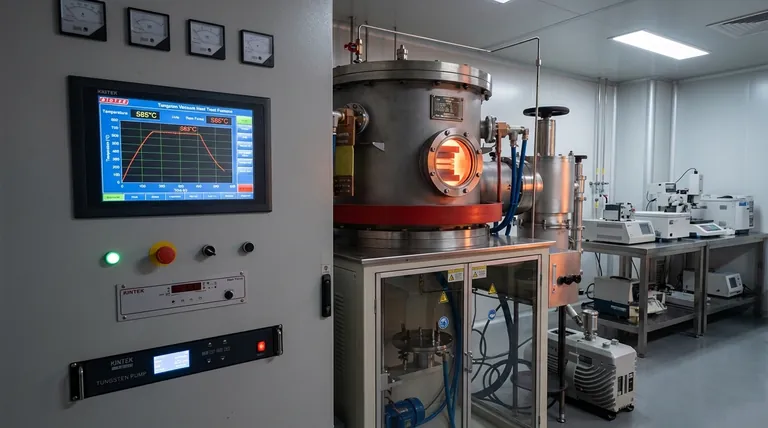
Precise temperature control is the critical factor that governs the transition from loose components to a unified composite in Vacuum Hot Pressing. For AZ31/UCF/AZ31 composites, specifically, this control dictates whether the binder material can effectively "glue" the carbon fibers to the magnesium alloy matrix without destroying the matrix itself.
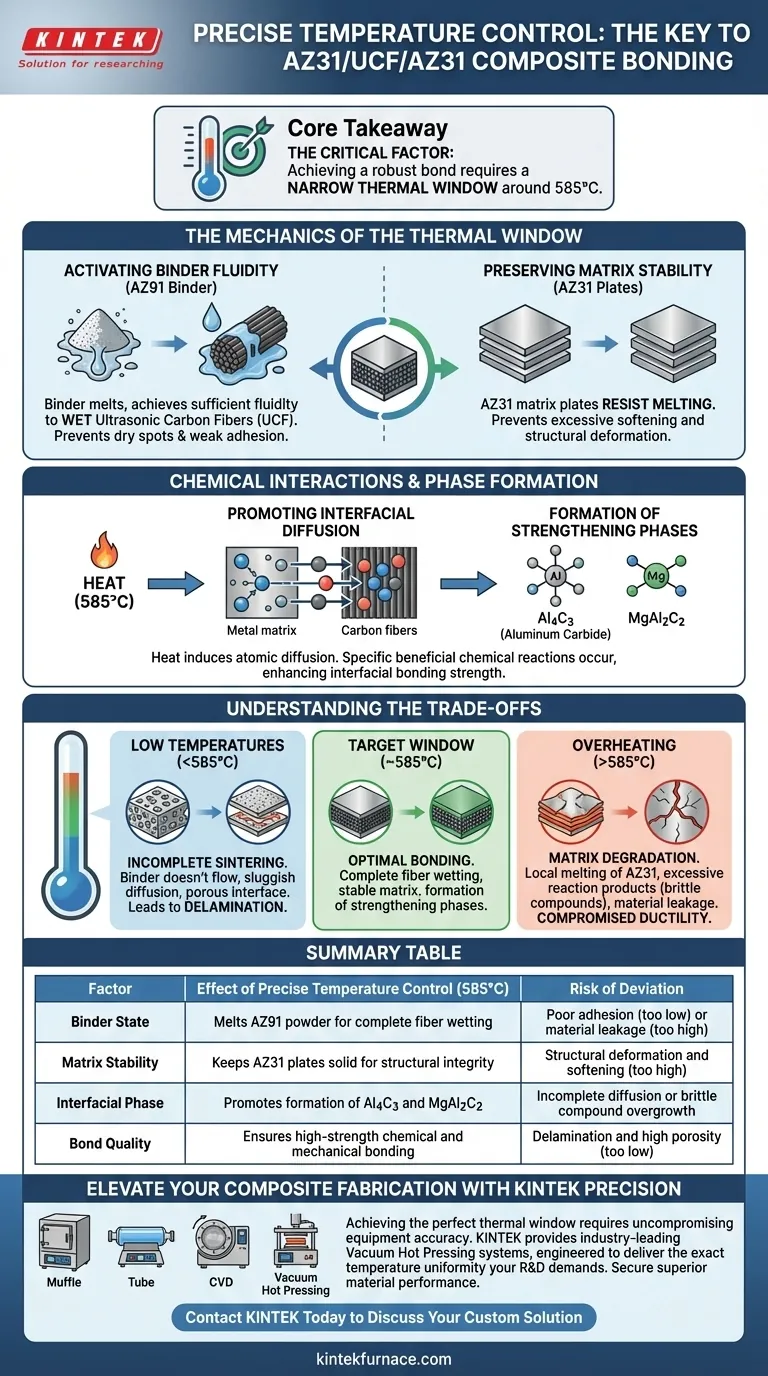
Core Takeaway Achieving a robust bond requires a narrow thermal window, specifically around 585°C for this material system. This temperature is the precise point where the AZ91 binder melts sufficiently to wet the carbon fibers, while the AZ31 matrix remains solid enough to maintain structural integrity, allowing for the formation of essential strengthening phases like Al4C3 and MgAl2C2.
The Mechanics of the Thermal Window
The Vacuum Hot Pressing (VHP) process relies on finding a specific thermal equilibrium. You are not simply heating material; you are managing two distinct physical states simultaneously within the same chamber.
Activating the Binder Fluidity
The binder, typically AZ91 powder, serves as the active adhesive agent. It must reach a temperature where it fully melts and achieves sufficient fluidity.
Without this liquidity, the binder cannot penetrate the fiber bundles. It fails to "wet" the Ultrasonic Carbon Fibers (UCF), resulting in dry spots and weak adhesion.
Preserving Matrix Stability
While the binder melts, the primary structural component—the AZ31 plates—must resist melting.
Precise control prevents the AZ31 matrix from softening excessively. If the temperature drifts too high, the plates lose their geometric stability, leading to structural deformation of the final composite part.
Chemical Interactions and Phase Formation
Beyond physical wetting, temperature control drives the chemical reactions necessary for a high-strength interface. The bond is not merely mechanical; it is chemical.
Promoting Interfacial Diffusion
The heat induces atomic diffusion between the metal matrix and the carbon fibers. This diffusion is the precursor to forming a permanent bond between dissimilar materials.
Formation of Strengthening Phases
At the target temperature (e.g., 585°C), specific chemical reactions occur that are beneficial to this specific composite.
The primary reference indicates that accurate heat control promotes the formation of interfacial phases such as Al4C3 (Aluminum Carbide) and MgAl2C2. Contrary to some systems where carbides are strictly avoided, here these phases enhance the interfacial bonding strength.
Understanding the Trade-offs
In VHP processes, the margin for error is often negligible. Understanding the consequences of deviating from the setpoint is as important as knowing the target.
The Consequence of Low Temperatures
If the furnace runs cooler than the target, sintering remains incomplete. The binder does not flow, diffusion is sluggish, and the interface remains porous. This leads to delamination under stress.
The Consequence of Overheating
If the temperature exceeds the specific window, the matrix degrades. You risk the local melting of the AZ31 plates or the formation of excessive reaction products.
While some reaction phases are beneficial, uncontrolled high temperatures can lead to an overabundance of brittle compounds or material leakage, compromising the composite's ductility.
Optimizing Your Sintering Protocol
To ensure the successful fabrication of AZ31/UCF/AZ31 composites, your process control must be rigorous.
- If your primary focus is Interfacial Strength: Target the precise melting point of the binder (approx. 585°C) to ensure maximum wetting and the formation of Al4C3 and MgAl2C2 phases.
- If your primary focus is Dimensional Accuracy: strictly limit temperature overshoot to prevent the AZ31 matrix plates from entering their softening range.
Success relies on maintaining the delicate balance where the binder is liquid enough to act, but the matrix remains solid enough to endure.
Summary Table:
| Factor | Effect of Precise Temperature Control (585°C) | Risk of Deviation |
|---|---|---|
| Binder State | Melts AZ91 powder for complete fiber wetting | Poor adhesion (too low) or material leakage (too high) |
| Matrix Stability | Keeps AZ31 plates solid for structural integrity | Structural deformation and softening (too high) |
| Interfacial Phase | Promotes formation of Al4C3 and MgAl2C2 | Incomplete diffusion or brittle compound overgrowth |
| Bond Quality | Ensures high-strength chemical and mechanical bonding | Delamination and high porosity (too low) |
Elevate Your Composite Fabrication with KINTEK Precision
Achieving the perfect thermal window for AZ31/UCF/AZ31 composites requires uncompromising equipment accuracy. KINTEK provides industry-leading Vacuum Hot Pressing systems, alongside our specialized Muffle, Tube, Rotary, and CVD furnaces, all engineered to deliver the exact temperature uniformity your R&D demands.
Our systems are fully customizable to meet the unique challenges of advanced material sintering and interfacial bonding. Backed by expert R&D and world-class manufacturing, we help you eliminate process variables and secure superior material performance.
Ready to optimize your thermal processing? Contact KINTEK Today to Discuss Your Custom Solution
Visual Guide
Related Products
- 600T Vacuum Induction Hot Press Vacuum Heat Treat and Sintering Furnace
- Vacuum Hot Press Furnace Machine for Lamination and Heating
- Vacuum Hot Press Furnace Machine Heated Vacuum Press
- Vacuum Hot Press Furnace Machine Heated Vacuum Press Tube Furnace
- High Pressure Laboratory Vacuum Tube Furnace
People Also Ask
- Why use Vacuum Hot Press (VHP) for ZnS Ceramics? Achieve Superior IR Transparency and Mechanical Strength
- How does a vacuum hot press sintering furnace mitigate copper sintering swelling? Solve Fe-Cu Expansion Issues
- What are the key advantages of vacuum hot press sintering furnaces? Achieve Superior Density and Purity in Materials
- What is the core function of a vacuum hot press sintering furnace in the preparation of high-density RuTi alloys? Achieve Maximum Density and Purity
- How does the vacuum environment in a vacuum hot press sintering furnace protect chromium-containing ceramics? Find out.



















