
Precise thermal regulation is the defining factor in transitioning from simple adhesion to structural integrity. In vacuum brazing, accurate control is necessary to maintain the process within a specific ideal range—typically 50 K above the liquidus temperature of the filler metal—to ensure optimal flow and wetting. Furthermore, strict management of holding time allows engineers to govern the depth of element diffusion, preventing the excessive formation of brittle phases that weaken the joint.
Core Insight: The mechanical strength of a brazed joint is dictated by the microstructural evolution that occurs during the hold cycle. By fine-tuning temperature and time, you actively control the diffusion depth and the reduction of brittle intermediate phases, ensuring the joint is not just bonded, but metallurgically sound.
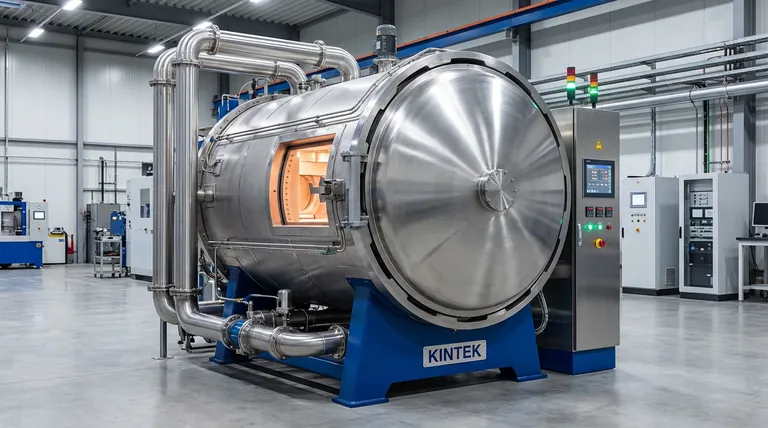
The Metallurgy of Control
Targeting the Ideal Thermal Window
Brazing is not simply about melting filler metal; it is about reaching a precise viscosity and reactivity state. The optimal processing temperature is generally located 50 K above the liquidus temperature (e.g., operating at 1250 K for a filler with a 1200 K liquidus).
Deviation from this window risks incomplete wetting (if too cool) or excessive base metal erosion (if too hot). Advanced vacuum furnaces utilize PID regulation and self-tuning technologies to maintain this temperature with an accuracy of ±1℃. This stability is essential for repeatability across production batches.
Controlling Element Diffusion
The duration of the heating cycle, known as the holding time, is the primary lever for controlling how deeply elements migrate between the filler and the base metal.
Varying the holding time (for example, between 10, 30, or 120 minutes) dramatically alters the diffusion depth. Short times may result in insufficient interaction for strong bonding, while excessive times can lead to detrimental microstructural changes or grain growth in the base materials.
Mitigating Brittle Phases
The most critical reason for precise time-temperature control is the management of intermediate phases.
In many alloy systems, extended exposure to high temperatures can lead to the formation of brittle compounds, such as chromium borides. These phases act as stress concentrators and crack initiation sites. By restricting the holding time and temperature to the minimum necessary for diffusion, you can limit the evolution of these brittle structures, thereby maximizing the mechanical integrity of the final joint.
Technological Enablers
Achieving Homogeneity
For complex components, a single temperature setpoint is often insufficient. Advanced vacuum furnaces employ multi-temperature zone designs.
This allows for independent control over different sections of the furnace, ensuring that the entire assembly reaches the target temperature simultaneously. This uniformity ensures that the temperature field stability remains within ±5℃, preventing distortion or uneven brazing caused by thermal gradients.
The Role of the Vacuum Environment
While thermal control drives the metallurgy, the vacuum level ensures the chemistry remains pure.
For sensitive heterometal joints (like Tungsten-EUROFER), an ultra-high vacuum (typically 10^-6 mbar) is required to prevent oxidation. This ensures the filler metal contacts fresh metal surfaces, guaranteeing the metallic continuity required for the thermal parameters to be effective.
Common Pitfalls to Avoid
The Danger of "Good Enough" Accuracy
Assuming that a general temperature setting is sufficient is a frequent error. A fluctuation of even 10-15 degrees can shift the process out of the optimal 50 K window, altering the viscosity of the filler and the rate of diffusion.
Overlooking Thermal Lag
The temperature displayed on the controller is often the thermocouple temperature, not the part temperature.
Without precise soak times (holding periods), the core of the part may not reach the required brazing temperature, leading to "cold joints." Conversely, overestimating lag can lead to excessive holding times, increasing the volume of brittle intermediate phases.
Making the Right Choice for Your Goal
To optimize your vacuum brazing process, align your control strategy with your specific mechanical requirements:
- If your primary focus is Maximum Mechanical Strength: Prioritize shorter holding times and precise temperature caps to minimize the growth of brittle phases like chromium borides.
- If your primary focus is Complex Geometries: Utilize a furnace with multi-zone control to ensure the temperature field stability stays within ±5℃ across the entire part.
- If your primary focus is Research and Development: Use variable holding times (e.g., 10 vs. 120 minutes) to map the diffusion depth and identify the exact threshold where brittle phases begin to compromise integrity.
True optimization is achieved when you stop treating temperature and time as general settings and start treating them as precise metallurgical tools.
Summary Table:
| Parameter | Influence on Brazing Quality | Optimal Standard |
|---|---|---|
| Temperature Window | Determines filler viscosity and wetting; prevents base metal erosion. | ~50 K above liquidus (±1℃ accuracy) |
| Holding Time | Governs element diffusion depth and manages microstructural evolution. | 10 to 120 mins (application dependent) |
| Thermal Uniformity | Prevents part distortion and ensures consistent joint quality. | Within ±5℃ across all zones |
| Vacuum Level | Prevents oxidation to ensure clean metallic contact. | Typically 10⁻⁶ mbar for sensitive alloys |
Elevate Your Brazing Precision with KINTEK
Don't let thermal instability compromise your structural integrity. Backed by expert R&D and manufacturing, KINTEK offers high-performance Vacuum, CVD, and customizable high-temp lab furnaces designed to provide the ±1℃ accuracy your metallurgical processes demand. Whether you are optimizing diffusion depth or eliminating brittle phases, our advanced multi-zone systems ensure perfect repeatability for every batch.
Ready to optimize your vacuum brazing results? Contact our technical experts today to find the perfect thermal solution for your lab or production line.
References
- Kirsten Bobzin, Sophie Vinke. Joining Stainless Steel with a Novel Fe‐Based Amorphous Brazing Foil. DOI: 10.1002/srin.202500141
This article is also based on technical information from Kintek Furnace Knowledge Base .
Related Products
- Vacuum Heat Treat Sintering and Brazing Furnace
- Vacuum Hot Press Furnace Machine Heated Vacuum Press
- Vacuum Hot Press Furnace Machine Heated Vacuum Press Tube Furnace
- Vacuum Hot Press Furnace Machine for Lamination and Heating
- 600T Vacuum Induction Hot Press Vacuum Heat Treat and Sintering Furnace
People Also Ask
- What is one of the most important uses of vacuum heat treating furnaces in aerospace? Achieve Superior Strength in Aircraft Alloys
- What are the benefits of using vacuum heat treating furnaces for metal alloys? Achieve Superior Metal Properties and Performance
- How does vacuum heat treating affect the grain structure of metal alloys? Achieve Precise Microstructure Control
- What is the temperature of a vacuum furnace brazing? Optimize Your Joint Strength and Cleanliness
- What are the steps involved in a typical vacuum brazing treatment? Master the Process for Strong, Clean Joints



















