
To ensure the precise chemical composition of high-entropy alloys, performing multiple vacuuming and ultra-pure argon filling cycles is non-negotiable. This rigorous process systematically flushes out residual air and moisture, replacing reactive atmospheric gases with an inert protective shield before the heating process begins.
High-temperature melting renders active metals highly susceptible to rapid oxidation. Repeatedly purging the chamber with vacuum and argon is the only reliable method to eliminate contaminants, preventing the loss of reactive elements and preserving the intended multi-component design.
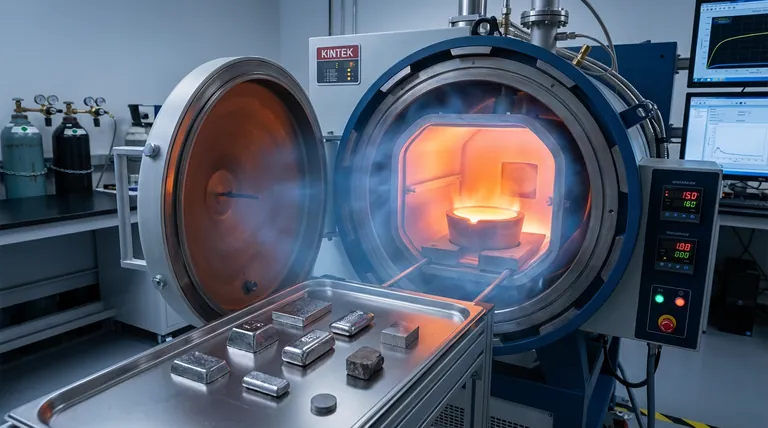
Creating a Pristine Melting Environment
Eliminating Residual Contaminants
The air inside a standard furnace chamber naturally contains oxygen and moisture. These are contaminants that can ruin high-performance alloys.
A single vacuum cycle is rarely sufficient to remove all adhered gas molecules from the chamber walls. By performing multiple cycles, you progressively dilute and extract these residual gases.
Establishing an Inert Shield
After vacuuming removes the air, the chamber is backfilled with ultra-pure argon.
Argon is an inert gas, meaning it does not react with the metal elements even at extreme temperatures. This creates a safe, neutral "atmosphere" that envelopes the raw materials.
Protecting Active Metal Elements
The Vulnerability of "Active" Metals
High-entropy alloys often contain active metal elements, such as chromium.
These elements are chemically aggressive and have a high affinity for oxygen. If oxygen is present during the high-temperature melting process, these metals will react immediately to form oxides (slag) rather than integrating into the alloy matrix.
Ensuring Chemical Accuracy
The fundamental premise of a high-entropy alloy is its specific, multi-component design.
If active elements like chromium are lost to oxidation, the final chemical composition will deviate from your design. The multiple purge cycles ensure that the elements remain metallic and mix correctly, guaranteeing the chemical accuracy of the final product.
Understanding the Risks of Process Shortcuts
The "Single Cycle" Trap
It is a common pitfall to assume that pulling a vacuum once is sufficient.
However, "virtual leaks"—gas trapped in micro-crevices or adsorbed moisture releasing from walls—can contaminate the chamber as it heats up. Without multiple flush cycles to dilute these remnants, you risk creating a low-quality atmosphere that compromises the material's structural integrity.
Oxidation and Property Degradation
Failing to achieve a sufficiently low oxygen partial pressure leads to the formation of inclusions.
These oxide inclusions act as defects within the alloy. They can severely degrade mechanical properties and alter the expected phase structure, effectively ruining the experiment or production run.
Making the Right Choice for Your Goal
Achieving a successful melt requires balancing time against purity requirements.
- If your primary focus is Chemical Precision: Perform at least 3-4 cycles of vacuuming to high vacuum followed by argon backfilling to ensure zero loss of active elements.
- If your primary focus is Material Purity: Prioritize the use of ultra-pure grade argon, as even trace impurities in standard industrial argon can react with highly sensitive active metals.
The integrity of your high-entropy alloy is determined before the melting even begins.
Summary Table:
| Process Step | Objective | Key Benefit |
|---|---|---|
| Multiple Vacuuming | Eliminate residual oxygen & moisture | Pristine, contaminant-free chamber |
| Ultra-Pure Argon Filling | Establish inert protective atmosphere | Prevents oxidation of active metals |
| Combined Cycles | Safeguard active elements (e.g., Chromium) | Ensures precise chemical composition |
| Prevent virtual leaks & inclusions | Guarantees superior material purity & integrity |
Ensure the integrity and performance of your high-entropy alloys. Backed by expert R&D and manufacturing, KINTEK offers advanced Muffle, Tube, Rotary, Vacuum, CVD systems, and other lab high-temp furnaces, all customizable for unique needs.
Ready to achieve flawless purity and chemical precision in your alloy development? Contact KINTEK today to discuss your specific furnace requirements and elevate your research!
Visual Guide

References
- Laurent Peltier, Jérome Slowensky. Design of Multiphase Compositionally Complex Alloys for Enhanced Hardness at Elevated Temperatures and Machinability: Comparative Study with Inconel 718. DOI: 10.1002/adem.202501146
This article is also based on technical information from Kintek Furnace Knowledge Base .
Related Products
- Vacuum Induction Melting Furnace
- Vacuum Heat Treat Sintering and Brazing Furnace
- Small Vacuum Heat Treat and Tungsten Wire Sintering Furnace
- Vacuum Heat Treat Sintering Furnace Molybdenum Wire Vacuum Sintering Furnace
- Vacuum Heat Treat Sintering Furnace with Pressure for Vacuum Sintering
People Also Ask
- What are the core functions of the High Vacuum Induction Melting (VIM) furnace? Optimize DD5 Superalloy Purification
- What is the role of VIM and directional solidification in aero-engine blade substrates? Engineering Extreme Durability
- What are the advantages of using a VIM furnace to control residual oxygen pressure? Achieve Superior Metal Uniformity
- What role does a Vacuum Induction Melting furnace play in the production of high-aluminum nickel-based superalloys?
- What are the technical advantages of using a Vacuum Induction Melting furnace in the development of advanced packaging steel?



















