
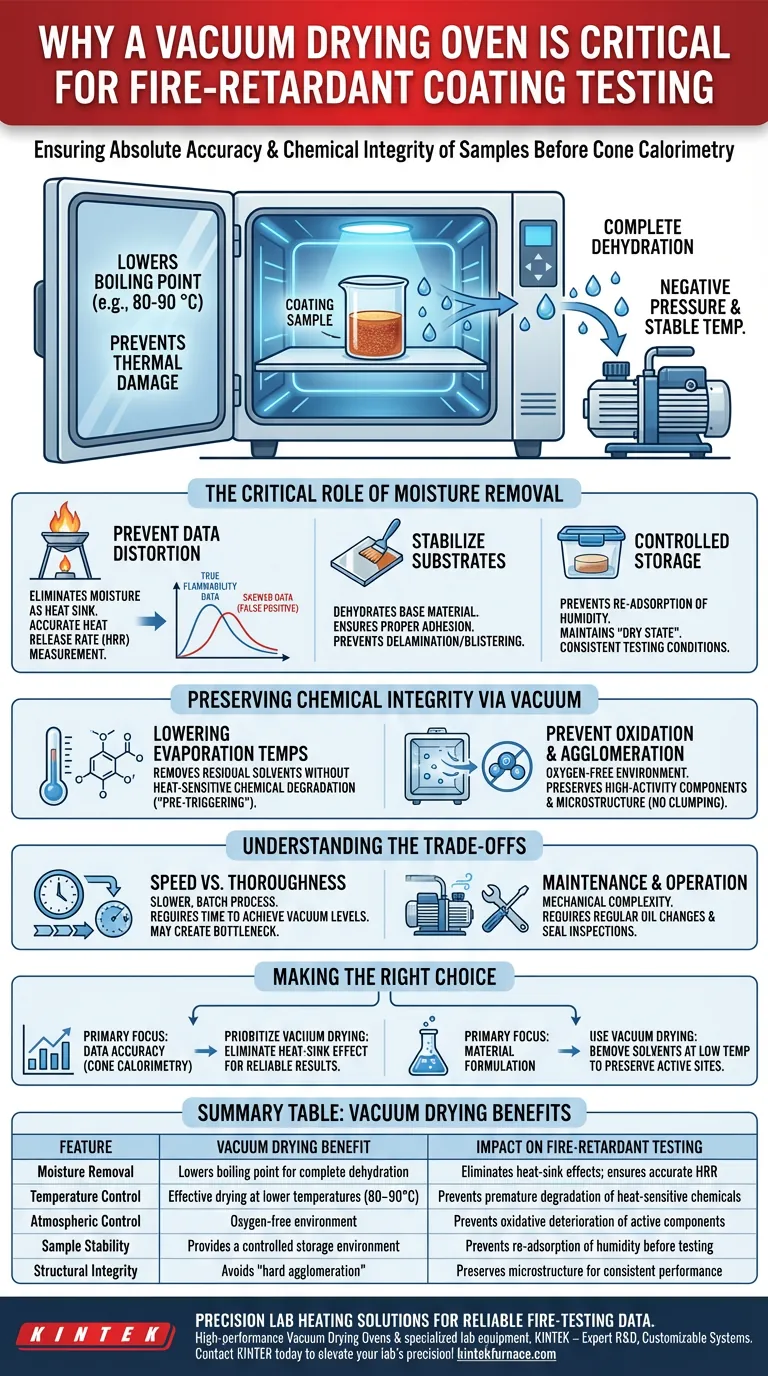
The primary necessity of a vacuum drying oven in processing fire-retardant coatings is to ensure the absolute accuracy of experimental data by thoroughly dehydrating the substrate and cured samples. By maintaining negative pressure and stable temperatures, the oven removes deep-seated moisture that would otherwise evaporate during testing, interfering with heat release measurements and skewing the results of critical cone calorimetry experiments.
By lowering the boiling point of water and solvents, vacuum drying ensures complete moisture removal without thermal damage, guaranteeing that subsequent fire-testing data reflects the true chemical performance of the coating rather than the physics of evaporating water.
The Critical Role of Moisture Removal
Preventing Data Distortion
The presence of moisture is the enemy of accurate fire testing. In experiments like cone calorimetry, the primary metric is heat release.
Water trapped within a substrate or coating acts as a heat sink. When the sample is exposed to fire, this water evaporates, absorbing energy and artificially lowering the measured heat release rate. A vacuum oven eliminates this variable, ensuring the data captures the true flammability of the material, not its water content.
Stabilizing Substrates Prior to Coating
The vacuum drying oven is not only used on the finished product; it is essential for the preparation of substrates.
Before a fire-retardant coating is even applied, the base material must be dehydrated. This ensures that the coating adheres properly and that no moisture is trapped at the interface, which could cause delamination or blistering during the curing process.
Controlled Storage Environment
Once the coating has cured, the sample must remain stable until the moment it is tested.
The vacuum drying oven provides a stable environment for sample storage. It prevents the re-adsorption of atmospheric humidity, maintaining the sample in a "dry state" so that the testing conditions remain consistent regardless of the ambient humidity in the lab.
Preserving Chemical Integrity via Vacuum
Lowering Evaporation Temperatures
Vacuum environments significantly reduce the boiling point of liquids. This allows for the removal of residual solvents and moisture at much lower temperatures (e.g., 80–90 °C) compared to standard atmospheric ovens.
This is critical for fire-retardant chemicals that might be sensitive to heat. Low-temperature drying prevents the premature degradation or "pre-triggering" of the fire-retardant mechanisms before the actual test begins.
Preventing Oxidation and Agglomeration
While primarily used for moisture removal in this context, the vacuum principle offers secondary benefits observed in advanced material processing.
By removing air, the oven creates an oxygen-free environment. This prevents oxidative deterioration of high-activity components within the coating formulation. Furthermore, vacuum drying helps preserve the coating's micro-structure by avoiding "hard agglomeration"—the clumping of particles that often occurs during high-temperature cracking in standard ovens.
Understanding the Trade-offs
Process Speed vs. Thoroughness
Vacuum drying is generally a slower, batch-based process compared to continuous convection drying.
Because the system relies on pressure reduction to drive evaporation, it requires time to achieve the necessary vacuum levels. This may create a bottleneck in high-throughput testing environments, requiring careful scheduling of sample preparation.
Maintenance and Operation
Vacuum ovens introduce mechanical complexity that standard ovens do not possess.
The system requires a vacuum pump, which demands regular oil changes (if oil-based) and seal inspections. A compromise in the vacuum seal renders the process ineffective, potentially ruining a batch of samples by failing to remove moisture adequately.
Making the Right Choice for Your Project
To maximize the reliability of your fire-retardant testing, align your drying strategy with your specific analytical goals:
- If your primary focus is data accuracy (Cone Calorimetry): Prioritize vacuum drying to remove all adsorbed moisture, as this eliminates the heat-sink effect that causes false-positive safety ratings.
- If your primary focus is material formulation: Use vacuum drying to remove solvents at low temperatures, preserving the active sites and porous structure of your chemical additives without thermal degradation.
Ultimately, the vacuum drying oven serves as a baseline calibration tool, ensuring that your test results measure the chemistry of the coating rather than the humidity of the laboratory.
Summary Table:
| Feature | Vacuum Drying Benefit | Impact on Fire-Retardant Testing |
|---|---|---|
| Moisture Removal | Lowers boiling point for complete dehydration | Eliminates heat-sink effects; ensures accurate heat release rate |
| Temperature Control | Effective drying at lower temperatures (80–90°C) | Prevents premature degradation of heat-sensitive fire-retardant chemicals |
| Atmospheric Control | Oxygen-free environment | Prevents oxidative deterioration of active coating components |
| Sample Stability | Provides a controlled storage environment | Prevents re-adsorption of humidity before cone calorimetry testing |
| Structural Integrity | Avoids "hard agglomeration" | Preserves the coating's microstructure for consistent chemical performance |
Precision Lab Heating Solutions for Reliable Fire-Testing Data
Don't let moisture compromise your experimental integrity. KINTEK provides high-performance Vacuum Drying Ovens and specialized lab equipment designed to ensure your fire-retardant coatings meet the highest standards of accuracy. Backed by expert R&D and manufacturing, we offer customizable Muffle, Tube, Rotary, Vacuum, and CVD systems tailored to your unique research needs.
Ready to elevate your lab's precision? Contact KINTEK today to discuss your custom furnace requirements!
Visual Guide
References
- James Covello, Gary E. Wnek. Tannic acid's role as both char former and blowing agent in epoxy‐based intumescent fire retardants. DOI: 10.1002/pls2.10118
This article is also based on technical information from Kintek Furnace Knowledge Base .
Related Products
- Vacuum Heat Treat Sintering and Brazing Furnace
- Vacuum Heat Treat Sintering Furnace Molybdenum Wire Vacuum Sintering Furnace
- Dental Porcelain Zirconia Sintering Ceramic Vacuum Press Furnace
- Molybdenum Vacuum Heat Treat Furnace
- Vacuum Hot Press Furnace Machine Heated Vacuum Press
People Also Ask
- What is one of the most important uses of vacuum heat treating furnaces in aerospace? Achieve Superior Strength in Aircraft Alloys
- How does vacuum heat treating affect the grain structure of metal alloys? Achieve Precise Microstructure Control
- What are the benefits of using vacuum heat treating furnaces for metal alloys? Achieve Superior Metal Properties and Performance
- What is the temperature of a vacuum furnace brazing? Optimize Your Joint Strength and Cleanliness
- What are the steps involved in a typical vacuum brazing treatment? Master the Process for Strong, Clean Joints












