
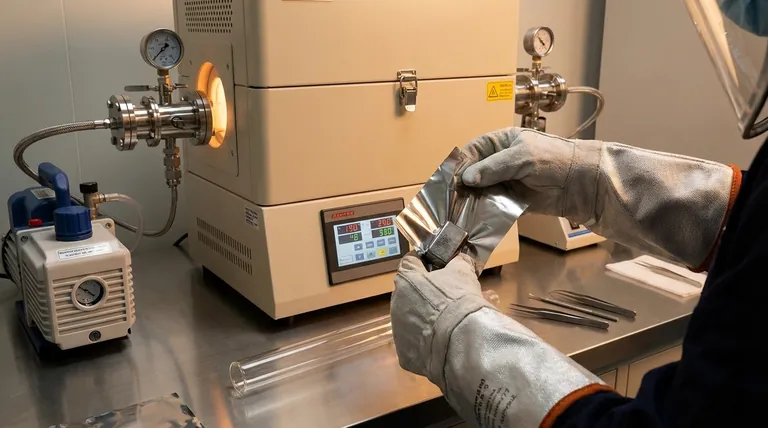
High-purity tantalum foil acts as a critical chemical barrier. It is used primarily to isolate the reactive Ce2(Fe, Co)17 alloy from the quartz tube walls during high-temperature melting and heat treatment. This isolation prevents the active rare-earth element, cerium, from reacting with the silicon dioxide in the quartz, ensuring the material retains its intended purity and magnetic properties.
The core function of tantalum foil in this process is to serve as a chemically stable shield. It prevents the active rare-earth components from attacking the containment vessel, thereby preserving the alloy's stoichiometry and preventing catastrophic contamination.
The Challenge: Reactivity of Rare-Earth Elements
The Volatility of Cerium
Rare-earth elements, particularly cerium, are highly chemically active. Under the intense heat required for processing Ce2(Fe, Co)17 ingots, cerium becomes unstable when in contact with standard containment materials.
The Quartz Reaction Problem
The processing vessels are typically made of quartz (silicon dioxide). Without protection, the hot cerium reacts aggressively with the silicon dioxide.
This reaction not only consumes the cerium, altering the alloy's composition, but also introduces silicon and oxygen impurities back into the melt.
Why Tantalum is the Ideal Solution
Exceptional High-Temperature Resistance
Tantalum possesses an incredibly high melting point and excellent thermal stability. It maintains its structural integrity throughout the heating cycle, ensuring the physical barrier never fails.
Superior Chemical Stability
Tantalum is chemically inert relative to the alloy components. Unlike the quartz tube, the tantalum foil does not react with the cerium, iron, or cobalt in the melt.
Preventing Cross-Contamination
By physically separating the ingot from the tube, the foil eliminates the risk of impurities migrating from the vessel wall into the alloy. This is vital for maintaining the strict purity standards required for high-performance magnetic materials.
Common Pitfalls: The Importance of Foil Purity
The Risk of Lower-Grade Foil
Using tantalum foil that is not high-purity defeats the purpose of the isolation layer. Low-purity foil may contain surface contaminants or interstitial impurities that outgas or diffuse into the alloy at high temperatures.
Compromised Magnetic Properties
If the isolation layer fails or introduces its own impurities, the magnetic properties of the Ce2(Fe, Co)17 alloy will degrade. The precise ratio of rare-earth elements to transition metals must be maintained to achieve the desired magnetic performance.
Making the Right Choice for Your Goal
To maximize the effectiveness of your heat treatment process, consider these priorities:
- If your primary focus is Material Purity: Ensure the tantalum foil is certified high-purity to prevent trace elements from leaching into the sensitive rare-earth alloy.
- If your primary focus is Vessel Integrity: Wrap the ingot completely to prevent any physical contact with the quartz, avoiding reaction-induced cracking or devitrification of the tube.
By utilizing high-purity tantalum as a shield, you stabilize the chemical environment and guarantee the structural integrity of your magnetic alloy.
Summary Table:
| Feature | Purpose in Ce2(Fe, Co)17 Processing | Benefit |
|---|---|---|
| Chemical Inertness | Prevents reaction between Cerium and Silicon Dioxide | Preserves alloy stoichiometry |
| High Melting Point | Maintains structural integrity at extreme temperatures | Reliable physical isolation |
| Barrier Function | Blocks impurity migration from quartz walls | Ensures high magnetic performance |
| High Purity | Eliminates outgassing of surface contaminants | Prevents trace element leaching |
Elevate Your Material Purity with KINTEK
Maintaining the integrity of sensitive rare-earth alloys like Ce2(Fe, Co)17 requires precision and the right thermal environment. KINTEK provides the expertise and high-performance equipment necessary for your most demanding lab applications.
Backed by expert R&D and manufacturing, KINTEK offers Muffle, Tube, Rotary, Vacuum, and CVD systems, along with specialized high-temperature furnaces—all fully customizable to your unique research needs. Don't let contamination compromise your results.
Contact KINTEK today to find the perfect thermal solution for your lab
Visual Guide

References
- H. Jaballah, Lotfi Bessais. Structural, Magnetic, and Magnetocaloric Properties of Ce2(Fe, Co)17 Compounds: Tuning Magnetic Transitions and Enhancing Refrigeration Efficiency. DOI: 10.3390/ma18091958
This article is also based on technical information from Kintek Furnace Knowledge Base .
Related Products
People Also Ask
- What are the advantages of using a condensing tube furnace for magnesium extraction? Achieve High Purity and Efficient Metal Recovery
- What is the difference between a tube furnace and a box furnace? Choose the Right Tool for Your Lab
- What role does a tube furnace play in the one-step pyrolysis of Fe-BN-C catalysts? Precision Synthesis Explained
- How does the design of tube furnaces ensure uniform heating? Master Precision with Multi-Zone Control
- How does the applicability of materials change with advancements in cracking technology? Unlock New Material Processing Possibilities
