
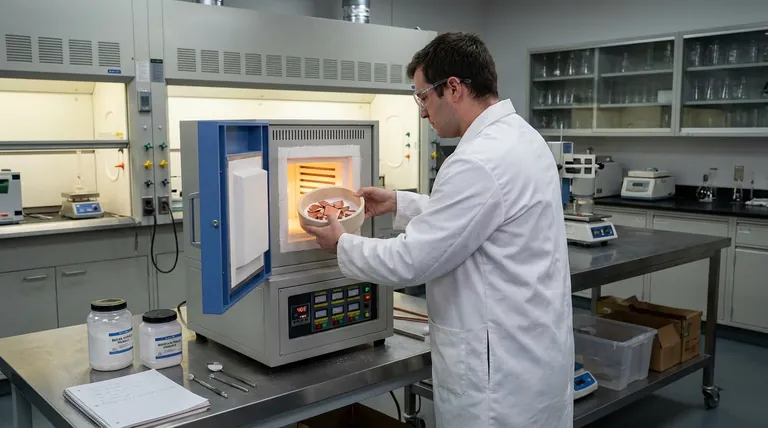
The combination of an air furnace and boron nitride powder creates a cost-effective system for heat treating copper without oxidation. The air furnace provides the necessary stable high-temperature environment (typically around 400°C) required for annealing. Simultaneously, the boron nitride powder serves as a protective physical barrier, allowing the copper to be heated in regular air without suffering from the surface degradation that usually occurs in oxygen-rich environments.
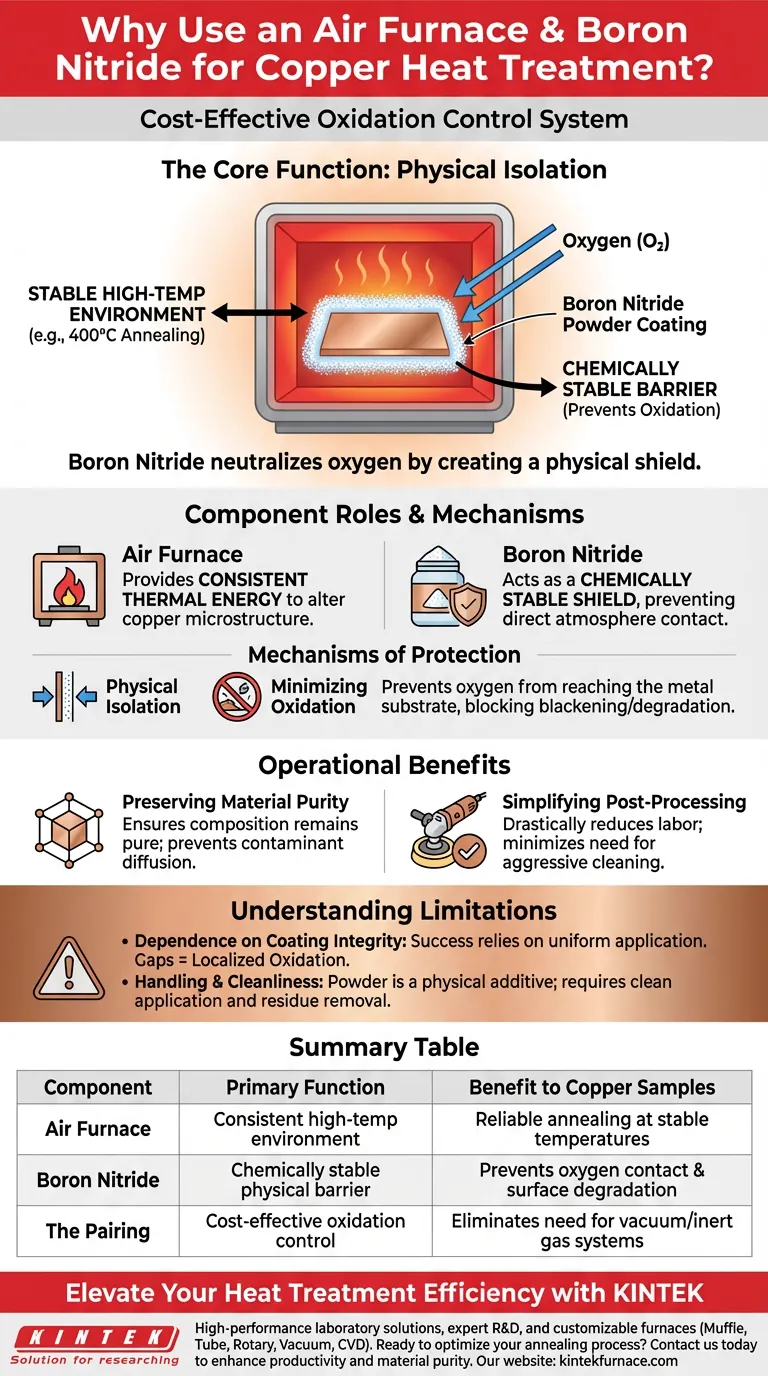
The core function of this pairing is physical isolation within a reactive environment. Boron nitride neutralizes the primary downside of an air furnace—the presence of oxygen—by coating the copper in a chemically stable layer that prevents direct contact with the atmosphere.
The Roles of the Components
The Function of the Air Furnace
The air furnace is utilized primarily to provide a stable high-temperature environment.
It maintains the consistent thermal energy required to alter the microstructure of the copper, such as during a 400°C annealing process.
The Protective Barrier of Boron Nitride
Boron nitride powder is applied as a coating directly onto the copper surface.
Because it is chemically stable, it does not react with the copper even at elevated temperatures.
Mechanisms of Protection
Preventing Physical Contact
The fundamental mechanism at work here is physical isolation.
The powder layer acts as a shield, creating a boundary between the metal substrate and the furnace atmosphere.
Minimizing High-Temperature Oxidation
Copper is highly susceptible to oxidation when heated in the presence of air.
By preventing oxygen from directly contacting the metal substrate, the boron nitride coating effectively blocks the oxidation reaction that would otherwise blacken or degrade the copper surface.
Operational Benefits
Preserving Material Purity
The isolation provided by the powder ensures the composition of the material remains pure.
It prevents external contaminants from the air from diffusing into the copper lattice during the heating cycle.
Simplifying Post-Processing
Using this method significantly reduces the labor required after heat treatment.
Because oxidation is minimized, the need for aggressive surface polishing or chemical cleaning steps is drastically simplified.
Understanding the Limitations
Dependence on Coating Integrity
The success of this method relies entirely on the uniformity of the boron nitride application.
If the powder coating is inconsistent or has gaps, oxygen will penetrate those areas, leading to localized oxidation spots on the sample.
Handling and Cleanliness
While chemically stable, the powder is a physical additive that must be managed.
Users must ensure the powder is applied cleanly and that the physical residue is removed appropriately after the process to avoid interfering with subsequent manufacturing steps.
Making the Right Choice for Your Process
If you are evaluating heat treatment methods for copper, consider your specific constraints.
- If your primary focus is process simplicity: Use this method to utilize standard air furnaces without the expense or complexity of vacuum or inert gas systems.
- If your primary focus is surface quality: Rely on the boron nitride barrier to minimize oxidation, thereby preserving the material's purity and reducing post-anneal polishing time.
This approach effectively bridges the gap between high-temperature requirements and the need for surface protection.
Summary Table:
| Component | Primary Function | Benefit to Copper Samples |
|---|---|---|
| Air Furnace | Consistent high-temperature environment | Reliable annealing at stable temperatures (e.g., 400°C) |
| Boron Nitride | Chemically stable physical barrier | Prevents oxygen contact and surface degradation |
| The Pairing | Cost-effective oxidation control | Eliminates the need for expensive vacuum or inert gas systems |
Elevate Your Heat Treatment Efficiency with KINTEK
Don't let surface oxidation compromise your research or production. KINTEK provides high-performance laboratory solutions backed by expert R&D and manufacturing. Whether you need Muffle, Tube, Rotary, Vacuum, or CVD systems, our high-temp furnaces are fully customizable to meet your unique materials science requirements.
Ready to optimize your annealing process? Contact us today to discover how our precision equipment can enhance your lab's productivity and material purity.
Visual Guide
References
- Daniel Shtuckmeyster, Roni Z. Shneck. The Influence of Crystal Orientation and Thermal State of a Pure Cu on the Formation of Helium Blisters. DOI: 10.3390/met14030260
This article is also based on technical information from Kintek Furnace Knowledge Base .
Related Products
- 9MPa Air Pressure Vacuum Heat Treat and Sintering Furnace
- 1700℃ Controlled Inert Nitrogen Atmosphere Furnace
- 1200℃ Controlled Inert Nitrogen Atmosphere Furnace
- Mesh Belt Controlled Atmosphere Furnace Inert Nitrogen Atmosphere Furnace
- Vacuum Heat Treat Sintering Furnace with Pressure for Vacuum Sintering
People Also Ask
- What are the key features of vacuum pressure sintering furnaces? Unlock High-Purity, Dense Materials
- What materials can be processed using vacuum pressure sintering furnaces? Unlock High-Performance Material Densification
- What are the key components of a vacuum pressure sintering furnace? Essential Systems for High-Performance Materials
- What safety features are integrated into vacuum pressure sintering furnaces? Ensure Operator and Equipment Protection
- What are the main technical parameters of vacuum pressure sintering furnaces? Key Specs for Advanced Materials



















