
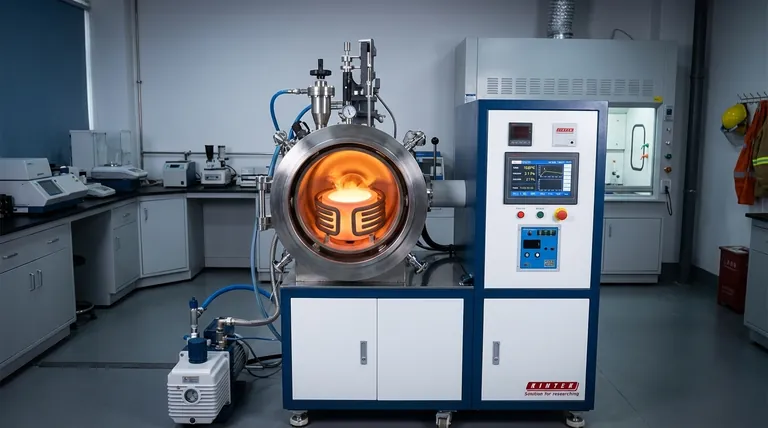
A Vacuum Induction Melting (VIM) furnace is essential because it creates the only environment capable of stabilizing the complex chemistry of superalloys. Specifically, it provides a high-vacuum shield that prevents oxygen from reacting with critical active elements like aluminum and titanium, while simultaneously removing gaseous impurities from the melt.
The Core Takeaway Nickel-based superalloys rely on reactive elements for their strength, but these elements are highly susceptible to oxidation. VIM technology is the standard manufacturing prerequisite because it guarantees the precise chemical composition required for high-temperature creep resistance, a feat impossible in open-air melting.
Preserving Chemical Precision
Preventing the Loss of Active Elements
Nickel-based superalloys derive their high-performance properties from active elements, primarily aluminum (Al) and titanium (Ti).
In a standard environment, these elements oxidize rapidly, turning into unwanted slag rather than strengthening the alloy. The VIM furnace creates a high-vacuum barrier that effectively prevents this oxidative loss, ensuring these vital ingredients remain in the solution.
Managing High-Temperature Volatility
The casting of these alloys requires extreme heat, often involving pouring temperatures around 1520°C.
At these elevated temperatures, the risk of chemical degradation spikes. The vacuum environment allows manufacturers to maintain tight control over the alloy's chemistry even during these aggressive thermal processing stages.
Achieving Structural Homogeneity
The Power of Electromagnetic Stirring
Beyond simple protection, the VIM furnace actively improves the quality of the mix through induction heating.
This mechanism generates strong electromagnetic stirring forces within the molten metal. This constant motion ensures that the chemical composition is uniform throughout the entire batch, preventing segregation.
Distributing Trace Elements
Superalloys often contain trace elements like boron (B) and zirconium (Zr) that must be dispersed evenly to be effective.
The electromagnetic stirring inherent to the VIM process ensures these trace elements are distributed homogeneously within the complex nickel matrix. This uniformity is critical for consistent performance across the entire metal ingot.
Enhancing Mechanical Performance
Eliminating Gaseous Impurities
Trapped gases can create voids and weak points in a cast component.
The low-pressure environment of the VIM furnace (often between 1.4 and 5.3 Pa) acts as a degassing chamber. It forces volatile impurities and dissolved gases out of the liquid metal, resulting in a cleaner, higher-purity final product.
Guaranteeing Creep Resistance
The ultimate goal of using VIM is to secure the mechanical longevity of the component.
By ensuring high purity and precise chemistry, VIM directly enables the superior high-temperature creep performance of the alloy. This is particularly vital for single-crystal components used in jet engines or gas turbines, which face immense stress and heat.
Understanding the Trade-offs
Operational Complexity and Cost
While VIM offers superior quality, it introduces significant operational complexity compared to air melting.
The equipment requires robust vacuum systems and precise power controls, increasing both capital investment and cycle times. It is a batch process that generally yields lower throughput than continuous casting methods.
Volatility Management
While the vacuum removes unwanted gases, it can also unintentionally vaporize desirable elements with high vapor pressures if not carefully managed.
Operators must strictly control pressure levels and melt temperatures to refine the alloy without boiling off essential constituents. This requires a higher tier of process control and technical expertise.
Making the Right Choice for Your Project
For critical applications, the melting method dictates the material's lifespan.
- If your primary focus is critical rotating components (e.g., turbine blades): You must use VIM to guarantee the creep resistance and fatigue life required for safety-critical hardware.
- If your primary focus is complex alloy development: You should utilize VIM to isolate variables and ensure that performance changes are due to your formula, not impurities.
- If your primary focus is standard structural castings: VIM may be an unnecessary expense; standard air melting or argon shielding might suffice for non-critical, low-stress parts.
VIM is not merely a furnace; it is a precision instrument that transforms raw chemistry into engineering-grade performance.
Summary Table:
| Feature | VIM Benefit | Impact on Superalloys |
|---|---|---|
| Atmosphere Control | High vacuum shield | Prevents oxidation of Al and Ti |
| Impurity Removal | Degassing (1.4 - 5.3 Pa) | Eliminates gaseous voids and impurities |
| Mixing Action | Electromagnetic stirring | Ensures chemical homogeneity and uniformity |
| Performance | Precise chemistry control | Guarantees superior high-temperature creep resistance |
| Application | Controlled batch processing | Essential for turbine blades and jet engine parts |
Elevate Your Material Performance with KINTEK
Don't let impurities compromise your critical aerospace or turbine components. KINTEK provides industry-leading VIM solutions designed to stabilize complex chemistries and ensure the structural integrity of your high-performance alloys.
Backed by expert R&D and world-class manufacturing, KINTEK offers a full range of lab and industrial systems, including Muffle, Tube, Rotary, Vacuum, and CVD systems. Whether you need standard equipment or a customized high-temp furnace tailored to your unique specifications, our engineers are ready to assist.
Contact KINTEK today to discuss your project requirements and discover the precision of vacuum thermal processing.
References
- Study of the Non-uniform Distribution of Primary Dendrite Arm Spacing (PDAS) Across the Width of a Single-Crystal Nickel-Based Superalloy Casting. DOI: 10.1007/s40962-025-01717-1
This article is also based on technical information from Kintek Furnace Knowledge Base .
Related Products
- Vacuum Induction Melting Furnace
- 600T Vacuum Induction Hot Press Vacuum Heat Treat and Sintering Furnace
- Small Vacuum Heat Treat and Tungsten Wire Sintering Furnace
- Vacuum Heat Treat Sintering and Brazing Furnace
- Vacuum Heat Treat Sintering Furnace Molybdenum Wire Vacuum Sintering Furnace
People Also Ask
- What are the core functions of the High Vacuum Induction Melting (VIM) furnace? Optimize DD5 Superalloy Purification
- What role does a Vacuum Induction Melting furnace play in the production of high-aluminum nickel-based superalloys?
- What is the role of VIM and directional solidification in aero-engine blade substrates? Engineering Extreme Durability
- What are the advantages of using a VIM furnace to control residual oxygen pressure? Achieve Superior Metal Uniformity
- Why is a Vacuum Induction Melting furnace (VIM) used for Cu-Zn-Al-Sn alloys? Achieve Precision Composition Control



















