
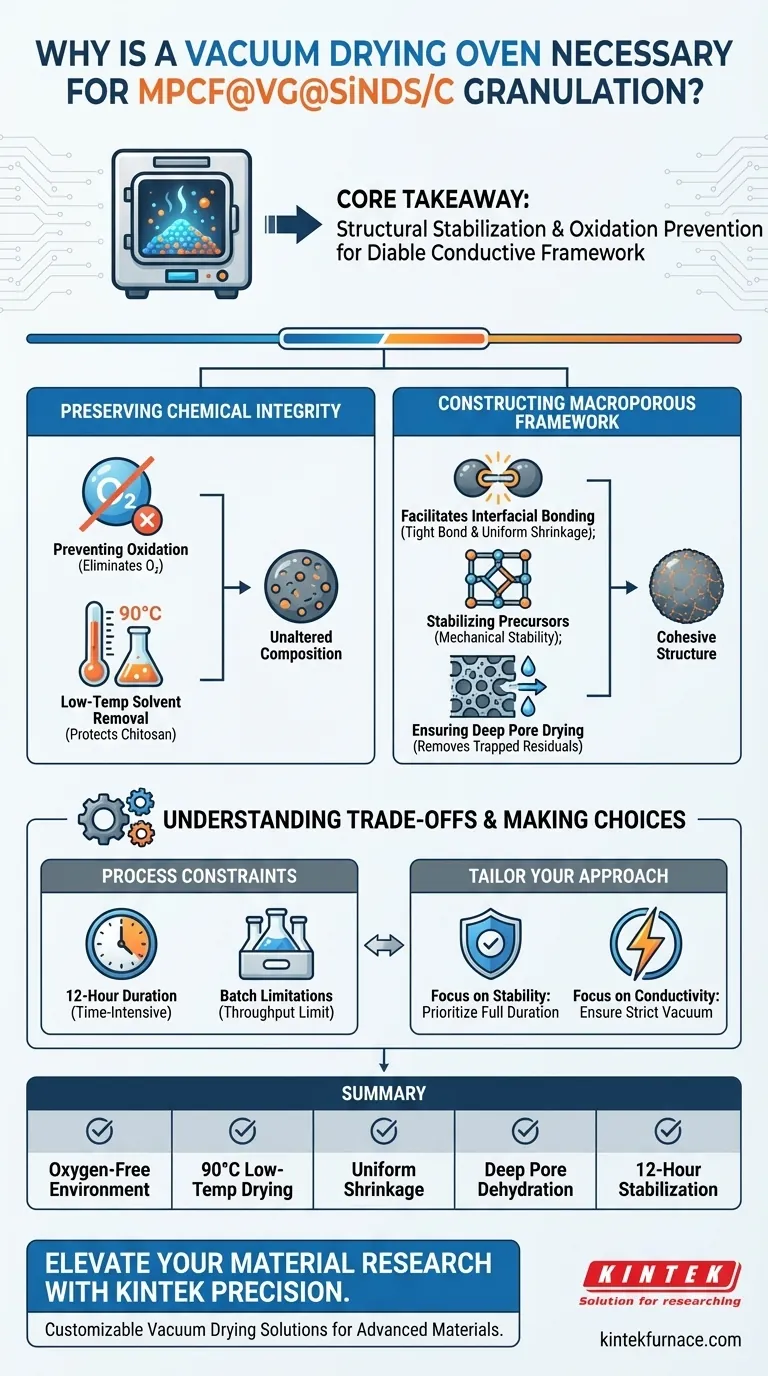
The use of a vacuum drying oven is a non-negotiable step in ensuring the structural and chemical integrity of MPCF@VG@SiNDs/C granules. By processing chitosan and functional composite slurries at a controlled 90 °C for 12 hours, the oven removes solvents efficiently while completely preventing material oxidation. This precise dehydration creates a tight, necessary bond between organic precursors and nanodots, establishing the foundation for a stable macroporous conductive framework.
Core Takeaway: Vacuum drying is not merely about moisture removal; it is a structural stabilization process that prevents oxidation and facilitates the critical interfacial bonding required to build a durable, high-performance conductive framework.
Preserving Chemical Integrity
To achieve high performance in MPCF@VG@SiNDs/C materials, the chemical composition must remain unaltered during the drying phase.
Preventing Oxidation
The primary function of the vacuum oven is to eliminate oxygen during the heating process. Functional composite materials and nanodots are highly susceptible to oxidation when exposed to air at elevated temperatures.
Low-Temperature Solvent Removal
Vacuum environments lower the boiling point of solvents. This allows for efficient drying at 90 °C, a temperature that effectively removes moisture without thermally degrading the sensitive organic components like chitosan.
Constructing the Macroporous Framework
The granulation process is not just about drying; it is about setting the physical structure of the material prior to carbonization.
Facilitating Interfacial Bonding
A specific advantage of vacuum drying is the promotion of a "tight bond" between organic precursors and nanodots. As solvents evaporate under vacuum, the chitosan matrix shrinks uniformly around the functional particles.
Stabilizing the Precursors
This bonding process is critical for mechanical stability. It ensures that the organic precursors and nanodots are locked into a cohesive structure, which is a prerequisite for constructing a stable macroporous conductive framework.
Ensuring Deep Pore Drying
While surface drying is simple, the complex structure of these materials can trap solvents deep within microscopic pores. The vacuum environment forces these residuals out, ensuring the material is thoroughly dehydrated from the inside out.
Understanding the Trade-offs
While vacuum drying is essential for quality, it introduces specific process constraints that must be managed.
Process Duration
The process is time-intensive, requiring a 12-hour cycle at 90 °C. Attempting to rush this process by increasing temperature or vacuum pressure too quickly can lead to structural defects or incomplete bonding.
Batch Limitations
Unlike continuous airflow drying, vacuum drying is typically a batch process. This limits throughput and requires careful scheduling to maintain production flow without creating bottlenecks.
Making the Right Choice for Your Goal
To maximize the quality of your MPCF@VG@SiNDs/C granules, tailor your drying approach to your specific performance metrics.
- If your primary focus is Structural Stability: Prioritize the full 12-hour duration to guarantee that the bond between organic precursors and nanodots is fully established.
- If your primary focus is Conductivity and Purity: Ensure strict vacuum adherence to prevent even trace oxidation, which can compromise the conductive network of the nanodots.
Precise control over the drying environment is the difference between a loose aggregate and a high-performance conductive framework.
Summary Table:
| Feature | Impact on MPCF@VG@SiNDs/C Material |
|---|---|
| Oxygen-Free Environment | Prevents oxidation of sensitive nanodots and functional composites. |
| 90 °C Vacuum Drying | Lowers solvent boiling points to protect organic precursors from thermal degradation. |
| Uniform Shrinkage | Promotes tight interfacial bonding between chitosan and nanodots. |
| Deep Pore Dehydration | Removes trapped residuals from complex macroporous structures. |
| 12-Hour Cycle | Ensures full structural stabilization and mechanical integrity. |
Elevate Your Material Research with KINTEK Precision
Don't let oxidation or structural defects compromise your high-performance conductive frameworks. KINTEK provides industry-leading vacuum drying solutions specifically designed for the delicate processing of advanced materials like MPCF@VG@SiNDs/C.
Backed by expert R&D and manufacturing, KINTEK offers Muffle, Tube, Rotary, Vacuum, and CVD systems—all fully customizable to meet your unique laboratory or production needs. Ensure your organic precursors and nanodots achieve the perfect bond with our stable, high-precision thermal equipment.
Ready to optimize your granulation process? Contact our laboratory specialists today to find the ideal furnace configuration for your research.
Visual Guide
References
- Zhenwei Li, Jie Yu. Macroporous Directed and Interconnected Carbon Architectures Endow Amorphous Silicon Nanodots as Low-Strain and Fast-Charging Anode for Lithium-Ion Batteries. DOI: 10.1007/s40820-023-01308-x
This article is also based on technical information from Kintek Furnace Knowledge Base .
Related Products
- Vacuum Heat Treat Sintering and Brazing Furnace
- Vacuum Heat Treat Sintering Furnace Molybdenum Wire Vacuum Sintering Furnace
- Dental Porcelain Zirconia Sintering Ceramic Vacuum Press Furnace
- Vacuum Hot Press Furnace Machine for Lamination and Heating
- Vacuum Hot Press Furnace Machine Heated Vacuum Press
People Also Ask
- What is one of the most important uses of vacuum heat treating furnaces in aerospace? Achieve Superior Strength in Aircraft Alloys
- What are the benefits of using vacuum heat treating furnaces for metal alloys? Achieve Superior Metal Properties and Performance
- How does vacuum heat treating affect the grain structure of metal alloys? Achieve Precise Microstructure Control
- What is the temperature of a vacuum furnace brazing? Optimize Your Joint Strength and Cleanliness
- What are the steps involved in a typical vacuum brazing treatment? Master the Process for Strong, Clean Joints







