
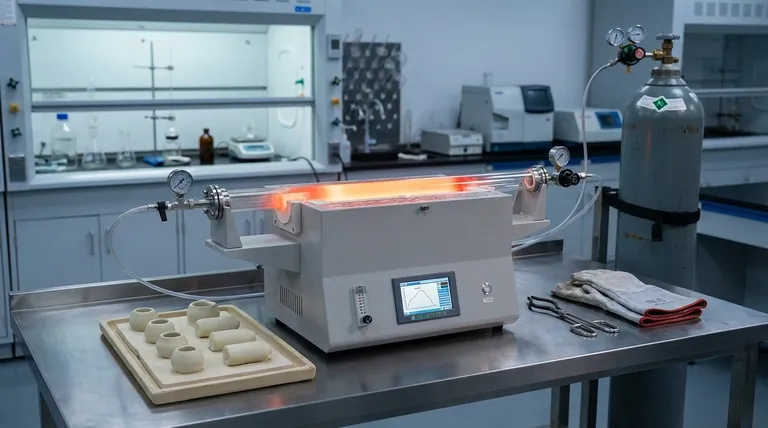
A tube furnace is required for the debinding of kaolin ceramic green bodies because it creates a strictly controlled environment that prevents the physical destruction of the part. By maintaining an inert atmosphere (typically argon or nitrogen), the furnace forces the organic binders to decompose slowly rather than burning violently, ensuring the ceramic retains its shape and structural integrity.
The inert atmosphere of a tube furnace transforms the removal of binders from a volatile combustion event into a controlled decomposition process. This prevents thermal shock and structural failure, ensuring the ceramic green body transitions successfully to its final form.
The Critical Role of Atmosphere Control
Preventing Violent Combustion
In the presence of oxygen, the photosensitive resins and binders within a green body will combust. This exothermic reaction is often violent and creates rapid gas expansion. By utilizing an inert atmosphere, the process is shifted to endothermic pyrolysis, where binders break down chemically without burning.
Preserving Structural Integrity
The primary danger during debinding is the formation of cracks or deformation. Violent combustion exerts internal pressure on the ceramic matrix that the green body cannot withstand. A tube furnace ensures a smooth release of pyrolytic gases, protecting the delicate structure of the transition material.
Handling Thick-Walled Parts
For large or thick-walled ceramic parts, the risk of "explosive cracking" is significantly higher. The stable environment of a tube furnace is essential here. It allows for the gradual removal of binders from deep within the part without creating fatal stress gradients.
Why the Tube Furnace Design is Necessary
Hermetic Sealing
To maintain a true inert atmosphere, the heating chamber must be isolated from the outside air. Tube furnaces are designed with tight seals around thermocouple ports, door access points, and heating elements. This prevents oxygen from leaking in and disrupting the pyrolysis process.
Gas Purging Capabilities
A critical feature of the tube furnace is the ability to purge the chamber. Before heating begins, gas inlets allow the operator to displace room air with the desired inert gas (such as argon or nitrogen). This ensures the debinding phase begins in a completely oxygen-free environment.
Controlled Heating Rates
Beyond the atmosphere, these furnaces provide precise temperature control. A stable heating rate is required to match the rate of binder decomposition. If the heat rises too fast, even in an inert atmosphere, the volume of escaping gas could damage the ceramic.
Understanding the Trade-offs
Process Speed vs. Safety
Operating under an inert atmosphere converts the process into a slower, endothermic reaction. While this is safer for the ceramic, it significantly increases the cycle time compared to burning binders out in the air. You are trading speed for yield and quality.
Complexity of Operation
Using a tube furnace requires managing gas flow, pressure, and seal integrity. This adds a layer of operational complexity not found in standard air kilns. Failure to properly purge the system or maintain seals can lead to partial combustion and part ruin.
Making the Right Choice for Your Goal
To ensure success with kaolin green bodies, align your equipment usage with your specific processing needs:
- If your primary focus is preventing cracks: Prioritize a verified inert atmosphere (argon or nitrogen) to force a slow, non-violent pyrolysis of the binders.
- If your primary focus is processing large parts: Ensure your heating profile is sufficiently slow to allow gases to escape from the core without building internal pressure.
- If your primary focus is process consistency: regularly inspect the furnace seals and gas inlets to ensure no oxygen ingress occurs during the cycle.
Control the atmosphere, and you control the integrity of your final ceramic product.
Summary Table:
| Feature | Purpose in Debinding | Primary Benefit |
|---|---|---|
| Inert Atmosphere | Shifts combustion to pyrolysis | Prevents violent exothermic reactions & cracking |
| Hermetic Sealing | Isolates chamber from oxygen | Ensures a pure nitrogen or argon environment |
| Gas Purging | Displaces room air before heating | Protects green bodies from early oxidation |
| Precise Heat Control | Matches decomposition rates | Prevents internal pressure build-up in thick parts |
Achieve Perfect Ceramic Sintering with KINTEK
Don't let violent combustion ruin your kaolin ceramic green bodies. KINTEK provides industry-leading thermal solutions specifically designed for complex debinding and sintering processes. Backed by expert R&D and manufacturing, we offer high-performance Tube, Muffle, Rotary, Vacuum, and CVD systems—all fully customizable to meet your unique laboratory or production needs.
Ready to optimize your inert atmosphere process? Contact us today to consult with our experts and find the perfect high-temperature furnace for your application.
Visual Guide

References
- Viktor Kurylenko, Tetiana Dontsova. ПЕРСПЕКТИВИ ВИКОРИСТАННЯ ТЕХНОЛОГІЇ 3D ДРУКУ DLP ДЛЯ ВИРОБНИЦТВА МЕМБРАННИХ КЕРАМІЧНИХ МОДУЛІВ. DOI: 10.15421/jchemtech.v33i2.317663
This article is also based on technical information from Kintek Furnace Knowledge Base .
Related Products
- 1200℃ Controlled Inert Nitrogen Atmosphere Furnace
- Mesh Belt Controlled Atmosphere Furnace Inert Nitrogen Atmosphere Furnace
- 1700℃ Controlled Inert Nitrogen Atmosphere Furnace
- Controlled Inert Nitrogen Hydrogen Atmosphere Furnace
- Custom Made Versatile CVD Tube Furnace Chemical Vapor Deposition CVD Equipment Machine
People Also Ask
- What controlled-atmosphere furnace conditions are required for sintering powder metallurgy copper alloy compacts? Ideal Setup
- How does a controlled atmosphere furnace prevent oxidation and decarburization? Master Precision Heat Treatment
- What are the advantages of a controlled atmosphere furnace over tube furnaces? Superior Process Control for Sensitive Materials
- How does a vacuum or controlled atmosphere furnace facilitate sessile-drop experiments? Optimize Alloy Wetting Analysis
- Why is a controlled atmosphere furnace required for 316L debinding? Ensure Structural Integrity & Zero Cracks



















