
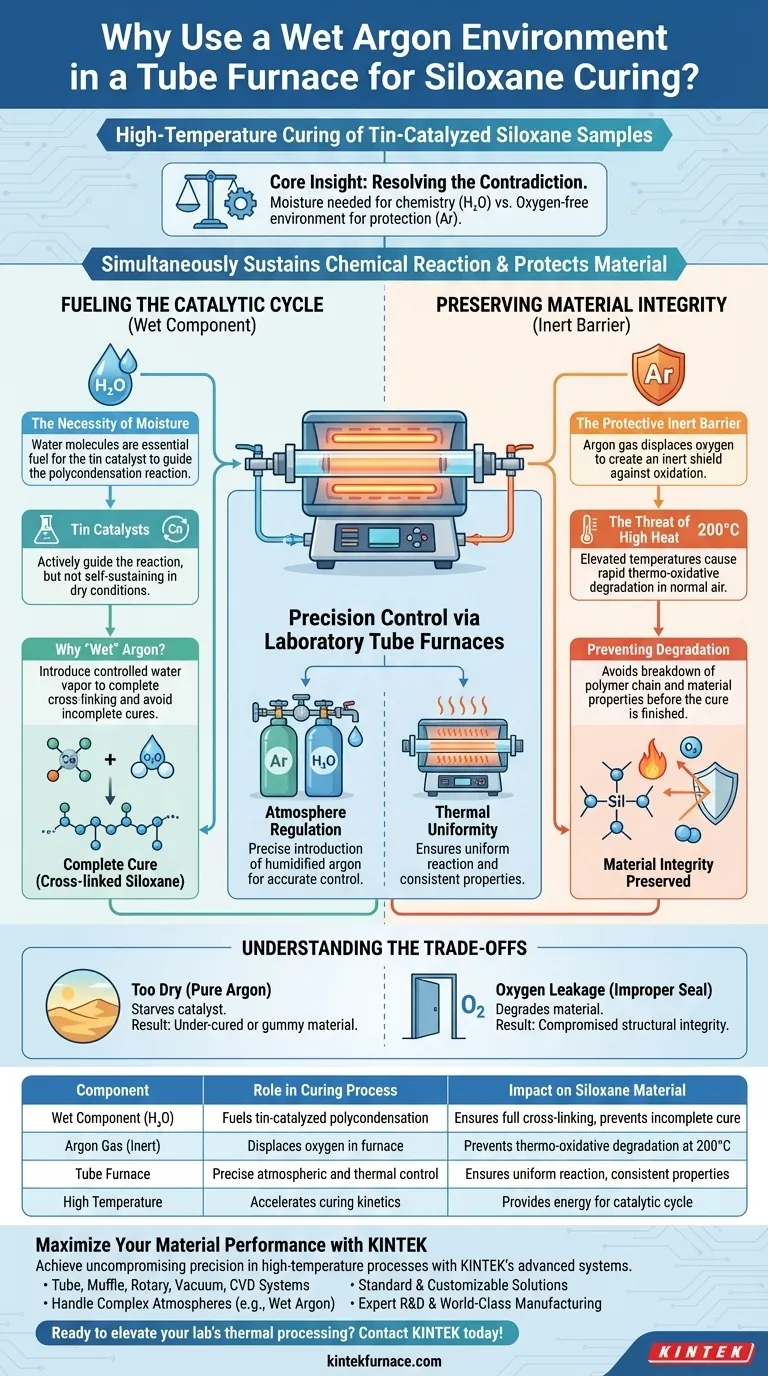
The primary purpose of using a wet argon environment in a laboratory tube furnace for this application is to simultaneously sustain the chemical reaction and protect the material. This setup provides the essential moisture required to drive the tin-catalyzed polycondensation reaction while creating an inert shield that prevents the siloxane from suffering thermo-oxidative degradation during high-temperature exposure (e.g., 200 °C).
Core Insight: Curing tin-catalyzed siloxanes presents a contradiction: the chemistry requires moisture to function, but the necessary high temperatures causes the material to degrade in normal air. A "wet argon" environment solves this by delivering the necessary water vapor for the catalyst within a protective, oxygen-free bubble.

Fueling the Catalytic Cycle
The Role of Tin Catalysts
Tin catalysts are not passive agents in siloxane chemistry; they actively guide the polycondensation reaction.
However, this specific catalytic cycle is not self-sustaining in a dry vacuum or dry gas.
The Necessity of Moisture
To keep the reaction moving, the catalyst requires the presence of water molecules.
Without an external source of moisture, the catalytic cycle halts, resulting in an incomplete cure.
Why "Wet" Argon?
The "wet" component of the gas stream is strictly functional.
It introduces a controlled amount of water vapor into the furnace tube, ensuring the tin catalyst has the fuel necessary to complete the cross-linking process.
Preserving Material Integrity
The Threat of High Heat
Effective curing for these materials often requires long-term treatment at elevated temperatures, such as 200 °C.
At these temperatures, standard atmospheric oxygen becomes destructive to siloxanes.
Preventing Thermo-Oxidative Degradation
Exposure to oxygen at high heat leads to rapid degradation of the polymer chain.
This results in a breakdown of material properties before the cure is even finished.
The Protective Inert Barrier
Argon is used because it is an inert gas.
By flooding the tube furnace with argon, you displace the oxygen, allowing the material to withstand the 200 °C heat needed for curing without chemically breaking down.
Precision Control via Tube Furnaces
Atmosphere Regulation
Tube furnaces are specifically engineered for operations requiring precise atmospheric control (Chemical Vapor Deposition, sintering, etc.).
They allow the user to introduce specific gas mixtures—in this case, humidified argon—with high accuracy.
Thermal Uniformity
Beyond the atmosphere, the tube furnace ensures consistent heat distribution.
This is critical for ensuring the polycondensation reaction occurs uniformly throughout the sample.
Understanding the Trade-offs
The Consequence of "Too Dry"
If you use pure, dry argon to maximize protection against oxidation, you will likely fail to achieve a cure.
The lack of moisture will starve the tin catalyst, leaving the siloxane under-cured or gummy.
The Consequence of Oxygen Leakage
Conversely, if the system is not properly sealed or the gas flow is insufficient, oxygen may enter the chamber.
Even with the correct moisture levels, the presence of oxygen at 200 °C will degrade the surface of the sample, compromising the structural integrity of the final product.
Making the Right Choice for Your Process
To achieve a high-quality cure, you must balance the introduction of moisture with the exclusion of oxygen.
- If your primary focus is Reaction Completion: Ensure your argon stream is actively humidified (wet) to prevent the tin catalyst from stalling during the process.
- If your primary focus is Material Stability: Verify that your tube furnace seals are intact and the inert gas flow is sufficient to prevent thermo-oxidative damage at 200 °C.
Summary: The wet argon environment is the critical bridge that allows you to satisfy the moisture requirements of the chemistry while bypassing the thermal limitations of the material.
Summary Table:
| Component | Role in Curing Process | Impact on Siloxane Material |
|---|---|---|
| Wet Component (H2O) | Fuels tin-catalyzed polycondensation | Ensures full cross-linking and prevents incomplete cure |
| Argon Gas (Inert) | Displaces oxygen in the furnace tube | Prevents thermo-oxidative degradation at high heat (200°C) |
| Tube Furnace | Precise atmospheric and thermal control | Ensures uniform reaction and consistent material properties |
| High Temperature | Accelerates the curing kinetics | Provides necessary energy for the catalytic cycle |
Maximize Your Material Performance with KINTEK
Achieve uncompromising precision in your high-temperature processes. Backed by expert R&D and world-class manufacturing, KINTEK offers high-performance Tube, Muffle, Rotary, Vacuum, and CVD systems designed to handle complex atmospheric requirements like wet argon curing. Whether you need a standard setup or a fully customizable solution for your unique lab needs, our team is ready to support your innovation.
Ready to elevate your lab's thermal processing? Contact KINTEK today to consult with our experts!
Visual Guide
References
- Max Briesenick, Guido Kickelbick. Thermal Post-Cross-Linking of Siloxane/Silsesquioxane Hybrids with Polycyclic Aromatic Units for Tailored Softening Behavior in High-Temperature Applications. DOI: 10.3390/molecules30173532
This article is also based on technical information from Kintek Furnace Knowledge Base .
Related Products
- Vertical Laboratory Quartz Tube Furnace Tubular Furnace
- 1400℃ High Temperature Laboratory Tube Furnace with Alumina Tube
- Laboratory Vacuum Tilt Rotary Tube Furnace Rotating Tube Furnace
- 1700℃ High Temperature Laboratory Tube Furnace with Alumina Tube
- Laboratory Quartz Tube Furnace RTP Heating Tubular Furnace
People Also Ask
- What are the key differences between single-zone and multi-zone vertical tube furnaces? Choose the Right Furnace for Your Lab
- What is the purpose of using an industrial-grade vertical tube furnace in phosphorus recovery? High-Fidelity Simulation
- How are metal support wires selected for sample suspension? Expert Guide to High-Temp Furnace Materials
- What physical conditions does a vertical tube furnace provide for desulfurization experiments? Precision Heat Control
- What is a vertical tube furnace and how does it function? Optimize Material Processing with Precision



















