
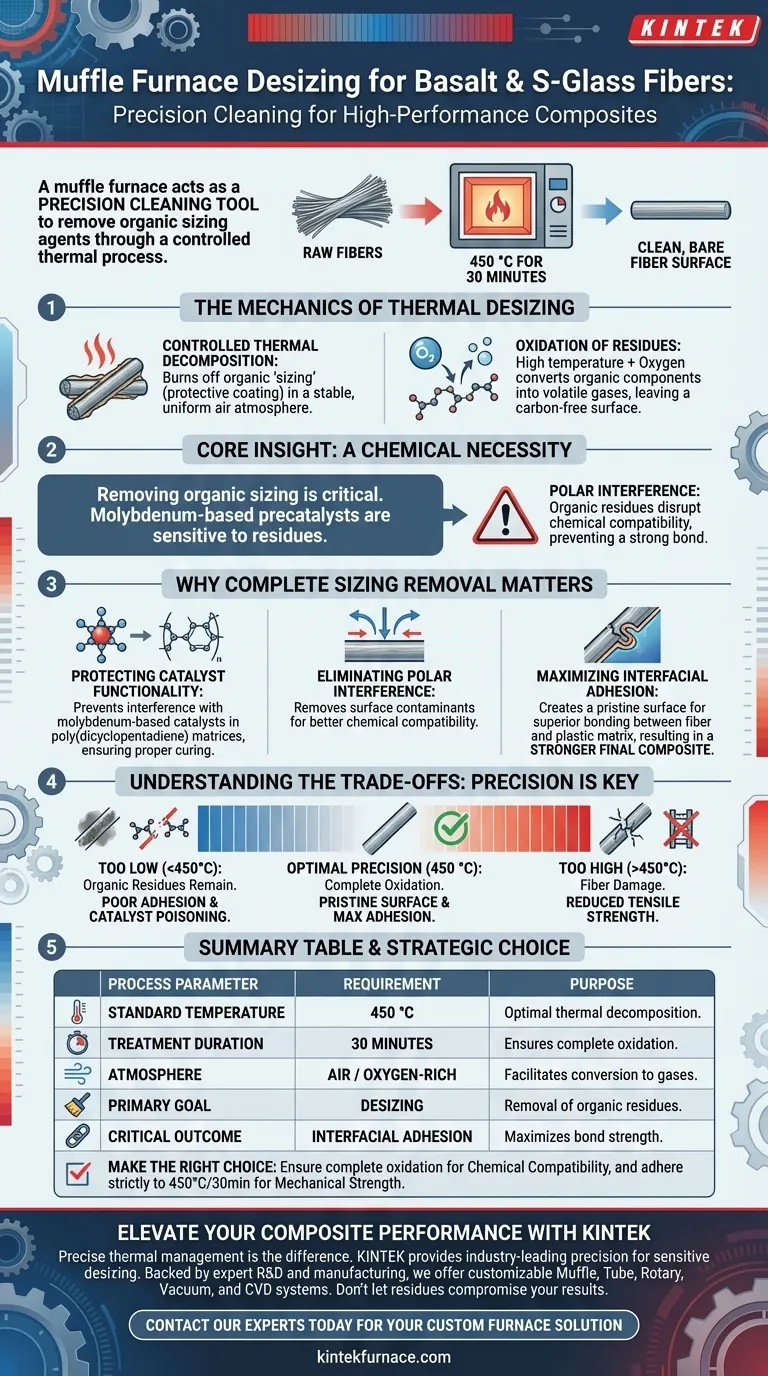
A muffle furnace acts as a precision cleaning tool used to strip organic sizing agents from basalt or S-glass fibers through a controlled thermal process. By subjecting the fibers to a high-temperature air environment—specifically around 450 °C for 30 minutes—the furnace ensures the complete thermal decomposition and oxidation of the carbonaceous coatings applied during fiber manufacturing.
Core Insight: The removal of organic sizing is not merely a cleaning step; it is a chemical necessity. Molybdenum-based precatalysts used in specific composite matrices are highly sensitive to organic residues, and failing to remove them causes polar interference that compromises the final material's structural integrity.
The Mechanics of Thermal Desizing
Controlled Thermal Decomposition
The muffle furnace provides a stable, uniform environment essential for thermal desizing. This process burns off the organic "sizing" (a protective coating applied during fiber production) by exposing it to consistent heat in an air atmosphere.
Oxidation of Residues
The combination of high temperature and oxygen facilitates the complete oxidation of organic components. This transforms the coating into volatile gases, leaving behind a clean, bare fiber surface free of carbonaceous contaminants.
Why Complete Sizing Removal Matters
Protecting Catalyst Functionality
In specific composite preparations involving a poly(dicyclopentadiene) matrix, the chemical reaction relies on molybdenum-based precatalysts.
These catalysts are chemically sensitive to the organic sizing agents found on raw fibers. If the sizing is left intact, it interferes with the catalyst's operation, inhibiting the curing process.
Eliminating Polar Interference
Organic residues on the fiber surface can create polar interference. This phenomenon disrupts the chemical compatibility between the fiber and the resin system, preventing a strong bond from forming.
Maximizing Interfacial Adhesion
The mechanical strength of a composite depends heavily on the interface—the point where the fiber meets the plastic matrix. By using a muffle furnace to create a pristine surface, you significantly improve the interfacial adhesion between the basalt or S-glass fibers and the matrix, resulting in a stronger final composite.
Understanding the Trade-offs
The Importance of Temperature Precision
While heat is the cleaning agent, precision is the safety mechanism. A muffle furnace is required because it offers exact temperature control.
Risks of Improper Heating
If the temperature is too low or the time too short, organic residues remain, leading to poor adhesion and catalyst poisoning. Conversely, significantly exceeding the standard 450 °C threshold risks damaging the physical structure of the glass fibers themselves, reducing their tensile strength before they are even molded.
Making the Right Choice for Your Goal
To ensure high-performance composites, apply the desizing process based on your specific chemical requirements:
- If your primary focus is Chemical Compatibility: Ensure complete oxidation of organics to prevent poisoning molybdenum-based precatalysts.
- If your primary focus is Mechanical Strength: Strictly adhere to the 450 °C / 30-minute parameter to maximize interfacial adhesion without thermally degrading the fiber.
Reliable composite performance begins with a pristine interface, achievable only through precise thermal management.
Summary Table:
| Process Parameter | Requirement | Purpose |
|---|---|---|
| Standard Temperature | 450 °C | Optimal thermal decomposition without fiber damage |
| Treatment Duration | 30 Minutes | Ensures complete oxidation of carbonaceous coatings |
| Atmosphere | Air / Oxygen-rich | Facilitates conversion of sizing to volatile gases |
| Primary Goal | Desizing | Removal of organic residues to prevent polar interference |
| Critical Outcome | Interfacial Adhesion | Maximizes bond strength between fiber and matrix |
Elevate Your Composite Performance with KINTEK
Precise thermal management is the difference between a compromised material and a high-performance composite. KINTEK provides the industry-leading precision required for sensitive desizing treatments. Backed by expert R&D and manufacturing, we offer a comprehensive range of Muffle, Tube, Rotary, Vacuum, and CVD systems, all fully customizable to your specific laboratory or industrial needs.
Don't let organic residues compromise your catalyst functionality or interfacial adhesion. Partner with KINTEK to ensure your basalt and S-glass fibers are processed with the exact temperature stability your research demands.
Contact our experts today to find your custom furnace solution!
Visual Guide
References
- Benjamin R. Kordes, Michael R. Buchmeiser. Ring‐Opening Metathesis Polymerization‐Derived Poly(dicyclopentadiene)/Fiber Composites Using Latent Pre‐Catalysts. DOI: 10.1002/mame.202300367
This article is also based on technical information from Kintek Furnace Knowledge Base .
Related Products
- 1400℃ Muffle Oven Furnace for Laboratory
- 1700℃ High Temperature Muffle Oven Furnace for Laboratory
- 1800℃ High Temperature Muffle Oven Furnace for Laboratory
- 1200℃ Muffle Oven Furnace for Laboratory
- High Temperature Muffle Oven Furnace for Laboratory Debinding and Pre Sintering
People Also Ask
- What is the primary function of a high-temperature laboratory muffle furnace in chemical synthesis? Achieve Precision.
- How does a high-temperature laboratory muffle furnace affect material properties? Transform Anodic Oxide Films Fast
- How does a laboratory high-temperature muffle furnace facilitate the homogenization of borosilicate glass samples? Expert Insights
- What are the primary objectives of using a muffle furnace in zirconia synthesis? Achieve precision phase control.
- What function does a muffle furnace perform in perovskite formation? Optimize Your Thermal Synthesis



















