
A muffle furnace acts as the definitive transformative tool in nanoparticle synthesis, moving beyond simple drying to precise structural engineering. It provides the essential high-temperature calcination environment—often starting around 350°C—required to convert amorphous precursors into pure, stable zinc oxide crystals. Without this specific thermal treatment, the material would lack the necessary crystalline structure and purity required for advanced applications.
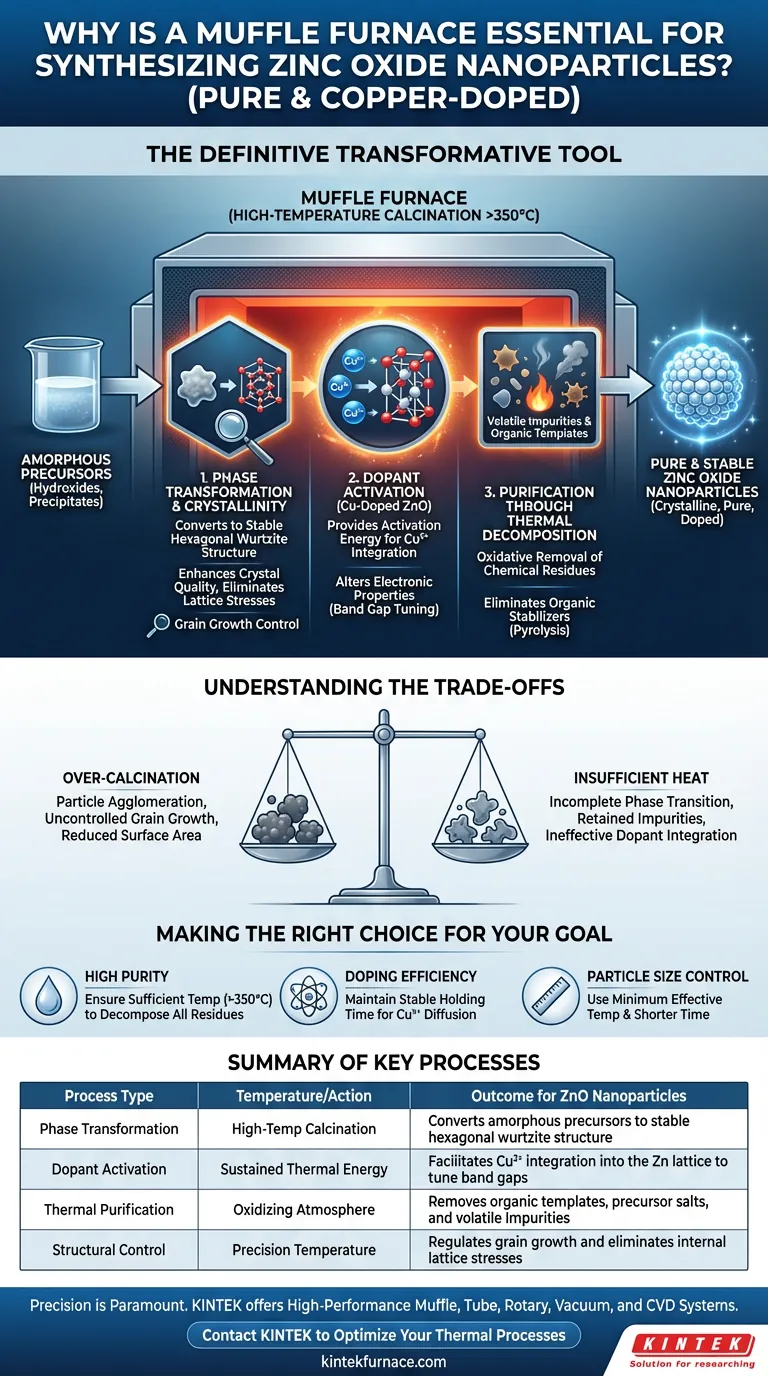
The muffle furnace facilitates high-temperature calcination, which drives three critical processes simultaneously: the oxidative removal of chemical impurities, the crystallization of the material into a stable hexagonal wurtzite structure, and the thermal activation required for copper dopants (Cu2+) to successfully integrate into the zinc oxide lattice.
Driving Phase Transformation and Crystallinity
Establishing the Wurtzite Structure
The primary function of the muffle furnace is to facilitate a phase transformation. It converts amorphous precursors (typically hydroxides or chemical precipitates) into zinc oxide crystals with a specific hexagonal wurtzite structure. This structure is fundamental to the material's stability and semiconductor properties.
Enhancing Crystal Quality
High-temperature treatment significantly increases the degree of crystallinity in the nanopowder. By subjecting the material to sustained heat, the furnace eliminates internal stresses within the crystal lattice, resulting in a more robust and uniform final product.
Controlling Grain Growth
The precise temperature control of a muffle furnace allows for the regulation of grain size. Adjusting the calcination temperature directly influences the surface area and particle size, which are critical for applications like catalysis or sensing.
The Critical Role of Dopant Activation
Integrating Copper Ions
For copper-doped zinc oxide, the furnace provides the necessary activation energy for doping to occur effectively. The thermal environment enables dopant ions, specifically Cu2+, to migrate and physically enter the zinc oxide crystal lattice, replacing zinc ions.
Altering Electronic Properties
This successful integration of copper modifies the material's electronic band structure. The calcination process ensures the dopants are not just sitting on the surface but are structurally incorporated, which is essential for tuning the optical band gap and achieving specific electronic characteristics.
Purification Through Thermal Decomposition
Removing Volatile Impurities
The oxidizing atmosphere within the muffle furnace ensures the complete removal of residual chemical impurities left over from the synthesis phase. This includes the decomposition of precursor salts and the evaporation of solvents that would otherwise contaminate the final product.
Eliminating Organic Templates
If organic stabilizers or templates (such as starch or glucose) were used during synthesis, the muffle furnace burns these off completely. This process, known as pyrolysis or oxidative removal, leaves behind high-purity metal oxide powders free of carbonaceous residues.
Understanding the Trade-offs
The Risk of Over-Calcination
While heat is necessary for crystallization, excessive temperature or duration can be detrimental. Over-calcination often leads to particle agglomeration and uncontrolled grain growth, which reduces the specific surface area and can diminish the reactivity of the nanoparticles.
The Danger of Insufficient Heat
Conversely, failing to reach the required temperature threshold results in an incomplete phase transition. This leaves the material with an amorphous structure, retained impurities, and dopants that have not properly integrated into the lattice, rendering the nanoparticles ineffective for their intended application.
Making the Right Choice for Your Goal
To optimize your synthesis of pure and copper-doped zinc oxide, consider how the furnace parameters align with your specific objectives:
- If your primary focus is High Purity: Ensure the temperature is sufficient (typically above 350°C) to fully decompose all precursor salts and organic templates.
- If your primary focus is Doping Efficiency: Maintain a stable holding time at the calcination temperature to allow sufficient thermal energy for Cu2+ ions to diffuse into the Zn lattice sites.
- If your primary focus is Particle Size Control: Use the minimum effective temperature and shorter holding times to achieve crystallization while preventing excessive grain growth and agglomeration.
The muffle furnace is not merely a heater; it is the reactor that dictates the final structural integrity and chemical identity of your nanomaterials.
Summary Table:
| Process Type | Temperature/Action | Outcome for ZnO Nanoparticles |
|---|---|---|
| Phase Transformation | High-Temp Calcination | Converts amorphous precursors to stable hexagonal wurtzite structure |
| Dopant Activation | Sustained Thermal Energy | Facilitates Cu2+ integration into the Zn lattice to tune band gaps |
| Thermal Purification | Oxidizing Atmosphere | Removes organic templates, precursor salts, and volatile impurities |
| Structural Control | Precision Temperature | Regulates grain growth and eliminates internal lattice stresses |
Precision is paramount when synthesizing high-purity nanoparticles. Backed by expert R&D and manufacturing, KINTEK offers high-performance Muffle, Tube, Rotary, Vacuum, and CVD systems—all fully customizable to meet your unique calcination and doping requirements. Ensure perfect crystallinity and dopant activation for your lab's materials. Contact KINTEK today to optimize your thermal processes!
Visual Guide
References
- V. Balasubramanian, S. Kalpana. Enhanced photocatalytic degradation of pure and Cu-doped ZnO nanoparticles prepared under Co-precipitation method. DOI: 10.15251/jor.2024.201.103
This article is also based on technical information from Kintek Furnace Knowledge Base .
Related Products
- 1400℃ Muffle Oven Furnace for Laboratory
- 1200℃ Muffle Oven Furnace for Laboratory
- Laboratory Muffle Oven Furnace with Bottom Lifting
- High Temperature Muffle Oven Furnace for Laboratory Debinding and Pre Sintering
- 1800℃ High Temperature Muffle Oven Furnace for Laboratory
People Also Ask
- What is the primary function of a high-temperature laboratory muffle furnace in chemical synthesis? Achieve Precision.
- How does a high-temperature laboratory muffle furnace affect material properties? Transform Anodic Oxide Films Fast
- What role does a laboratory high-temperature muffle furnace play in the treatment of highly contaminated waste glass?
- What is the role of a laboratory high-temperature muffle furnace in H13 steel treatment? Optimize Tool Performance
- How does a muffle furnace facilitate Ag/ATP catalyst preparation? Optimize Calcination for Superior Performance



















