
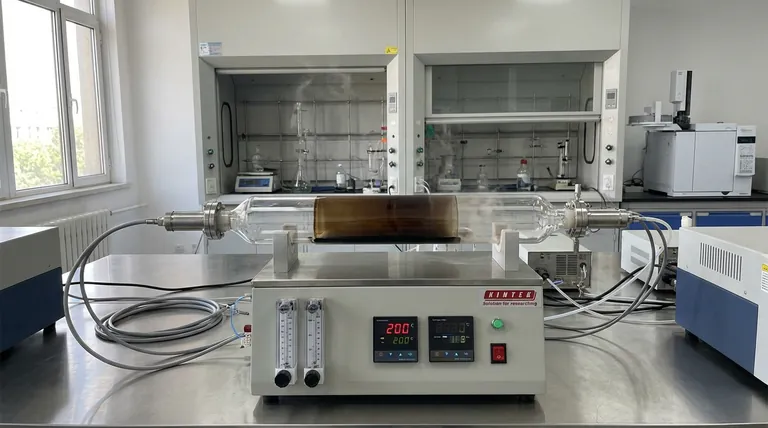
A low-temperature annealing furnace serves as the critical stabilization chamber required to transform liquid coal tar into a solid, usable film for sensor production. It provides a precise thermal environment that drives oxidative heating, evaporating organic solvents while simultaneously triggering the chemical reactions necessary to solidify the material.
The annealing process is not merely about drying; it is a vital chemical conditioning phase. By initiating oxygen-induced cross-linking and enhancing molecular stacking, the furnace establishes the mandatory structural foundation required for subsequent high-energy laser carbonization.
The Mechanism of Film Formation
Solvent Evaporation and Stabilization
The primary function of the furnace is to create a stable thermal environment. This controlled heat is essential to initiate the oxidative heating of the coal tar solution.
During this phase, the heat forces the evaporation of small molecules and organic solvents. Removing these volatiles is the first step in converting the liquid solution into a stable solid state.
Oxygen-Induced Cross-Linking
The solidification of the film is chemical, not just physical. The furnace facilitates oxygen-induced cross-linking of aromatic clusters within the coal tar.
This cross-linking creates a cohesive network of bonds. It turns a loose collection of molecules into a unified, durable film structure.
Enhancing Molecular Alignment
Beyond solidification, the annealing process refines the material's internal architecture. It significantly enhances the conjugation and stacking of the material’s molecular components.
This alignment improves the material's physical properties. It ensures the film is homogenous and ready for further processing.
Pre-Treatment for Advanced Processing
Establishing a Structural Foundation
The annealing phase acts as a prerequisite for more aggressive manufacturing steps. Specifically, it builds the structural foundation needed for high-energy laser carbonization.
Without this low-temperature conditioning, the material would not be prepared to absorb or react correctly to high-energy laser exposure. The film must be chemically stabilized first to ensure the laser processing is effective.
Understanding the Constraints
The Necessity of Temperature Control
While the goal is to heat the material, the emphasis is on "low-temperature" annealing. Excessive heat at this stage could degrade the aromatic structures rather than cross-linking them.
Stability vs. Speed
The process relies on a stable thermal environment, implying a need for consistency over speed. Rushing this stage with unstable heat sources can lead to uneven evaporation or incomplete cross-linking, compromising the sensor's final performance.
Making the Right Choice for Your Goal
To optimize your sensor production workflow, consider the specific function the annealing furnace performs regarding your end goals:
- If your primary focus is Film Durability: Ensure the furnace maintains a stable temperature long enough to maximize oxygen-induced cross-linking of aromatic clusters.
- If your primary focus is Laser Processing Efficiency: Prioritize the enhancement of conjugation and stacking to ensure the material is perfectly prepped for carbonization.
Correctly utilizing the annealing phase transforms raw coal tar from a volatile solution into a precision-engineered substrate ready for advanced fabrication.
Summary Table:
| Process Phase | Key Function | Impact on Sensor Film |
|---|---|---|
| Solvent Evaporation | Removes volatiles | Stabilizes liquid solution into solid |
| Oxygen Cross-linking | Bonds aromatic clusters | Creates a durable, unified molecular network |
| Molecular Stacking | Enhances conjugation | Prepares internal structure for laser carbonization |
| Thermal Control | Low-temp stabilization | Prevents structural degradation of aromatics |
Optimize Your Sensor Production with KINTEK Precision
High-performance sensors start with perfect film stabilization. At KINTEK, we understand that the integrity of your coal tar films depends on precise thermal control and consistent atmospheric conditions. Backed by expert R&D and world-class manufacturing, we provide high-performance Muffle, Tube, and Vacuum systems specifically engineered to handle delicate low-temperature annealing and complex CVD processes.
Whether you require a standard solution or a customizable high-temp furnace tailored to your unique R&D needs, our equipment ensures the oxygen-induced cross-linking and molecular stacking required for superior laser carbonization.
Ready to elevate your material science? Contact KINTEK today to discuss your project requirements!
Visual Guide

References
- Jincai Huang, Xining Zang. Laser-upgraded coal tar for smart pavements in road and bridge monitoring applications. DOI: 10.1038/s41378-024-00670-z
This article is also based on technical information from Kintek Furnace Knowledge Base .
Related Products
- Controlled Inert Nitrogen Hydrogen Atmosphere Furnace
- 1700℃ Controlled Inert Nitrogen Atmosphere Furnace
- 1200℃ Controlled Inert Nitrogen Atmosphere Furnace
- Laboratory Muffle Oven Furnace with Bottom Lifting
- 2200 ℃ Graphite Vacuum Heat Treat Furnace
People Also Ask
- How does hydrogen furnace annealing assist in preparing mechanically alloyed powders for compaction?
- How does atmospheric annealing in a controlled hydrogen furnace affect the cold compaction behavior of metal powders?
- What are the characteristics and uses of hydrogen atmosphere in furnaces? Achieve Superior Surface Purity and Bonding
- What are the characteristics and uses of hydrogen atmospheres in furnaces? Unlock Clean Metal Processing
- What controlled-atmosphere furnace conditions are required for sintering powder metallurgy copper alloy compacts? Ideal Setup



















